
Night Comes After Day
Two Muslim Women on Choosing a Child-Free Life
Delina Haileab
May 8, 2026
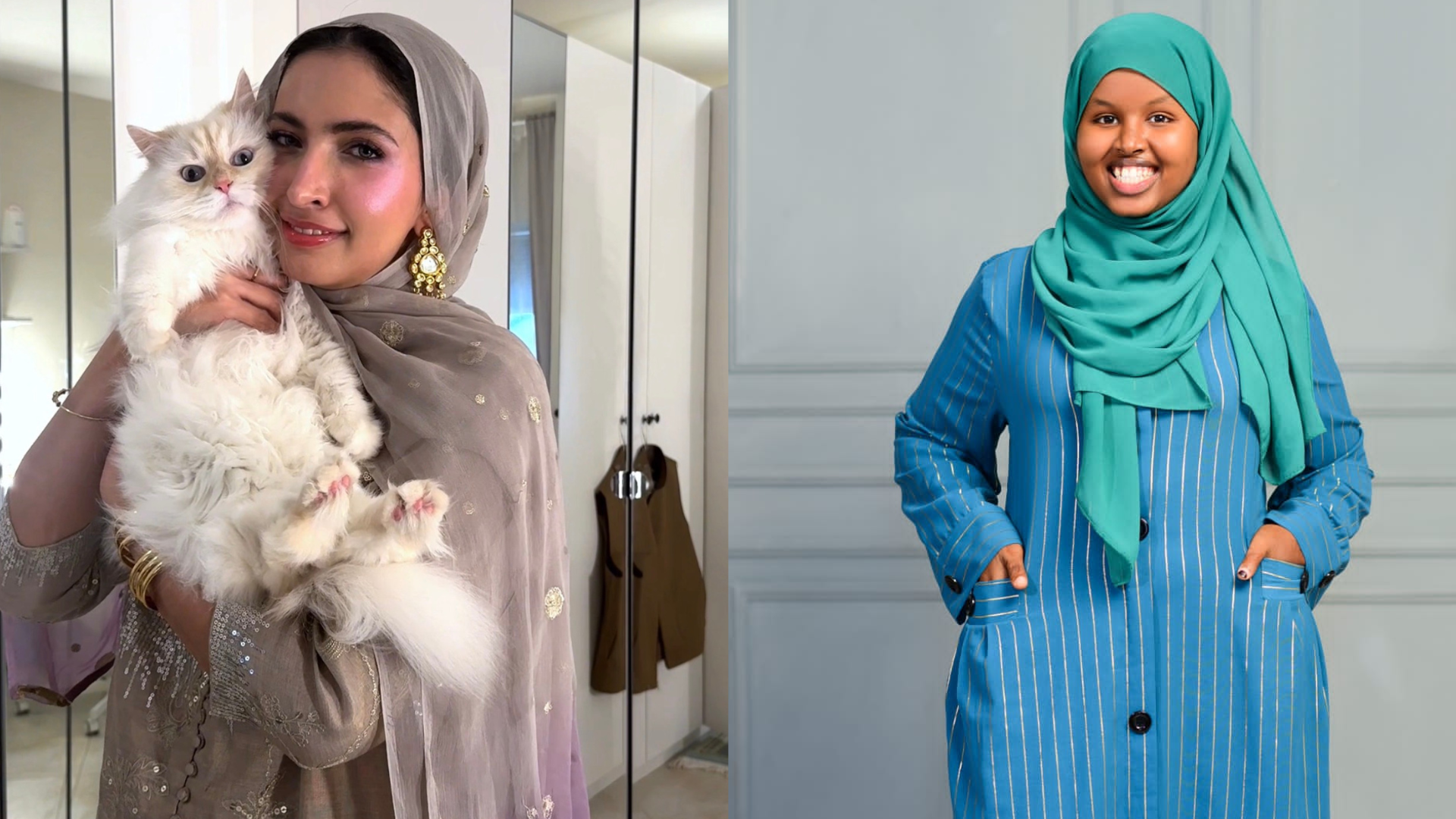
Emaan (left) and Maya (right), two Muslim women navigating the choice to be child-free in communities where, as Emaan puts it, "there is no space for any other reality."
Part of being the first-generation to be born outside of my family’s ancestral homelands, Eritrea, is to experience many spaces and thoughts for the first-time. These ‘firsts’ are evermore stark a woman. Perhaps most unconventionally, I believe I am the first to outwardly question if I really want to get married and have children. In my family’s part of the world, marriage is life’s main event, and having children is a given, not a question.
By the time they were my age, 25, my grandmothers nearly completed bearing their multiple children, many of whom they birthed as teenagers — my maternal grandmother had seven children, and my paternal grandmother had five, with three others who passed in infancy. My mother, who emigrated to the U.S. in the 80s during Eritrea’s armed 30-year struggle against Ethiopian occupation, had her oldest, me, at an age to this day she considers an exceptionally late stage to have children — 28.
In a radical break from my foremothers and culture, I have come to see becoming a parent as an option, rather than the inevitable next step of my life. Something I could live with or without, and possess a meaningful life in either outcome. Generational differences between my grandmothers, my mother, and me as it concerns motherhood are rooted in dramatic economic and cultural variances between my life and theirs, but also reflects a growing shift in how many women are approaching the question of children.
In the U.S. (and broader Western world), ‘childlessness’ is on the rise amongst women statistically, and cultural narratives reflect such trends. Instagram Reels and TikTok videos show women opting for a child-free lifestyle. The hashtag ‘childfree’ has hundreds and thousands of posts across social media platforms, indicating the growing inclusion of such choices into mainstream discourse. Yet, closer analysis of the numbers reveal that likelihood of ‘childlessness’ differs according to lines along race and class, prompting the question of how child-free choices differ across cultures, too.
A growing number of millennial and Gen Z women across the West are actively choosing to be child-free — not just as a circumstantial outcome, but as a deliberate and often political and economic choice. How does such a decision manifest in other parts of the world, given cultural, political, economic, and social variances?
Maya and Emaan
To better understand and extend the conversation to women in geographic contexts outside of the West, I spoke with Maya and Emaan, two women with social media platforms discussing themes of womanhood and identity, and both of whom are outspoken on their decision to be child-free.
Maya, ethnically Somali, born and raised in Mombassa, Kenya, but now living in Nairobi, self-described as always being the black sheep of the family, the opinionated one. Not being around people who shared her thoughts, she turned to TikTok. “Since no one is listening within the house, why don’t I share with the people following me.” For Emaan, a Pakistani woman, residing in the Gulf, social media allowed her to amplify naturally occurring conversations amongst her inner circles of friends. Already feeling othered and diminished by family and culture, it became therapeutic, or a catharsis, as Emaan described, to meet people and discuss her beliefs, long before words of ‘patriarchy’ and ‘feminism’ entered her vocabulary.
For both Maya and Emaan, the choice to be child-free is as simple as not wanting children. As Emaan describes, “I simply do not want to be a mother…I do not feel the calling to birth a baby or raise a human being from infancy into adulthood.” In a video posted to her TikTok page, Maya also discusses the expectation of a ‘valid’ reason in response to choosing a life sans offspring, a notion which she challenges by articulating her reason is simply no desire.
While a conversation around child-free choices across cultures merits attention to structural factors, central to Maya and Emaan’s decisions is the lack of wanting children. “I like my life the way it is. I don’t want to change it,” Emaan explains. “Outside factors like the experience of motherhood under patriarchy definitely matter, but for me they are reinforcing factors.” Thus, while my interviews with Maya and Emaan expand upon the layered nature of what it means to not want kids and how the decision manifests, important is that at the heart of their child-free choice is simply a choice to be child-free.
Before the Child-Free Choice
Maya grew up in a household consisting of nine children and two parents. “There was a time I saw my mom pregnant and in labor, and she almost gave birth at home. My aunt asked me to get scissors to help her deliver. It was the most terrifying moment in my life. I could not fathom the pain. I decided never to be a doctor. The idea of being child-free came around this time.” As the oldest sibling, and in particular, the eldest daughter, Maya assumed many parental responsibilities, helping to raise other children in the home. She described the experience of being a mother to her siblings. “School? I am the one they called. Problems at home? I am the one they called. If there are issues between my parents? I am the one they called.”
The term ‘parentified eldest daughter’, Maya embodied. Now 28 years old, taking care of children as a child and young adult herself led her to the realization that perhaps it was to end there. “I want to live a life where no one is depending on me. All my life people have depended on me. I want to wake up without worrying, “have they gone to school”?”
Emaan reflected on the courage it required to even consider a child-free lifestyle, and that “it takes a certain amount of awareness and exposure. I’m grateful for the internet. It has opened up the world to women who have never thought this way, who could not. Now we have an exchange of ideas and perspectives, and we can see there is a different way to live…It is happening, but it is very silent, not public.”
As is the case for many women around the world, motherhood was inevitable for Emaan. “I remember being very young, 5 or 6, thinking about how I will go to work and serve my kids breakfast. There was no space for any other sort of life.” Now married, Emaan considered herself “lucky that [my current] perspective opened up to me before [marriage]. Before I made the choice, before I was pushed into motherhood. Social media had a huge huge part. I read a lot. I used to read books… fiction. I don’t know if it helped, but it opened up new ways of thinking.”
The Cultural Angle
Emaan’s arrival to a child-free choice and discussing feminist themes on social media involves an overall critique of culture. “Where I come from, saying a man should warm his own food is radical.” Furthermore, “[motherhood] is not something you question. It is inevitable you will have children. Night comes after day. There is no space for any other reality. Either you have children or you are infertile. There is no space for choice.”
Similarly, in Maya’s culture, people ask, “what’s wrong with you?” when she describes her decision. In the Somali community and many others around the world, the norm is to have several children, for a myriad of reasons, one of which being social and economic insurance. “Children are retirement plans in our community,” Emaan explained, detailing conversations with friends and colleagues, who although shared other beliefs with her, would ask what Emaan would do with herself when she was older and who would take care of her. Maya too gets questions about how she will be cared for in later stages of life without children of her own. “I don’t want kids to take care of me. It’s not a must. It’s not an obligation. When I retire, what will happen? I will still be young, I can put things in place.”
Unequal responsibilities placed on a mother and less so for a father also was a factor in Maya’s decision to embrace a child-free lifestyle. “In my community, there are so many single mothers. What’s the point? We made the child together, we should raise the child together. The woman becomes the default parent. People don’t praise that as much. People can die. Kids can die. Disease…and it is all underrewarded.”
The Social Cost of No Kids
The judgement and lack of empathy towards women who opt to not have children results in social consequences. “People see me as a rebel. It feels lonely. Explaining myself is very hard,” Maya noted in describing the isolation she experiences. “I don’t know many Somali muslim women who are child-free. All the time I have to explain myself.” Maya also is characterized as a social outcast, one not belonging to the community. “This woman is a feminist. Those westernised women, they don’t listen.” In turn, Maya at times has questioned her choices, considering the degree of pushback from those around her. Ultimately, asking herself if bringing a child into the world would make her happy, the resounding no to the question solidifies her position to who it matters most — Maya.
Support independent journalism
Enjoy reading The Parlor?
Become a paid subscriber to get full access, early releases, and subscriber-only extras.
Become a paid subscriberEmaan similarly spoke to her social seclusion. “You just have to accept that no one is going to understand this…There’s a certain loneliness, not because of not having children, but not having community.” Emaan emphasized that the loneliness of a child-free choice does not derive from the lack of children in her life. “When I mention loneliness, I don’t mean it in that way. I mean the loneliness of not being understood, of having to explain yourself, or choosing not to [have kids]. Not in the sense that you will be left to wither and die.”
Through Emaan’s eyes and witnessing motherhood in others, the social loneliness of being child-free does not outweigh the loneliness of being a mother. “I truly feel the loneliest woman I’ve ever seen is a new mother. Because of how much she carries it alone…I know I carry so much alone. In terms of domestic labor, the mental load, everything that’s got to do with running a home, maintaining ties of kinship…We’re already functioning so much without kids in the picture. With kids, that’s multiplied by a thousand or a million. I don’t think there’s any reality in my community or culture, I would feel like my partner is doing as much as I am...I don’t think a man will ever carry it.”
For Maya, how she approaches her social life has changed, particularly as her peers and friends get married and enter parenthood, making Maya question the degree to which she will resonate with those around her. “Motherhood consumes you. Is the friendship going to die?” A friend of Maya’s, more traditional than her, said to Maya that God would change her position. “I really don’t want someone changing my mind. We don’t align anymore, so I become the lonely person in the group.” To counter the loneliness, Maya takes time to build a community and lifestyle aligned with her, consisting of her podcast, diverse friendships, and therapy.
Religion and its Weaponization
Both practicing Muslims and hijabis, Emaan and Maya offered their interpretations of Islam as it concerned their lives, and how religiosity has been used to pressure them into a lifestyle they do not want.
“It’s considered blasphemy,” Emaan said. “I have been told you’re no longer Muslim, or you’re going to go to hell.”
For Maya, religion never forces parenthood. “In Islam, it is not required, it is recommended. [Many say] what’s the point of marriage if not having kids? Companionship, someone to experience life with.” Blurry lines between culture and religion, and a widespread interpretation of Islam and other abrahamic traditions that to reproduce is required, makes it difficult for Maya to explain her stance, but it has not wavered her faith. “I love being Muslim. This religion allows me to explore, and gives me parameters. The requirement is to worship God, the rest is a recommendation. People use religion to oppress other people, even in the Muslim community. Go forth and reproduce. Is it my responsibility to do that? To have more kids and fill the world? It’s not my responsibility. Even if it was, I don’t want it to be. People use religion against me,…I may not have the desire to be a mother, but I have the desire to be a good friend, good neighbour, good sister.”
Community as Integral but Romanticized
In speaking with Maya and Emaan, an absence of a particular theme within the discussion became evident – economics. In Western discourses surrounding child-free choices, declining economic conditions and costs of child-care are often raised. However, this was not brought up once in my conversation, until I raised it with Emaan. “The financial aspect of it is not the reason. It’s not even 2 percent of the reason women in my community would choose to be child free.”
Rather, for Emaan, reasons to not have children were rooted in the social and cultural. “I have seen people, Western women, talk about multigenerational homes, or how a village is what women need to counter everything that they’re carrying. There’s this idea that in the Global South, we have that village. I would say that’s not true. On the surface, you’ll see 5-6 families living in a big house, everyone taking care of everyone’s kids, but actually there’s so much hierarchy in that structure. The woman or the mother comes at the lowest. She is the one everyone controls, everyone commands, and she is the loneliest.”
Emaan raised what many do not consider, which is the romanticization of familial or local communes in patriarchal contexts. “Those structures exist because they make women's labor accessible. It’s not men keeping the family together, it’s women breaking their backs.”
Maya shared similar sentiments. “In Africa or the Somali community, people live as a community…My mother lives somewhere there, I’m living with my auntie here. It makes it ten times harder to [express] these decisions. People tell me I’m pretending to be from the West, from America or Europe or whatever. People are not open-minded here. They’re pulling you back because of community, because of togetherness.” Here, Maya articulates a reality that many do not contend with, which is that while more natural and conducive to human nature, communalism practiced within or parallel to certain economic, social, political, and cultural structures produces its own inequalities and societal flaws. In some instances (and which is just as pronounced in individualistic societies), there is an expectation to “do what others are doing. You are here because your mother gave birth to you. Just because my mom jumped over a cliff, I should jump too?”
Nevertheless, in particular cultures and spaces, motherhood is integrated into everyday conversation in a way that feels especially pronounced. Emaan explains, “You cannot fathom how much of a conversation this is in our world. This is the only thing people talk about. The only thing. What sex positions to try, to pray, eat this, this doctor I know you should go. That's the only conversation a married nonpregnant woman will have…It’s constant swimming against the current. It’s the water around you. I don’t think any woman in the Western world can fathom, it takes so much energy.”
It is not a condemnation of community, but rather a desire to reimagine one that embraces the individual. “Community is a very important aspect of life. Human beings are not meant to live on our own,” Emaan says. “As an adult, I can choose the kind of community I have, so I started looking for people I align with. I’m not giving up on [community], I’m making my own.”
In an Alternate Reality and the Patriarchal Bargain
Given what Emaan and Maya described to me, I wondered, then, to what extent was their decision to be child-free a choice, versus a decision negotiated within a set of constraints and realities. “To be child-free is a very radical decision with lots of pushback. But no choice is made without a vacuum,” Emaan said. “Maybe if I was living in a different world where mothers had more support, maybe my choice wouldn’t be what it is right now. We can talk about idealistic situations and worldviews, but at the end of the day, what matters is how a woman is affected by it, and how a woman chooses to bargain with it.” And there are concessions on both sides of the matter. In a patriarchal context where women hold little social, economic, and political power, Emaan puts forth that children, and sons in particular, are a means of women accessing higher status. “Choosing to be childfree, then, also means giving this up and stepping away from maybe the only route to power that is available to a woman in this society.”
Maya attributes very little of her decision to pure choice. “Choice is 5% of it, the rest is influence. I’ve seen how bad it can be for someone that has come from a very large family and has never had a choice of their own. Especially as a first-born Somali muslim eldest daughter. It’s not a choice…I don’t think I was naturally born to not want to have kids. For a majority of people, it is influence. It’s how I’ve grown up, how I’ve seen things happen. As a choice, you have to say yes or no… I can choose differently…but all along it was an influence of how people treated me.”
In the end…
For Maya and Emaan, to be child-free means unwarranted opinions, unsolicited advice, and little, if any, understanding. “There’s absolutely zero legitimacy given to this lifestyle. It’s always seen as temporary, and she’s going to change her mind,” Emaan explains. Yet, it does not alter her position. “I have never let an opinion shape a choice I make, such a huge decision. No matter what people say, I wouldn’t go home and [reconsider]...I just get very annoyed that people don’t understand. I have accepted that people will never understand. That’s what helps me stay sane. You would not go to someone who says the earth is flat and start debating that it’s round.” Emaan finds solace and fulfillment in social dynamics she has curated for herself, rather than ones she was born into. “At the end of the day you still have to form your own community, I try to invest in friendship more, female friends. That’s what carries any woman through, not family, not in-laws.”
Maya finds deep confidence and comfort in her decisions. “It’s okay to question yourself. You don’t follow the map of family, ancestors, or whoever. If I get to 40 and I want to change my mind, I can still change my mind. I am an adult…There’s always an opportunity to become a mother…today you can wake up so adamant on one decision. That can change. It’s okay to feel lonely and different in the community, as long as you’re being authentic. Am I able to sleep comfortably if I say no kids? And the answer is yes…Give yourself a choice to decide, and you have the liberty to change…As human beings we just want to be given the choice. Can I say yes or no, and can I change that later. If people shame you, it’s people's lack of empathy, it has nothing to do with you.”
Patriarchy as a social organization that positions women as domestic laborers and child bearers, regardless if they want to or not, transcends borders but manifests differently according to cultural, social, and economic factors. It supersedes geography, yet still performs according to geographic context. For Maya and Emaan, resisting such dominating forces in their decisions to not have children demonstrates how the child-free conversation and thought process unfolds in worlds not in the West. A woman’s life is whole, with or without children, with or without a partner. As Maya puts it, when those around her attempt to induce pressure by raising biological clocks or potentially increasing infertility with age, she says, “Did you forget? I don’t want kids. I have a really fulfilling life, whether a man wants to join me or not, whether I have a kid or not.”
About the author
Delina Haileab
Delina Haileab is a writer whose literary interests range widely, and particularly enjoys discussing lifestyle topics through a political lens. She is an Eritrean born and raised in Minnesota, has had the privilege of living in and traveling to various parts of the world, and has an academic background in both anthropology and economics. In her free time, Delina loves the beach, good food, live music/dj sets, and reading.
Conversation
A space for Parlor members. Be generous, be real.
Loading…