
The Safety Trap
How "Protecting Women" Became a Weapon Against Trans People

Lindsey Brock Morales
July 12, 2026
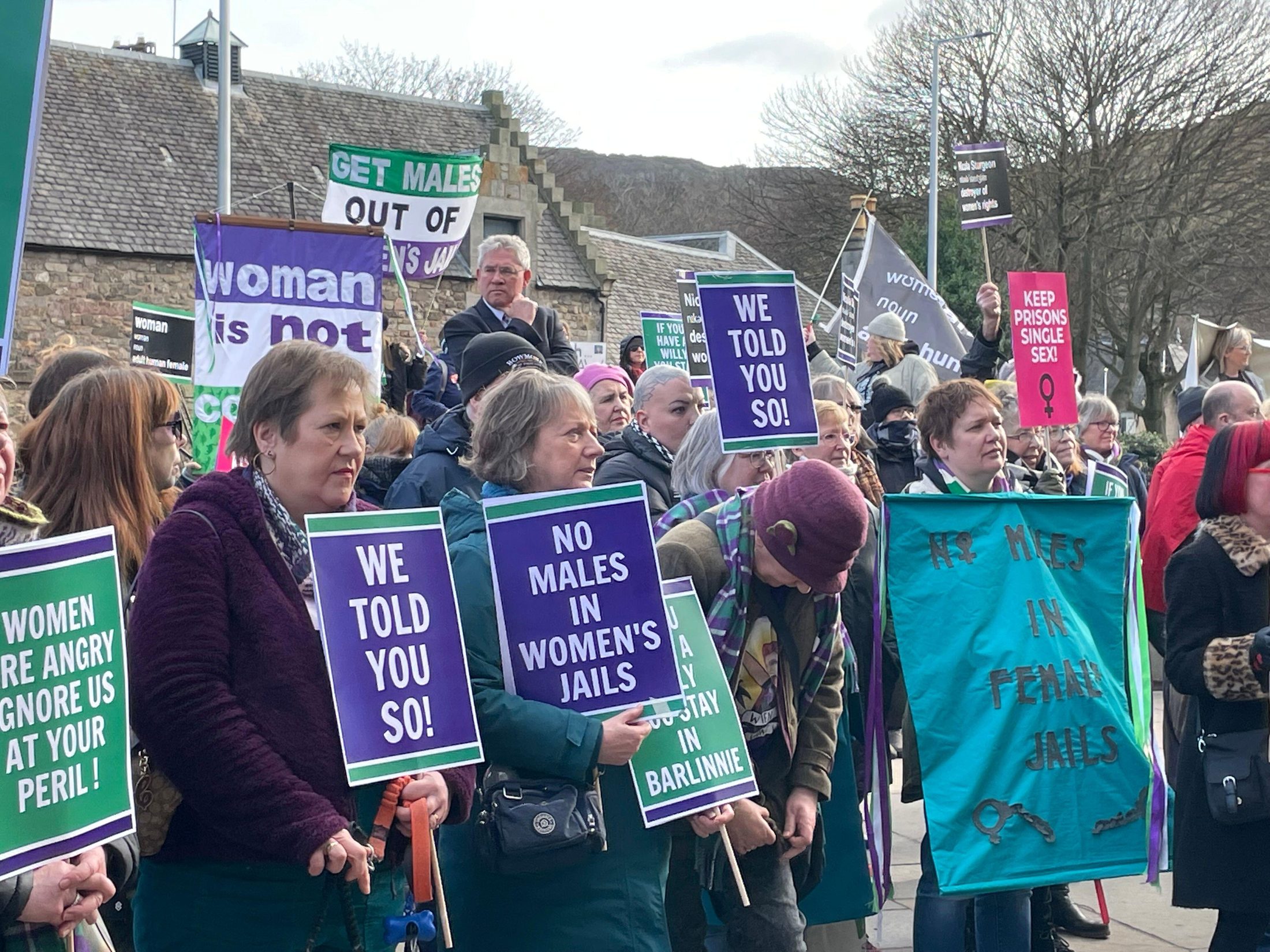
Campaigners from Women Scotland protest outside Holyrood against male transgender prisoners being housed in female prisons. Picture date: Thursday February 9, 2023. (PA Images / Alamy)
Lamble has spent nearly two decades working inside the machinery they now study from the outside. As a professor of criminology and queer theory at Birkbeck, University of London, and a longtime organizer with the Bent Bars Project — a letter-writing initiative that has connected queer and trans people outside prison with those incarcerated inside it — Lamble has watched, up close, what happens when moral panic gets routed through a prison cell.
Their new book, Unsafe: The Carceral Roots of the Anti-Trans Backlash, explores the sudden rise in organized transphobia in the UK after 2017. The root, Lamble argues, isn't about gender at all — it's a much older political technology: the idea that safety comes from identifying a "dangerous" other and policing them.
"It's not just the claim that trans rights are in conflict with women's rights," Lamble told me. "It's the claim that trans people acutely pose a danger to cis women and children."
From "clash of rights" to "danger"
Britain's anti-trans movement didn't begin by framing trans people as a threat to women's safety. It began as a rights dispute — a "clash of rights" framing that emerged when the government opened a public consultation in 2018 on reforming the Gender Recognition Act to allow for self-identification. Mainstream outlets, including left-leaning ones, largely reproduced that framing: two identity groups, two sets of legitimate claims, in tension.
However, telling left-leaning audiences that trans people's rights conflicted with women's rights was never going to be enough, on its own, to convince them that trans women were the enemy. Campaigners realized that framing trans inclusion as dangerous — rather than simply rights-competing — could unite a much broader coalition than a rights framing ever could. Opponents of self-ID argued the reform would let predatory men access women and girls in toilets and rape shelters — despite the Equality Act 2010 already granting trans women access to those spaces regardless of whether the reform passed. Groups like Fair Play for Women, formed to campaign against the reform, framed their cause explicitly around "privacy, safety, and fairness" in hospital wards, prisons, and changing rooms.
The 2018 conviction of Karen White became the case campaigners returned to again and again. White had raped two women in 2003 and 2016 — while still living and presenting as a man — and was later convicted of sexually assaulting fellow inmates after being remanded to a women's prison in 2017 for an unrelated offense. For opponents of reform, the case became proof that self-ID would flood women's prisons with male rapists, even as the case involved a failure to follow existing prison policy rather than evidence that the policy itself was unsafe.
"Nobody, whether you're on the left or the right, likes the sex offender," Lamble said. "That figure becomes a point at which you can unite across the left, liberal, and right."
Lamble calls this mechanism "carceral safety": a vision of protection built on punishment, exclusion, and surveillance, in which one group's safety is made contingent on another group's un-safety. This framework is not unique to trans politics, as Lamble notes. "We see it in migrant politics, we see it in the war on terror, we see it in Islamophobia politics," they said. "The idea that there is a kind of dangerous other, and if we can identify the dangerous other and keep them out of our community, then we will be safe. That is not only very problematic, it's also not true."
Two prison cases that became flashpoints
As of today there are zero trans women in the general women's estate, with only a handful in a segregated unit in the UK. In Scotland, following a recent ruling, they are all being moved out. Most trans women in custody in England, Wales, and Scotland are held in the men's estate. These facts run directly counter to the public perception of "hordes of trans women invading women's prisons," a claim that Lamble says is not only alarmist, it's simply false.
The cases that dominated British headlines — Karen White in England, Isla Bryson in Scotland — were treated as representative of all trans women, rather than exceptions. Lamble doesn't minimize what happened in either case. "What they did is not okay," Lamble said of both White and Bryson, both of whom committed sexual assault before transitioning, while still presenting as men. "That violence is absolutely unacceptable." But Lamble pushes back hard on how the cases have been retold: Bryson, for instance, was held in segregation, away from the general population, during her brief time in a women's facility. White's case involved a failure by the prison system to follow its own policy.
What gets lost in the retelling, Lamble argues, is scale and context. Women's prisons in England average more than five physical assaults a day — and per capita, assault rates in women's prisons run higher than in men's (573 assaults per 1,000 prisoners, versus 347 in men's facilities). These assaults are committed overwhelmingly by cis women against cis women, and in some cases by prison staff. "We didn't have a conversation about the violent conditions that people face in prison more broadly," Lamble said. "We sutured the concern to just trans people." Trans people, meanwhile, are far more likely to be victims of prison violence than perpetrators of it.
Lamble has watched this rhetoric metastasize inside the prison walls themselves, through Bent Bars. Years ago, letters from trans women in custody described camaraderie. "The girls did my hair and my makeup," one wrote. As a false statistic claiming that half of trans women in prison were incarcerated for sexual offenses spread through the media, the tone of those letters began to change. Suspicion crept in. Prison staff, Lamble said, often layer a "presumption of disbelief" onto trans prisoners — doubted first because they are prisoners, doubted again because their gender identity itself is treated as suspect.
Why locking people up doesn't make anyone safer
Lamble's skepticism of incarceration isn't limited to how trans people are housed within it — it extends to the premise that a prison sentence is not an effective tool to stop people from committing acts of violence. British police themselves estimate that one in twenty adults will engage in violence against women or children in a given year — roughly 2.3 million people. "We're not going to deal with that by locking people up," Lamble said.
Most gender-based and sexual violence occurs between people who already know each other — partners, family members, colleagues, neighbors — not strangers. And most instances of sexual violence never reach a courtroom at all; the ones that result in prison time represent a vanishingly small fraction of total harm, disproportionately concentrated among people who lack the privilege to avoid the system altogether. "The people who end up in prison are the people who don't have privilege to protect them from imprisonment," Lamble said — poverty, racism, addiction, and untreated mental illness are frequently the real story behind a conviction.
Lamble is wary, too, of the instinct that shows up even among sympathetic critics of the carceral system: an "obsession with prison reform" that keeps the focus locked inside the criminal justice system rather than on what actually prevents people from ending up there in the first place. "If you want to prevent people from ending up in prison, you need to focus on things like housing, poverty reduction, health care, access to mental health support, community connection," They said. "The more you invest in those systems, the less likely you're going to have people funneled into the prison industrial complex."
However the deeper obstacle isn't a lack of alternatives, but rather a cultural attachment to punishment itself. Lamble teaches a course on restorative and alternative justice, and describes watching students hit the same wall every year. "They recognize the criminal legal system is racist, sexist, classist — they get that," Lamble said. "But they really struggle to imagine justice without punishment. Even when you show them that punishment actually makes things worse — that it increases the likelihood someone will reoffend — the attachment to punishment is still really strong." Lamble doesn't dismiss the impulse itself. "Feelings of anger and vengeance, especially when someone you care about has been hurt, are totally understandable," Lamble said. "What we can't do is channel those feelings into retribution — because retribution is counterproductive. It doesn't actually work."
A common misreading of abolitionist politics is the assumption that abolition means "flinging open the doors" and walking away. "Prison abolitionists are much more about building the systems we need, so that people have access to everything they need and we don't have to rely on that harmful, violent system anymore," Lamble said. In place of the current system, Lamble points to existing transformative justice models — the Creative Interventions Toolkit for alternative solutions to interpersonal violence and the Generation FIVE model for addressing child sexual abuse — built around early intervention, accountability, and repair rather than exile. Lamble is careful not to romanticize the work: "It's difficult, hard work. It's not a simple solution." But the evidence for prison as a deterrent, Lamble argues, simply isn't there. "That system does not work effectively to address gender-based violence."
The honest caveat, in Lamble's telling, is scale. The alternative models that already exist tend to operate at the community level, sustained by people doing intensive, often under-resourced work — nothing close to a system capable of absorbing what prisons currently absorb. Building that infrastructure, Lamble said, is "a long-term struggle," not a switch that can be flipped. But the goal isn't to replace one totalizing system with another; it's to shrink the need for the current one by investing in what actually keeps people safe upstream.
The emotional core of the backlash
One of the more uncomfortable threads in our conversation was Lamble's insistence that facts alone are not enough to counter the anti-trans backlash. Their reasoning: the fear driving it, while misdirected, is often genuinely felt. Lamble pointed to J.K. Rowling, who has written publicly about surviving domestic and sexual violence as part of her explanation for her anti-trans positions. "I have empathy for her experience of violence," Lamble said. "But what she's done is channel that experience into a kind of hatred of trans people. Trans people didn't hurt her. It was cis men." That conflation, Lamble argues, is doing a great deal of political work — not because the fear is fabricated, but because it has been redirected toward a target that was never the source of it. "The fears are real," Lamble said. "They're just misplaced." For this reason, Lamble considers empathy and dialogue paramount to dismantling harmful beliefs.
Lamble is careful to draw a line here: this isn't an obligation that they expect trans people themselves to carry. "I'm not going to ask trans women to do that work," Lamble said. But for people who aren't on the receiving end of that hostility, Lamble argues there's real value in engaging directly with the people caught in the middle — not the most committed anti-trans campaigners, but the wider group of people, often women, who've been pulled toward that politics through fear rather than ideology.
Support independent journalism
Enjoy reading The Parlor?
Become a paid subscriber to get full access, early releases, and subscriber-only extras.
Become a paid subscriberLamble described attending a counter-protest against Kellie-Jay Keen (known publicly as Posie Parker) and trying to talk, not shout, with women standing on the other side of the barricade. "I tried to dialogue with them," Lamble said. "I was like: Posie Parker is not a feminist. She's said so herself — she's against feminism. She uses the language of women's rights, but she's not on your side. She has clear connections to the far right. She's against reproductive justice." The women Lamble approached were carrying signs associated with gender-critical feminism and describing themselves in explicitly feminist terms — which, to Lamble, was itself revealing. "I don't think that conversation is going to solve the problem," Lamble said. "But I do think there's something in it. You've got to hear and understand."
That instinct — to listen before arguing — is what has pushed Lamble to attend gender-critical events directly, rather than only engaging with them from a distance. "I don't want to assume I know where these people are coming from," Lamble said. "I need to really listen and understand before I just tell them why I think they're wrong. And I think concerns about gender-based violence are where a lot of anti-trans feminists are actually coming from." Lamble frames it as a deliberate strategy, not just a personal disposition: acknowledging the underlying fear, rather than dismissing it outright, as one of the only ways to slow the pipeline pulling more women and feminists into anti-trans politics.
Diagonalism, and the laundering of the far right
A key factor in the feminist-to-gender-critical pipeline is what Lamble calls carceral diagonalism — a political concept describing how disparate factions across the left, liberal, and right align through a shared belief that the safety and rights of one group require the punitive control and exclusion of another. "The important thing about diagonalism in a general sense is not that the left and the right merge," Lamble explained. "It's that the left and the right can retain their positions even though they have a kind of synergy around something."
Lamble has watched this play out directly in organizing spaces. Two decades into abolitionist organizing, Lamble described the surge of interest in police and prison abolition that followed the resurgence of Black Lives Matter — and the limits of that enthusiasm once sexual violence entered the conversation. "People are like, yeah, I don't believe in prisons, we shouldn't have racist policing — except when it comes to the rapist," Lamble said. "Then those politics go away."
Lamble pointed to Women's Place UK, now disbanded, as a clear example: a group founded by trade union organizers, clearly left-identified, that became one of the central organizing forces behind Britain's anti-trans backlash — while remaining, in Lamble's words, "very carceral" in its underlying politics. Even Jeremy Corbyn, during his tenure leading the Labour Party, campaigned to put more police on the streets. "Sections of the left are into abolitionist politics — they're critical of police abuses," Lamble said. "But when it comes to sexual violence, there's a kind of exceptionalism. It's too important, too serious, to not be dealt with by the criminal legal system."
In Britain, this dynamic has meant that "gender critical" feminism — a deliberately rebranded successor to the older, more overtly hostile "TERF" label — spans a political spectrum that includes Conservative Party leader Kemi Badenoch, self-described non-feminist campaigners like Posie Parker, and figures like Rowling, who has described herself as "a left-leaning liberal who's fiercely anti-authoritarian" and has previously identified as a card-carrying Labour Party member. The effect, Lamble argues, is that anti-trans politics in Britain does not read as inherently right-wing the way it more consistently does in the United States. "In Britain, it's been transformed so that anti-trans could mean feminist," Lamble said.
The danger, in Lamble's analysis, isn't that gender-critical feminists are secretly right-wing operatives. But their politics feed a broader rightward drift regardless of individual intent. "They are laundering far-right ideas and repackaging them as progressive or leftist ideas," Lamble said, citing British feminist and professor Alice Sullivan who famously said that it was "hard for a lefty like me to admit that Trump is right on gender issues." The claim to a left identity, Lamble argues, is precisely what gives the anti-trans position its cover.
An imported playbook
Lamble is emphatic that none of this is contained to Britain. Bell's solicitor and a key expert witness in Bell v Tavistock both had documented ties to the Alliance Defending Freedom, the same US Christian-right legal network that engineered the overturn of Roe v. Wade. That network's UK presence has only grown since: Good Law Project has found that groups like CitizenGO — once known mainly for online petitions — are now directly funding UK legal cases, and that the legal team behind a 2026 challenge to the NHS's puberty blocker trial had direct ties to ADF. "There's a lot of exchange between countries and contexts," Lamble said. "I was not at all surprised that we saw anti-abortion campaigners from the US being involved in that UK case."
The exchange runs deeper than court cases. The Hands Across the Aisle Coalition — a US group founded in 2017 explicitly to bridge anti-trans feminists and conservative Christian organizations, including the Heritage Foundation — has worked directly with UK groups Transgender Trend and LGB Alliance. In 2019, UK gender-critical activists, including Posie Parker joined HATAC and the Women's Liberation Front for a joint "Women Stand Up!" week of action, capped by an event hosted at the Heritage Foundation itself. The coalition's own founding language is explicit about the trade-off: members agree to table their differences on issues in order to unite against what they call "gender identity ideology."
The framing differs by country even where the alliances overlap. In the US, Lamble noted, the anti-trans movement leans more openly on religious and child-protection language than on feminist vocabulary — safety for children, rather than safety for women, is often the more prominent register, with groups like the American College of Pediatricians providing the movement's scientific cover.
Attacks on trans issues were a defining feature of both Trump's 2024 campaign and his administration's first months, deployed against everything from sports, to school policy to military service. The pattern crystallized after the September 2025 assassination of conservative activist Charlie Kirk, who was shot immediately after answering a question about transgender mass shooters. Right-wing media outlets, including the Wall Street Journal, circulated an unverified claim that shell casings at the scene carried "transgender ideology" messaging; the shooter himself was not transgender, but his romantic partner was reported to be transitioning, and that detail alone was enough to fuel days of online insistence that a "trans shooter" had killed Kirk. Meanwhile, state legislatures continued passing bans on gender-affirming medical care for minors in the same sessions, and often through the same coalitions, that were restricting abortion access.
The through-line, in Lamble's telling, is that the broader anti-gender movement treats trans issues as a wedge — a comparatively easier target than reproductive rights, capable of building coalitions that a direct assault on abortion access could not. Undermine the right to gender-affirming care for minors, and you've built the precedent to undermine the right to reproductive care for minors, too. "The moment you try to overturn that, you're overturning lots of other kinds of medical autonomy," Lamble said.
Toward a shared politics of safety
The premise of Lamble's book, ultimately, is that safety was never something the carceral state could provide. It's something that communities build for each other, through relationships of trust and mutual care rather than surveillance and punishment. But communities, without the underlying material conditions, cannot create safety on their own. True safety is achieved, Lamble writes, through infrastructure: housing, health care, income security, community support, and higher levels of social equality. Lamble makes this case specifically about the fight over the Gender Recognition Act. Legal recognition doesn't redistribute resources, raise incomes, or provide shelter — it feels like inclusion in power, a seat at the table, while changing very little. The problem with the entire campaign, in Lamble's account, was never the reforms themselves, but their isolation from those broader material demands. "We have more than enough in this world for everyone to have what they need," Lamble said. "It's the wealth hoarding that is making that impossible."
The unifying thread in our conversation surfaced oddly enough, in a story about toilets. Public restrooms without locks that exclude homeless people. Restrooms accessible to wheelchair users. Restrooms where a parent can accompany a child. "It's like the struggle around making sure people can access something as basic as a toilet in public space is connected to loads of different people's needs," Lamble said. "The patriarchy fucks over cis women and trans women. It's a shared struggle. And it fucks over men, too."
That, for Lamble, is the alternative to the zero-sum politics their book spends its length dismantling — not a hierarchy of whose safety matters most, but a recognition that the mechanisms harming trans people, migrants, poor women, and incarcerated people are, more often than not, the same mechanism harming us all. "It's about recognizing those shared struggles," Lamble said. "When we act in solidarity with each other, we build our strength and capacity to actually address these larger structural problems. That is how we are going to win."
Sarah Lamble is a professor of criminology and queer theory at Birkbeck, University of London, and a longtime organizer with the Bent Bars Project. Their book, Unsafe: The Carceral Roots of the Anti-Trans Backlash, is available now at Haymarket Books.
Direct quotes from Lamble have been edited for length and clarity.
About the author
Lindsey Brock Morales
Lindsey is the Founder and Editor-in-Chief of The Parlor. After over a decade in humanitarian aid and community organizing, she founded The Parlor in 2025 to build a publication rooted in the belief that the people most affected by power are the most qualified to describe it. She is based between Washington, D.C. and Bologna, Italy.
Conversation
A space for Parlor members. Be generous, be real.
Loading…