

Who Gets to Speak?
The Institutional War Over Nonspeaking Autistic Communication
Lindsey Brock Morales
July 26, 2026
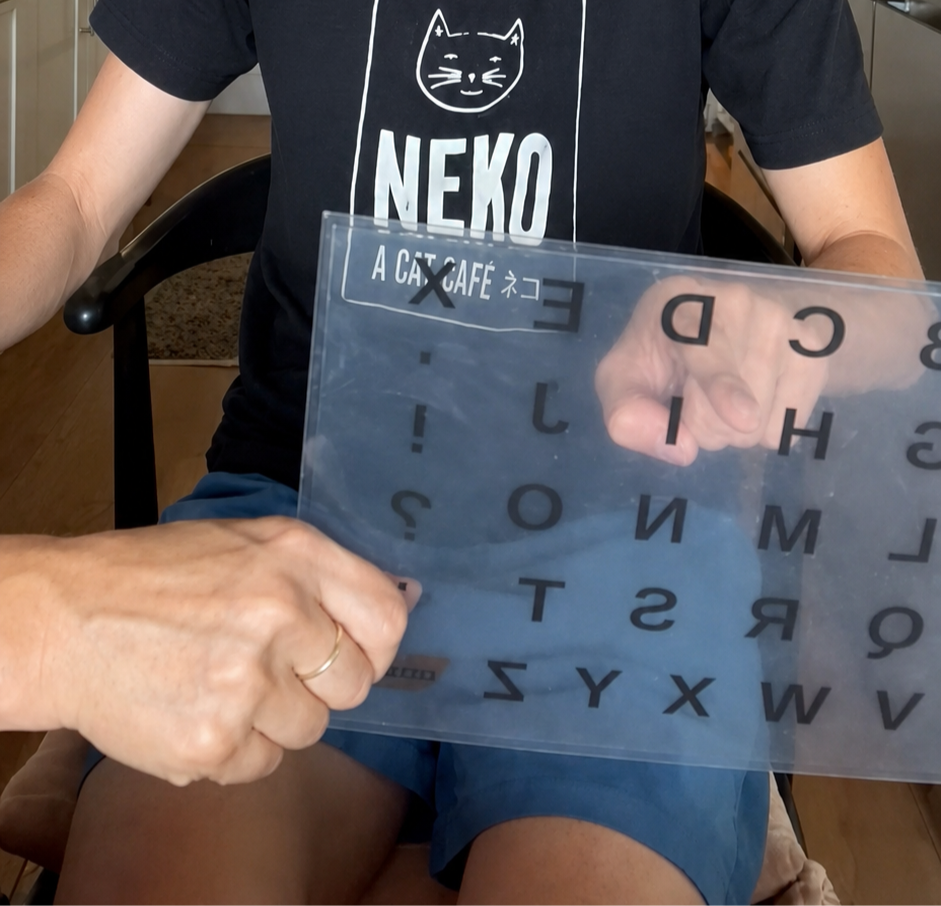
Beau spelling on a letterboard. Used with permission.
This piece has been updated since publication. For the newest verified developments, see the updates section at the bottom.
Beau was 21 years old the first time he communicated a full sentence.
He was in a session with a practitioner who had been working with him for some time, going through a lesson about Ernest Shackleton — the polar explorer who led his crew across Antarctic ice after their ship was crushed. The practitioner asked him: if you could name your family's boat anything, what would you name it?
He spelled out: Absolute Love.
"That was the first time I got a glimpse into his inner world," his mother Julianne told me. "It has been so fun to get to know my son. So exciting. And I'm constantly getting to know him better."
Beau is nonspeaking and autistic. He had spent more than two decades in a world that had largely decided, without asking him, that there was nothing much going on inside. His school kept him in a self-contained classroom doing remedial work — coloring, naming pictures, counting to 100 — until he aged out at 21. No one had suggested to his family that what they were seeing might be a motor-planning disorder rather than an intellectual disability: a disconnect between what his mind wanted and what his body could execute.
The method that finally gave Beau a voice is called Spelling to Communicate, or S2C. It is one of several related methods — along with the Rapid Prompting Method (RPM) and the broader category of letterboard-based communication — in which a nonspeaking person points to letters on a laminated alphabet board held by a trained communication and regulation partner, spelling out words, sentences, thoughts.
It sounds, to most people who haven't seen it, either miraculous or suspicious. To the American Speech-Language-Hearing Association (ASHA), the private membership association that credentials speech-language pathologists, accredits the graduate programs that train them, and sets the profession's practice standards, it is something closer to dangerous: an unvalidated, "not recommended" method that its position statement warns may produce messages that reflect the partner's intent rather than the speller's own. The Parlor contacted ASHA in May with questions about its position; the organization did not respond.
This stance creates immediate, practical roadblocks. Schools have banned letterboards from classrooms, courts have refused to let spellers testify, and training for the method is not covered by insurance. In a New York State Senate chamber, a bill that would have affirmed the right of people with disabilities to use any validated communication method was amended to define "validated" as methods that are "evidence-based, empirically supported and has demonstrated results in autonomous communication." The amendment is a single clause, but it effectively excludes any method that does not yet have an established research base — which is precisely the situation S2C is in.
The Bill of Rights That Wasn't
New York Senate Bill S7792 (NY A07363) began as a communication bill of rights — and for a moment, it looked like one. Championed by Assemblymember Angelo Santabarbara, whose own son Michael is nonspeaking and autistic, the Assembly version passed every single committee and floor vote unanimously: 9-0, then 28-0, then 133-0 on the full Assembly floor. Every member of the New York State Assembly voted to affirm that people with disabilities cannot be denied access to their preferred means of communication. Nonspeaking advocates led the charge to pass the bill, backed by groups like I-ASC's Spellers and Allies Advocacy Network and Elizabeth Bonker’s Communication 4 ALL. The goal was simple: pass a law ensuring that no school or group home could strip a disabled person of their chosen way to communicate.
Then it moved to the Senate. State Senator Patricia Fahy, chair of the Senate Disabilities Committee, amended the Senate companion bill without informing Santabarbara. According to City & State New York, Fahy had been directly contacted by the New York State Office for People with Developmental Disabilities (OPWDD) — the state agency that oversees group homes and services for disabled people, and that stood to lose oversight authority under the original bill's broad protections. OPWDD leaders raised concerns about legal liability: specifically, whether a message produced via letterboard truly reflects the thoughts of the person with a disability or the person holding the board.
Santabarbara, who had already resisted the same agency pressure, was unambiguous about what was happening: "The agency's happy with her version. They don't want to change what they have in place. Their bill sets us back — they will have complete control over everyone's communication device, everybody's communication method — and exactly the opposite of what everybody was fighting for." Fahy, for her part, said she was doing her job. "I talk to all the agencies, of course we get technical assistance," she told City & State. "It has to be grounded in evidence-based practice."
Advocacy groups raised questions about Fahy's financial relationships with organizations that stood to be affected by the original bill. Public campaign finance records show that her two largest union donors — 1199 SEIU and CSEA's Vote Cope PAC — represent workers employed in the OPWDD-funded group homes and facilities whose oversight authority the original bill would have curtailed. ESAAL, a trade association for residential care facilities, contributed $5,250 across seven separate transactions between 2024 and 2026 (1). While Fahy has not indicated that donor relationships influenced her decision, and the contributions do not prove a quid pro quo, the financial ties remain a matter of public record. The Parlor reached out to Fahy's office in May, but we did not receive a response to our request for comment.
When Lora, a nonspeaking speller in California, heard about the amendments, she was quick to respond. "Senator Fahy wants to rob voices in New York, which will rob voices everywhere," she spelled.
Lora started spelling five years ago, after her mother read a book about a boy's experience with the method. They drove from Los Angeles to San Diego for their first session to see the same practitioners mentioned in the book. Her mother had tried everything and wasn't expecting much. Within a month of daily practice, everything shifted.
"One of the first words that she spelled was 'heuristic,'" her mother told me. "And I thought: how did she know this?"
Lora's mother had to reframe her entire model of what autism is. "No one had ever explained to me that autism was a motor disability," she said. "I thought it was an intellectual disability because that's what I had been told."
Lora's school laughed at the method. Her mother pulled her out. She earned an accredited high school diploma through homeschooling, and this semester she completed her first two college courses — sociology and statistics — passing both with flying colors.
When I asked Lora what it felt like when her communication wasn't respected or supported, she spelled: To say it is mortifying is an understatement. It strips us of our humanity.
The Body That Won't Cooperate
The controversy over letterboards hinges on a neurological condition, what researchers call apraxia, documented across a range of populations including stroke, dementia, and Parkinson's patients.
The clinical term for the developmental form, in autism research, is dyspraxia — impaired performance of skilled, purposeful movement. In a 2007 study in Developmental Medicine & Child Neurology, Dziuk and colleagues at Johns Hopkins and the Kennedy Krieger Institute found that autistic children continued to show significantly poorer praxis than controls even after accounting for basic motor skill, and that praxis performance strongly predicted the social, communicative, and behavioral impairments that define the diagnosis. The authors concluded that dyspraxia may be a core feature of autism, or a marker of the neurological abnormalities underlying it.
Spellers and the clinicians who work with them describe the disconnect as extending across all voluntary movement — initiating a point, stopping one, holding a sequence together — which is why the partner's role is framed as motor and regulatory support rather than interpretation.
"Apraxia is like having a schizophrenic body that must do what it wants in spite of what my brain wishes," Lora spelled. "Spelling set my voice free but my body loves to rebel and betray me at every turn."
This matters enormously for how we understand nonspeaking autistic behavior — and for how we should understand the controversy around communication methods. The "behaviors" that the behavioral therapy industry has spent decades treating as problematic — self-injury, repetitive movements, apparent noncompliance — may in many cases be the involuntary expressions of a body that won't cooperate with its owner's intentions, not chosen behaviors to be extinguished.
Betsy Hicks Russ, whose son Joe began spelling at around thirty, spent decades before that assuming that her son didn't understand what was going on around him. "The system that is in place is basically set up to make it look like that is the case — the way that assessments are done, the way that schools teach — they are made to reinforce these old thought patterns."
When Joe finally began spelling in open sentences, the first thing that came through was not frustration or accusation. It was forgiveness. Betsy told me he communicated his "unequivocal forgiveness to those like me for not presuming competence."
The Science That Gets Excluded
Some of the most prominent research supporting spelling-based communication methods comes from Dr. Vikram Jaswal, a developmental psychologist and professor at the University of Virginia. His lab has published two peer-reviewed studies that challenge the dominant skeptical narrative, using methodologies that are standard in cognitive science but novel in their application to nonspeaking autistic communication.
In the first study, Jaswal and his colleagues used eye-tracking to examine whether nonspeaking autistic spellers were actually initiating their letter selections — or simply moving their hands in response to cues from their communication partners, as critics allege. Participants were spelling at roughly one letter per second with accuracy above 90%. More importantly, they were consistently looking at letters before pointing to them, on average about half a second in advance.
"If the board is being moved underneath their finger," Jaswal explained to me, "you wouldn't expect any systematic pattern in what they're looking at. But we found that they were looking at the letters they were about to point to, and doing it faster than the human information processing system could accommodate if they were responding to cues."
The second study used a reaction-time paradigm — Jaswal described it as inspired by Whack-a-Mole — to assess literacy in nonspeaking autistic participants without requiring them to demonstrate it explicitly, which motor challenges make impossible. Participants tapped letters as they pulsed on a screen. When the sequence of letters spelled a sentence they'd just heard, they were measurably faster than when the sequence was random. Roughly half showed evidence of foundational literacy skills — in a population that educational professionals estimated, at rates of fewer than 10%, could spell even a basic sentence.
"Just because somebody doesn't do well on a given task doesn't mean they don't have the underlying competencies," Jaswal said. "It's our responsibility as researchers to continue to innovate and develop methods that do allow them to show what they know."
Both studies have drawn published rebuttals in Evidence-Based Communication Assessment and Intervention, a journal co-edited by Ralf Schlosser, who also co-authored the ASHA position statement. Both were written by Katharine Beals, an adjunct assistant professor in the University of Pennsylvania's autism programs and an adjunct professor at Drexel, who co-founded FacilitatedCommunication.org. Beals first took her critique of the eye-tracking study to Scientific Reports itself. She submitted it to the journal's Matters Arising section — the format reserved for post-publication challenges — and on December 11, 2020, an editor declined it after consulting external advisers, citing limitations in the arguments and concluding that publishing the exchange would not sufficiently clarify the issues for the journal's readers. It appeared in Evidence-Based Communication Assessment and Intervention five months later. Beals posted the reviewer reports and the rejection letter on her blog, under the heading "What Scientific Reports would not publish."
Her response to the eye-tracking study argues that gaze preceding a point does not establish authorship, since a person responding to a cue would also look where they are about to move, and that message passing remains the direct test of who is producing the message. Her response to the literacy study argues that response times to pulsing letters measure knowledge of spelling conventions rather than reading comprehension, that receptive language — a prerequisite for literacy — is impaired in this population, and that because the experimenter read each sentence aloud with no silent comparison condition, the effect could reflect prediction from hearing rather than from reading. Roughly half the participants did not show the pattern; Jaswal's research notes the task required sustained attention across more than 550 targets. His answer on receptive language is that no measure he would trust currently exists.
Critics treat message passing as the decisive test of authorship — the speller is shown information the communication partner does not have, and is then asked to convey it — demonstrating, through successful transmission, that the message is originating with the speller rather than being unconsciously telegraphed by the partner. The problem, as Jaswal points out, is that no such studies have been successfully conducted — not because spellers fail them, he argues, but because the design presents significant challenges for a population with motor difficulties, high anxiety, and no experience with adversarial testing conditions.
"I'm puzzled by who decided message passing was the gold standard," Jaswal told me. "It's not applied to other AAC methodologies. No one subjects people learning to use picture-based communication to message-passing tests. And we know from research that with practice, nonspeaking autistic people can improve at this kind of study. That suggests the problem is lack of practice, not lack of ability."
What's more, the systematic review most often cited by opponents of spelling-based methods — conducted by Schlosser and colleagues — evaluated facilitated communication (FC) specifically, not letterboard methods, against message-passing criteria, with inconclusive evidence about the success of FC users. A footnote identifies it as ISAAC governance material that, unlike other content in the journal, "did not go through the journal's peer review process." Schlosser’s updated review focusing exclusively on letterboard users, scheduled to be published in Review Journal of Autism and Developmental Disorders, screened over 5,800 publications on methodological grounds but excluded all studies from its final evidentiary set.
Schlosser reached his conclusion of “no evidence” by limiting the criteria to message-passing studies applied to the method, of which there are none. "They designed the review to find what they already knew," Jaswal said carefully. "That the methodology they favor hasn't been applied. That's not the same as saying there's no evidence."
The review was co-authored by Dr. Howard Shane, one of S2C's most frequently quoted critics. Shane, an ASHA fellow and recipient of the organization's Honors of the Association award, holds two U.S. patents on speech-generating device technology, alongside more than a dozen commercial AAC applications he's developed. The Parlor sought comment from Dr. Shane through Boston Children's Hospital media relations in July, including questions about his patent holdings and disclosure practices; we did not receive a response.
The Industry Behind the Science
Applied Behavior Analysis — the dominant therapeutic approach for autistic children, and the method that the vast majority of nonspeaking autistic people have spent years in — is now a more than $4.4 billion industry. Medicaid alone spends over $2 billion annually on ABA services. All 50 states now mandate insurance coverage for ABA, the result of aggressive lobbying campaigns.
Autism Speaks — a parent-founded organization that for its first decade had zero autistic people on its board, and which has historically promoted ABA as the standard of care — and the ABA industry's own professional bodies: the Council of Autism Service Providers (CASP), the Association of Professional Behavior Analysts (APBA), and the Behavior Analyst Certification Board (BACB) together comprise the ABA Coding Coalition, a formal structure designed specifically to support insurance coding and reimbursement for ABA services. At the state-level, ABA provider associations like the Wisconsin Autism Providers Association, exist explicitly to hire lobbyists and push for Medicaid coverage of ABA in their states.
A single Board Certified Behavior Analyst (BCBA) overseeing a case bills $120 to $250 an hour for supervision, typically two to five hours a week; the Registered Behavior Technicians who deliver the bulk of direct therapy bill $50 to $80 an hour, for anywhere from 10 to 40 hours a week depending on the treatment plan. Add periodic reassessments and parent training, and a single child's ABA program can run $26,000 to over $166,000 a year — to cover the volume of hours a "comprehensive" plan requires.
Families and practitioners consistently cite that once someone is able to express what they need, want, and feel, self-injurious behavior and dysregulation — the "behaviors" ABA is built to treat — tend to decrease.
Heather Burroughs, a former school psychologist and mother of Devyn, a nonspeaking 19-year-old, names the financial logic: "If you can communicate, your behaviors go down," she said. "I hate to say it because it sounds so evil, but if you could get 40 hours a week when you’re non-verbal and have bad behaviors, you’re not gonna get that if you're communicating and regulated and have coping skills."
Entrenchment is not the same as evidentiary standing. A Cochrane systematic review found the quality of evidence for Early Intensive Behavioral Intervention to be "low" or "very low" across outcome measures, with no evidence that it improves autism symptom severity. The researchers noted that only a single study in their review had an optimal randomized design.
However, the deeper problem is who produced the evidence.
Two peer-reviewed studies by Bottema-Beutel and colleagues — published in Frontiers in Psychology in 2021 and updated in a SAGE journal in 2026 — examined conflict-of-interest disclosures in ABA autism intervention research. The findings are alarming. In the 2021 study, 84% of papers had at least one author with an undisclosed conflict of interest related to employment as an ABA clinical provider or training consultant. In the 2026 update: 78% of authors held clinical or consultancy conflicts. 93% of studies had at least one such author. Only 8% of studies disclosed any conflicts. And 93% of statements claiming no conflicts of interest were false.
The structural explanation is embedded in the publication process itself: ABA intervention research is routinely published in ABA-specific journals, where it is peer-reviewed by researchers with the same conflicts as the submitting authors, edited by people with the same financial stakes. A 2025 paper in the Journal of Social Issues situates this explicitly within political economy, describing ABA as a component of a "lucrative Autism Industrial Complex, fueled by a tragedy narrative that commodifies autism as a disorder to justify behavioral interventions."
"In ABA, they love to talk about compliance and behaviors,” Lora's mother said. “I never heard the word apraxia until she was sixteen. And I learned that the things she was doing were not 'behaviors' at all, but rather a disconnect between mind, body, and intent."
On the communication side of Autism therapy, the recommended alternatives to spelling based methods — AAC, including PECS and speech-generating devices — don't fare much better under scrutiny. An early, oft-cited meta-analysis by Flippin, Reszka, and Watson, published in an ASHA journal in 2010, found that PECS produced small to negative gains in speech and flagged serious concerns about whether skills held up over time or transferred outside the training setting. More recently, a systematic review of acquisition and mastery of PECS skills tracking how far users actually progress through the protocol found that most never advance past its earliest phase — physically handing over a single picture — and that even those who reach the third phase are typically choosing from an array of only a few symbols, a vocabulary too narrow to support real linguistic independence. A separate meta-analysis of randomized controlled trials found that while PECS reliably teaches functional requesting, it produced no statistically significant effect on language development itself — teaching a demand, in other words, without building the generative language underneath it.
The financial structure behind PECS's evidence base echoes the one Bottema-Beutel documented in ABA research. PECS is not an open method — it's a trademarked, commercially licensed system owned by Pyramid Educational Consultants, an approved ASHA continuing-education provider, meaning SLPs who pay for Pyramid's PECS training workshops can apply that attendance directly toward the certification hours ASHA requires them to maintain. ASHA's approval is advertised as a selling point on Pyramid's own tuition pages.
ASHA, the organization that decides what counts as "evidence-based" communication practice, produces over $75 million in revenue a year, nearly 70% of which comes from dues paid through the credentialing pipeline. That pipeline is also what makes ASHA's endorsement commercially valuable: a method Pyramid can sell to SLPs as counting toward the hours ASHA requires is a method with a built-in market. ASHA decides which methods get that.
That asymmetry has a mirror image on the high-tech side of ASHA's endorsed AAC spectrum. Speech-generating devices require costly hardware, licensed software, ongoing clinical training, and continual reconfiguration as a user's vocabulary needs grow — a system with real billing infrastructure behind it. While AAC devices are useful, the economic barriers many families face in acquiring one are steep, and in many cases the devices themselves are not optimized for users with severe motor differences. A 2024 multi-stakeholder study out of Murdoch University — surveying parent-carers, educators, and clinicians supporting autistic AAC users — found that up to 50% of AAC users abandon their devices, and that device fit rated as a top-three barrier by every parent-carer surveyed, along with 80% of educators and 73% of clinicians.
Spelling-based methods, by contrast, have no comparable billing infrastructure at all, and the laminated large alphabet targets or large letter stencils are described as easy to adapt to a variety of motor needs. "Nobody's making money on the spelling," Heather said. "Your mom can do it, your neighbor can do it. A speech therapist could do it if they wanted to. But the industry giants are so well established." That isn't to say spelling methods sit outside commerce entirely. S2C is trademarked and I-ASC is its exclusive training source, as HALO is for RPM — though neither certification is accredited or validated by any external body, and unlike ABA hours or device reconfiguration, the cost is front-loaded: once a parent learns to serve as a communication partner, there is no recurring billable relationship, no reassessment cycle, no hardware to replace.
The Classroom as Battleground
By far the biggest obstacle faced by every family I spoke with was the school. Not, in most cases, individual teachers or aides — many of whom, families report, were often sympathetic to their lived experiences — but the institutional machinery: the school district that assesses a child on their perceived intellectual capacities, decides what accommodations are worth providing, and whether or not they deserve to participate in integrated learning environments.
Heather Burroughs recognized this pattern long before the fight over letterboards. A former school psychologist, Burroughs had spent years administering IQ tests that helped determine which services children received. "I would get the number and think it helped people get what they needed," she told me. "Then I had Devyn. Her motor system was profoundly affected, she couldn't rely on speech, and I realized those scores weren't measuring what she knew. They were measuring what her body could demonstrate."
In 2012, Burroughs found herself in a legal battle with her daughter's elementary school over Devyn's service dog, Hannah. The district looked at Devyn's outward presentation, her inability to speak, her significant motor disability, and her test scores, and concluded she could never truly be Hannah's handler.
Support independent journalism
Enjoy reading The Parlor?
Become a paid subscriber to get full access, early releases, and subscriber-only extras.
Become a paid subscriberDevyn directed Hannah through gestures and other nonverbal cues, but she needed minimal assistance with tasks such as tethering, untethering, and occasionally being prompted to issue a command. She already had both a one-to-one aide and a one-to-one nurse assigned to her. Yet the district prohibited those staff members from providing that limited assistance and instead required Burroughs to hire and supply a separate adult to accompany the dog throughout the school day.
The assumption was revealing. The district treated Devyn's need for support as proof that the role of handler could not truly belong to her.
Burroughs fought the district for eight years. When the United States Department of Justice joined the case, it became about much more than one family's experience. It raised a broader question affecting students across the country: does a person lose agency simply because they need reasonable assistance to carry out a task? The resulting federal settlement required the district to recognize that students with disabilities may remain the handlers of their own service dogs while receiving reasonable modifications from school staff, helping establish an important national model for how public schools should apply the American with Disabilities Act.
Midway through the legal battle, the strain became too much and Burroughs transferred Devyn to another school district. There, the response was entirely different. The new district immediately recognized Devyn as Hannah's handler and provided the limited assistance she needed. Devyn had not changed. The assumptions about her had.
For Burroughs, the parallels to today's debate over spelling-based communication are impossible to ignore.
"People see someone who needs assistance and assume the thoughts, choices, or abilities must belong to the person providing the support," she told me. "But that's backwards. The support exists so the person's own intent can be expressed."
The same logic that nearly cost Devyn access to her service dog is now being applied to communication. Because some nonspeaking people need a communication partner to hold a letterboard, help regulate their body, or provide other forms of motor support, critics conclude the words cannot truly be theirs. In both situations, the need for assistance is treated as evidence that the person's abilities, decisions, and intent cannot truly be their own.
"The real question isn't whether someone performs every physical step independently," Burroughs said. "The question is whether the support preserves that person's agency, intent, and control. That's what the ADA has always been about."
Roughly four years later, another family in another state would find themselves fighting the same underlying assumption: that competence has to be proven before it can be presumed."
Alex Le Pape's family spent 17 months making at least 33 documented requests to their school district — the Lower Merion School District in Pennsylvania, one of the wealthiest and most highly regarded school districts in the country — to allow Alex to use a letterboard in school and to train staff to assist him with it. They sent videos. They brought in Alex's speech therapist, his psychiatrist, his behavior analyst — all of whom wrote to the district that the letterboard was effective for him. They offered to pay for staff training themselves.
The district declined. Its initial stated reason: spelling to communicate was not evidence-based. When ASHA published its formal position statement in 2018, the district cited it explicitly. What the family later learned was that the special education administrator leading the process, an SLP by training, had likely known the ASHA statement was coming.
"They weren't very clear," Jennifer Binder-Le Pape, Alex's mother, told me. "They didn’t come out and say we will never let you do this — though I think that was always their position in hindsight. I think they figured they had to at least appear open to it."
Alex, who was 16 when all of this began, developed self-injurious behaviors as the school conflict escalated. His psychiatrist recommended he be removed from school entirely. After his family withdrew him, the district reversed course and offered to allow the letterboard — but not to provide a trained communication partner. By then, Jennifer says, the damage was done. "You sat in a room and told us you didn't believe any of this. Why would we trust you to educate our son?"
The family filed for due process. The hearing officer — in a proceeding that would later be described by the Third Circuit Court of Appeals as deeply flawed — excluded videos of Alex communicating and refused to allow him to testify, ruling that permitting his testimony would amount to deciding in advance that the method was legitimate.
The family's lawyer, Nicole Reimann, countered in a filing that under Pennsylvania Rules of Evidence, every person is presumed competent to be a witness — and that the district bore the burden of proving incompetency by clear and convincing evidence, a burden it could not meet. The district, in its motion to preclude Alex's testimony, described him as "a student with an intellectual disability" whose "disability is known to impact his ability to communicate independently" — a characterization his family, his clinicians, and eventually three federal judges found to be precisely the assumption the case was about.
The hearing officer's ruling was reversed. The district court's subsequent ruling was reversed. The Third Circuit, in a 33-page precedential opinion issued in June 2024, found that the lower courts had applied the wrong standard of review, failed to consider extensive discovery evidence, and fundamentally confused the distinct legal questions posed by the IDEA, the ADA, and Section 504. Crucially, the court held that "whether or not the letterboard was effective communication for Alex was a disputed material fact, and therefore a question for a jury, not a hearing officer or a judge applying deference to an administrative record."
The precedent matters. A school district, the Third Circuit held, cannot unilaterally declare what counts as effective communication for a disabled student. When experts disagree, a jury must decide.
But Alex Le Pape is now 23 years old. He is not going back to high school.
The Courtroom Door That Closes
There is another dimension to this story that has received almost no attention, and it concerns what happens when the person whose voice has been silenced is also the victim of a crime.
Beau was 14 years old — before he had any access to spelling — when he was sexually assaulted in a public pool. He had enough spoken words to tell a caretaker what had happened. The police were called. But because Beau could not withstand cross-examination, there was no prosecution.
The perpetrator was not charged.
"Predators know this," Beau spelled, when I asked him about it. "They know that if there is not a secondary person that sees what happened, or a camera, they won't get prosecuted."
This is not an isolated case. Elizabeth Zielinski, a Special Education Advocate in Virginia who has been involved in landmark due process proceedings there, has also encountered cases in which spellers were victims of crimes but could not offer their testimony in a form courts would accept. Jennifer Binder-Le Pape described at least two such families in her network.
The standard objection — the one opponents of spelling-based communication reliably cite in this context — is the case of a teacher in the 1990s whose use of facilitated communication with a nonspeaking student produced messages that did not originate with the student and led to false accusations of sexual abuse against their family. It was a real harm. The facilitator, Janyce Boynton, later concluded the messages had been hers and has spent the years since writing publicly against the method. The families who use spelling methods do not minimize it. But several things are worth holding alongside it.
First, Janyce Boynton, the FC facilitator, had approximately 30 minutes of training. She would not meet current practitioner standards by any measure. Second, the method being used — facilitated communication, in which a partner applies backward resistance at the communicator’s hand, wrist, or elbow in order to guide them— is meaningfully different from modern S2C practice, in which the partner holds the board but does not touch the speller, and in which the training protocols are designed explicitly around minimizing influence and working toward independent communication. Third, as Jennifer Binder-Le Pape observed, the device at the center of that case was an early prototype of the modern AAC device — the picture-based, push-button technology that ASHA considers evidence-based and fully endorses — not a letterboard at all.
And fourth — and this is the argument made by disability scholar Rua Williams that Jaswal cited in our conversation — we might ask ourselves whether a false accusation is a greater harm than an inability to accuse. And whether or not the same standard of protection extended to support partners — shielding them from wrongful accusation — is proportional to the standard of protection withheld from nonspeaking people themselves, leaving them vulnerable to victimization with impunity.
There is currently no consistent standard governing the use of letterboard communication in U.S. courts. Some jurisdictions have allowed it; others have barred it. The Third Circuit's ruling in the Le Pape case establishes that in educational settings, effectiveness is a question for a jury. That principle has not yet been extended to criminal proceedings.
Elizabeth Zielinski shared her most recent win — a due process hearing in Fairfax County, Virginia involving a student who uses a letterboard in his special education plan — in which the hearing officer did not question the authenticity of his communication at any point and the student was allowed to testify on his own behalf. In a follow-up press event, he was asked two questions: what would you say to parents who believe their child is intellectually disabled, and what did you want Fairfax County to learn from having to face this case? The video of the board was displayed behind him at triple speed, she told me. It did not move.
"There are ways to scrutinize this while it's happening," she said. "Ways to validate, in real time, whether the communication is being influenced. What they're really doing is applying empirical proof to something that doesn't exist on an empirical level."
The Standard Unevenly Applied
Independent authorship in spelling-based communication is a reasonable evidentiary concern. The critics who insist on this point are not wrong that influence from communication partners is a genuine methodological risk that needs to be studied and minimized.
The standard is also not applied to any method ASHA endorses. PECS begins with a two-person procedure in which a second adult stands behind the learner and physically guides their hand to pick up a picture and place it in a communication partner's palm, with that physical assistance faded over subsequent trials. Partner-assisted scanning, a standard AAC technique, has a partner present options aloud or by pointing while the user signals a selection.
Endorsed methods also involve forms of mediation that shape what a user can express. The vocabulary available on a speech-generating device is initially selected and programmed by clinicians or communication partners. Although many systems can be expanded, a user’s expressive options remain constrained by what has been made available to them.
Institutions also do not ordinarily require conclusive evidence or universal effectiveness before allowing disabled people access to communication supports. PECS retains its endorsement despite outcome research finding that most users never progress past handing over a single picture and that it produces no measurable effect on language development. Speech-generating devices retain theirs despite the fact that up to 50% of AAC users ultimately abandon or under-use their devices.
The question is not only whether letterboard communication has met an authorship standard that is not routinely applied to endorsed communication methods. It is also whether, in practice, the method is beneficial for the people who choose to use it and how institutions should respond while the scientific questions remain unresolved.
When Beau was able to tell his doctors about symptoms he was experiencing, his family learned he had ulcerative colitis. When Alex Le Pape could tell his psychiatrist about his internal experience, he was able to get the psychological support he needed. When Joe could tell his mother what he needed and wanted, she finally had the gift, as she put it, of not guessing anymore. When Lora began communicating with her professors, she got an A in statistics.
"The gold standard," Jennifer told me, "should be giving them agency and a good life."
What Presumption of Competence Actually Means
The phrase "presumption of competence" has a specific intellectual history. Anne Donnellan, a professor and autism researcher who spent decades arguing that autistic people — including nonspeaking autistic people — were being systematically underestimated, grounded it in what she called the criterion of the least dangerous assumption: when you cannot determine with certainty what a person understands or is capable of, you choose the assumption whose consequences are least harmful if you turn out to be wrong. Assuming competence and being mistaken costs little. Assuming incompetence and being mistaken costs a person their education, their voice, and, sometimes, their safety.
That principle has never been applied consistently to nonspeaking autistic people as Dr. Jaswal pointed out. "We certainly extend the presumption of competence to young children who are not autistic," he said. "We should extend it to everybody, and recognize that people are on different developmental paths, and they're going to take different amounts of time, and we need different kinds of support. But if we don't provide those opportunities, then they're never going to acquire the kinds of skills they would like to."
Fewer than 10% of nonspeaking autistic people are estimated by educational professionals to have the literacy skills to spell a sentence. Jaswal's research suggests the real number is between one-third and two-thirds.
"I always knew I was smart,” Lora spelled to me during our interview. “But the world didn't know. It felt validating to be heard for the first time."
(1) New York State Board of Elections campaign finance database, candidate Patricia A. Fahy, State Senator, ID# 29901. Searched June 2026. Contributor searches conducted for 1199 SEIU, CSEA Political Action Fund, and ESAAL. Available at elections.ny.gov.
This article was reported over three months and draws on original interviews with nonspeaking autistic spellers Lora and Beau, their parents, Heather Burroughs, Jennifer Binder-Le Pape (whose son Alex's case produced a landmark Third Circuit ruling in 2024), Elizabeth Zielinski, and Dr. Vikram Jaswal of the University of Virginia. Court documents cited include Le Pape v. Lower Merion School District, No. 22-2931 (3d Cir. 2024). Research cited includes Bottema-Beutel et al. (2021, 2026), Reichow et al. (2018, Cochrane Database), and ongoing work from Jaswal's lab at UVA.
Updates and corrections
July 28, 2026:
Clarified.The account of Heather Burroughs's federal service-dog case, at Burroughs's request and with her own corrections to her quoted remarks.
Added. A section noting the published rebuttals to both of Dr. Vikram Jaswal's studies, written by Katharine Beals in Evidence-Based Communication Assessment and Intervention, along with the specific methodological objections each raises and Jaswal's responses.
Clarified. The description of ASHA's institutional interest. The original text placed the association's dues revenue alongside Pyramid Educational Consultants' commercial relationship in a way that could suggest ASHA earns revenue from PECS. It does not. The revised text describes what the reporting supports: that ASHA's endorsement determines which methods have a market among credentialed professionals.
July 29, 2026:
Added. A note that Ralf Schlosser, who co-edits Evidence-Based Communication Assessment and Intervention, was among the authors of ASHA's 2018 position statement on facilitated communication. The original text identified him as the journal's co-editor but did not note his role in the position statement.
Clarified. The description of Katharine Beals's academic appointments. She is an adjunct assistant professor in the University of Pennsylvania's autism programs and an adjunct professor at Drexel — part-time, non-tenure-track positions.
Added. The submission history of Beals's critique of the eye-tracking study. She first submitted it to Scientific Reports, which published the original study, as a Matters Arising post-publication challenge. On December 11, 2020, an editor declined it after consulting external advisers, citing limitations in the arguments and concluding that publishing the exchange would not sufficiently clarify the issues for the journal's readers. It appeared in Evidence-Based Communication Assessment and Intervention five months later. Beals posted the reviewer reports and the rejection letter on her blog.
Clarified. The description of the motor differences underlying letterboard use. The original text described a "full-body apraxia that many nonspeaking autistic people experience," stating as established both the prevalence and the term. "Full-body apraxia" is not a clinical designation; the term used in autism research is dyspraxia. The revised text attributes the clinical claim to Dziuk et al. (2007) in Developmental Medicine & Child Neurology, which found praxis impairments in autistic children that persisted after accounting for basic motor skill, and attributes the broader description of the disconnect across all voluntary movement to spellers and the clinicians who work with them, rather than stating it as a general finding.
Clarified. The section previously titled "The Standard That Nothing Could Pass." The original argument held that a message-passing standard, strictly applied, would disqualify most human communication, citing coached testimony and suggestibility as parallels. That comparison conflated two different questions — whether a message is accurate, and whether it originates with the speaker. Message passing tests only the second. The revised section, retitled "The Standard Unevenly Applied," concedes that partner influence is a legitimate methodological concern and makes a narrower argument: that the same standard has never been required of the methods ASHA endorses, several of which also involve partner mediation.The closing passage now distinguishes the unresolved authorship question from two additional policy questions: whether the method is beneficial in practice for people who choose to use it, and how institutions should respond while the scientific questions remain unresolved.
About the author
Lindsey Brock Morales
Lindsey is the Founder and Editor-in-Chief of The Parlor. After over a decade in humanitarian aid and community organizing, she founded The Parlor in 2025 to build a publication rooted in the belief that the people most affected by power are the most qualified to describe it. She is based between Washington, D.C. and Bologna, Italy.
Conversation
A space for Parlor members. Be generous, be real.
Loading…