

There is a printer in my house that I am not allowed to fix.
I bought it a couple of years ago. It works fine. The only thing wrong with it is that the company that made it decided it would accept cartridges from the company that made it, and nothing else — and that the arrangement would be a subscription, activated upon device configuration. Cartridges arrive whether I need them or not. I pay the fee whether they arrive or not. If I stop paying, I stop printing.
When I described my problem to Marloes de Valk, a Dutch artist and researcher who has spent years studying people trying to build computing differently, she elucidated the murky terms and conditions that are typical of most hardware companies, from printers to smart fridges. She told me that what I'd stumbled into wasn't a fluke of one bad printer but a legally protected arrangement: manufacturers are permitted to lock devices to their own consumables, to void a warranty the moment you open the case, to stop supplying spare parts whenever they choose.
All of it, she said, is completely legal.
My printer is an HP — which means it's also, technically, a monopoly enforcement device. HP's "Dynamic Security" firmware, pushed out in updates users never explicitly consented to, disables the printer the moment it detects a non-HP chip in a cartridge, even if that cartridge is otherwise fully functional. HP paid a $1.5 million settlement over the practice in 2019 and has been sued again since.
And that’s when I realized that the question is not whether or not I'm clever enough to hack my printer. It’s why I’m legally barred from even trying, despite the fact that I purchased the hardware.
Technology hasn't always been like this. I remember my own childhood in the 90s — cassette players, clunky desktops running Windows 95. Through the 1990s and into the 2000s, computing was still mostly local. The internet connected through the local phone line, programs were fully downloadable and lived on our devices. Then came the cloud computing boom of the early 2000s: AWS, Google Cloud, Microsoft Azure — and computing moved away from homes and into data centers. With that shift, the software on our devices changed hands, from something we fully owned, along with the computers running it, to something we rent for use. The migration came with a corresponding spike in energy consumption: data center electricity use grew roughly 7 percent annually between 2014 and 2018, and jumped to about 18 percent annually between 2018 and 2023. Industry forecasts project that growth could climb as high as 27 percent a year over the coming decade.

However, as computing and hardware became increasingly opaque to the average user, a subculture persisted. Its roots trace back to the demoscene — a digital art subculture, mostly European, where people compete to create self-contained, real-time programs called "demos," combining music, math, and visual effects to showcase what a machine can be made to do, often on hardware designed to do far less. From that same impulse — pushing a device past what its makers intended — small online groups of artists, computer nerds, and hackers concerned about the environmental toll of high-energy computing began forming their own solutions. These diverse communities, spanning geographies and movements, became known collectively as permacomputing: a movement dedicated to low-energy computing and repurposing obsolete hardware for everyday use, in order to reduce technology's carbon footprint.
The Birth of Permacomputing
Ville-Matias Heikkilä officially coined the term in a 2020 blog post which he published on his own website, under a Creative Commons license. Years prior, he was active in the demoscene as viznut where he contributed to a number of groundbreaking discoveries in low energy computing. In 2003 he found that the sound chip in the Commodore VIC-20 used shift registers rather than flip-flops, which meant it could produce waveforms nobody knew were in there. In 2011 he was one of the discoverers of bytebeat: one-line C programs that generate minutes of structured music.
His definition of Permacomputing suggests reorganizing computing according to the principles of permaculture: working with natural systems rather than against them, designing for intermittency and repair rather than growth and obsolescence, treating limits as a design input rather than an obstacle to engineer away. His framing of underlying problem is direct: “over the last few hundred years, artificially produced energy consumption has exploded, and in the computer world, this phenomenon gets multiplied by itself." Where mainstream computing solves problems by increasing control over a process — which almost always means increasing resource use — permaculture lets the system do more of the work.
Chip fabrication requires enormous energy and poisonous substances, he argues, "the resulting microchips should be treasured like gems or rare exotic spices." This ties directly into the problem of planned obsolescence in commercial devices: Apple has used chip-level "serialization" to tie internal parts to specific devices, so a working component can't be swapped into another phone without triggering software errors — France opened an investigation into the practice in 2023, and Italy has already fined Apple and Samsung for similar tactics that slowed older devices via software updates.
He also names a habit of mind he calls "yang hacking" — the traditional hacker's drive toward total understanding and control of a system, optimization toward a single measurable target — and sets it against something he calls "yin hacking," which accepts the parts of a system that are beyond rational control, and treats the relationship with a machine as observational and bidirectional rather than purely extractive. It's a distinction, he suggests, that maps neatly onto the difference between industrial agriculture and permaculture itself.
When viznut wrote his initial notes on permacomputing, he wasn't aware of anyone else working from the same premises. In June 2021, De Valk published a paper at the Computing within Limits workshop surveying the terminology in circulation, paired with a poll she ran on Mastodon among developers and activists working on sustainability in computing. What she found she called "a pluriverse of local worlds": small-scale practices that were less visible, harder to access, and largely siloed from one another. The academic wing runs through the Computing within Limits workshops themselves, active since 2015. The online wing clusters around the Mastodon server Merveilles.town and the "smolnet" — the deliberately small, low-bandwidth spaces of the Gemini protocol. Adjacent to both are Solar Protocol, a solar-hosted website this piece returns to later, and the solar-powered mirror of Low-Tech Magazine, which since 2018 has run on a single panel with a battery meter on the page — and which goes dark when the sun doesn't come out, because its makers were trying to cut energy use rather than guarantee uptime. Off to one side entirely sits Collapse OS, a project aimed at hardware and software that could survive the collapse of the semiconductor industry outright.
Two months after her paper, viznut published an update to his own essay that took up de Valk's map and extended it, adding Branch magazine's Sustainable Internet activism, and citing what unplanned obsolescence could look like according to a hypothesis from the 2017 paper by Jang et al.: that some of today's computer hardware could in principle be kept running for several human generations even if chip fabrication stopped tomorrow.
When I asked De Valk to define the community, she was reluctant to speak for something that vast. But one thing, she said, unites it: it is explicitly anti-capitalist, rooted in degrowth and decoloniality, and not remotely interested in being marketable.
"Technology has become uninhabitable"
In the early 2000s, De Valk was part of a collective called GOTO10, building the puredyne GNU/Linux distribution and running the Make Art festival — infrastructure for the kind of open, artist-run computing that a handful of companies had otherwise cornered. "They were basically dictating how artists should work," she told me, "and we wanted to challenge that." That instinct carried into her games: with the collective Iodine Dynamics, she built What Remains, an NES cartridge that walks players through how industry campaigns in the 1980s manipulated public opinion to delay climate regulation — the same disinformation playbook, she argues, still running today. She went on to collaborate in the creation of Villains and Heroes an interactive fiction unmasking the funding networks behind climate denial today traced across four decades. From there her attention moved to the environmental cost of the tools themselves: in 2022 she launched the Damaged Earth Catalog, a wiki mapping sustainable-computing communities and practices, deliberately rewriting Stewart Brand's Whole Earth Catalog for a depleted planet. That inquiry eventually became a PhD studying communities trying to build a less damaging tech infrastructure.

Her main argument, that spans across her work, is that the word technology itself has become uninhabitable. It's been made to carry a promise it can't keep — that economic growth can be separated from environmental damage — and the gap between promise and reality has broken the word for everyday users trying to do less harm. What's grown in the gap is a proliferation of names: permacomputing, computing within limits, collapse informatics, salvage computing, slow tech, feminist technology, convivial computing.
I asked her whether this fragmentation of terminology weakens the underlying politics. She rejected the premise. "Names don't really diffuse political force," she said. "The naming is not so much a form of power as it is a form of wanting to not be associated with — because big tech has poisoned tech for everyone." What she wants instead of one unified movement is explicitly plural: "There doesn't have to be a sort of unified consensus about how to do things, as long as there are alliances." The alternative — a single ethical rival to big tech, complete with "green data centres, green AI, sovereign tech" — is, in her view, just "copy-pasting whatever big tech is doing, with superficial improvements," but just as damaging at its core.
When asked about how all of this scales, she replied, "This is often the argument that is given against many attempts at doing tech differently," she said. "And no, it does not scale. But it is an example of how, in a situated way, we can do a lot with a lot less." The goal, in her account, was never to replace data centers with smaller, nicer data centers. "We shouldn't try to look at massively scalable things, because that was where we went wrong in the first place." She pointed to feminist server collectives as a parallel case — small groups negotiating in real time how to distribute the labor of server maintenance, who gets access and under what conditions — work that will never replace centralized infrastructure and isn't trying to.
She's equally direct about the myth that unlimited growth and environmental protection can coexist. The economies that appear to have pulled this off, she argues, have simply exported their production to low-wage countries — "who are then seen as the ones that pollute, whereas it's actually to make the stuff that the higher-income countries are having fabricated."
Therefore, decoupling economic growth from environmental damage, in her assessment, is not possible.
The Right to Repair and The Industry Response
I wondered if some of the environmental harm could be mitigated through repurposing old hardware.
This is where my printer comes back in.
Reusing and repairing hardware runs immediately into legislation, de Valk told me. You void your warranty by opening the case; if the device is under warranty, you can't repair it yourself at all. Manufacturers can legally stop supplying spare parts, or supply them for only a short window. They can legally stop shipping software updates, at which point a functional machine becomes a security liability — she pointed to the crates of still-working Chromebooks discarded by schools once Google support ends, and the enormous quantity of usable hardware that Windows 10's end of life rendered obsolete. And manufacturers can legally decline to make devices modular, so that one small failed part condemns a machine that's otherwise entirely fine.
DigitalEurope, the Brussels-based trade association whose corporate members include Apple, Amazon, Google, Microsoft, Samsung, Huawei, Dell, HP, Intel, and Sony, among dozens of others — and whose members, the group says, perform "millions of repairs annually" through their own repair facilities.
In 2023, The European Commission first introduced its “Directive on common rules promoting the repair of goods" as part of the European Green Deal's push toward a circular economy. It required sellers to prioritize repair over replacement when a product broke within the legal guarantee period, if repair cost the same as or less than a replacement, and it let producers charge for repairs performed outside that window. It also created the European Repair Information Form, meant to let consumers compare repair conditions and pricing across providers, and floated a future EU-wide quality standard for repair services.
Through the original proposal, repair obligations were tied to the EU's "ecodesign" system, where experts set narrow, product-by-product rules for which spare parts and repair info manufacturers must provide. When the file reached Parliament, its report amended that proposal — scrapping the ecodesign link and requiring manufacturers to instead make all parts, tools, and repair information available to everyone, including consumers themselves, for a product's full lifetime.
DigitalEurope objected to Parliament's universal-access requirement on safety and IP grounds — warning that untrained consumers attempting repairs could risk fire or chemical leaks, and that some tools and repair information should stay restricted to professional repairers to protect trade secrets.
It pushed to exclude servers and data storage products from the directive's scope entirely, on the grounds that they're purchased by businesses rather than individual consumers — carving a chunk of actual data-center hardware out of the law's reach. It also opposed direct producer liability, arguing it broke with the EU's existing framework in which consumers only have a legal relationship with the seller, not the manufacturer — which limits who can actually be held accountable when repair rights are denied.
In excluding data-center hardware and energy-heavy computing from the directive's scope, while simultaneously narrowing consumer repair access under the banner of ecosustainability — warning against the "overproduction, overstocking and wastage of spare parts" that the current model already produces at scale — DigitalEurope's edits shift the burden of the climate crisis onto consumers and sellers, and remove manufacturers from the equation entirely.
The conditioning that we change the world through our purchases, Marloes argues, dates to the mid-century plastics industry's discovery that environmental blame could be relocated onto the consumer. In 1953, after Vermont banned disposable bottles, beverage, packaging, and tobacco companies formed Keep America Beautiful, an anti-litter campaign that coined the term "litterbug" and taught schoolchildren "good outdoor manners" — recasting a packaging-design problem as a personal one of bad habits and wrong bins. The campaign's most famous line, from a 1971 ad funded by the same beverage and packaging firms it was meant to protect, put it plainly: "People start pollution. People can stop it."
"We have all been conditioned to feel personally, individually responsible for environmental harms that are happening at a much larger scale, that we can never stop through our individual choices," she said. "We should stop feeling guilty. We should start to feel empowered to actually organize collectively, to hold industry accountable — because we cannot do consumer activism and then save the world. It does not work. We've tried already since the sixties." She's careful not to let this collapse into an argument against living by your values, either — personal choices and political action, in her account, are mutually supportive, not mutually exclusive, and the framing that forces a choice between them is itself part of the machinery.
However, as things currently stand, my printer is roughly where it started — and I, the consumer, am left with a choice. I can't open the case and engineer it to run on different cartridges. I can keep paying for the Instant Ink subscription every month, whether I need the extra cartridges or not, at a cost that runs higher than just printing at the local library. Or I can walk away from the subscription and let the printer become useless — one more piece of hardware added to the pile.
The Cyberdeck Renaissance: Refusing the Black Box
The right-to-repair fight is being lost in committee rooms and trade lobbies. But there's a much scrappier version of the same argument playing out on TikTok and in maker forums. The object at the center of it is called a cyberdeck: a homemade, portable computer, assembled from salvaged or bare-bones parts and housed in whatever enclosure the builder can find — a repurposed briefcase, a toolbox, a gutted typewriter — rather than the sealed, glued, proprietary shells that consumer electronics now ship in.
The object takes its name from science fiction. In William Gibson's Neuromancer, console cowboys jack into the matrix using cluttered personal terminals called cyberdecks. Around 2018, makers began building real ones — a single-board computer, usually a Raspberry Pi, plus a screen, a keyboard, and a case, often salvaged. It stayed a fairly niche hacker pursuit for years. Then, starting in spring 2026, it exploded.
The creator CC, who posts as @bossbratbimbo, builds cyberdecks with no formal background in tech, and documents the process on her blog Bimbo Tech specifically so other women can follow along without already knowing what RAM is. Her most highly publicized creation — a working computer built inside a pink mermaid shell — is, in her own words, simultaneously a mermaid Tamagotchi, an e-reader, a Markdown editor, and a full terminal networked over a mesh VPN to her home servers and a local AI assistant. She’s also on a mission to bring whimsy back to tech: she told TechCrunch she's noticed a running pattern in how "pro" tech products get colored — always black or silver, never pink — and her building in public is a direct answer to that. She's also explicit about what the machines are for politically: she described the appeal of watching people "taking the power back into their hands" from devices designed to void your warranty the moment you try to “jailbreak” them.

Others in the same wave are even more pointed about the privacy angle. As the creator Sarahbelle Kim said on her tiktok channel: she doesn't want Meta's AI glasses — she wants "to pirate books in a tiny embellished shell" where no one can watch her, built from thrifted parts. The blockchain developer Maro Vardanyan has taken the reuse ethic somewhere stranger, weaving old Raspberry Pi boards into corsets and purses using conductive thread — a deliberate callback, she says, to the women who hand-wove the core memory for the Apollo Guidance Computer, since "the original processor was handwoven by seamstresses, not by engineers." When men online accused her of wasting components on something "performative," she pointed out the conductive thread actually completes the circuit.
The comparison the whole scene invites is the Homebrew Computer Club, and Mashable's history of the trend makes the case that the parallel runs deeper than aesthetics — that this generation of builders is picking up a spirit of hobbyist rebellion against mainstream computing that goes back fifty years, even if the makers themselves don't always know it. But the comparison is most useful for where it breaks. Homebrew was overwhelmingly white and male. This wave conspicuously isn't — comprised largely of women and non-binary creators.
Forbes notes that the trend's growth has run alongside Gen Z's broader disillusionment with the repetitive designs of mass-produced consumer laptops, and its aesthetics are doing real ideological work. A machine built in your own image, with parts you understand, running software you chose, is a different proposition than a machine built to be sold to everyone and therefore designed for no one. It would be easy to file all of this as nostalgia and cosplay. But there's a real thread of nineties-kid muscle memory running through it too — the era when you could still pop open the back of a tape player or a Tamagotchi and see the guts, before "device" started meaning "sealed unit." A newsletter called Sunshine and Seedlings traced this explicitly, connecting the cyberdeck wave to permacomputing's own language — the same essay's insistence that hardware "originates from Earth's finite resources" and that maximizing a device's lifespan is a form of care, not sentimentality — and further back, to the Arts and Crafts movement's revolt against industrial standardization a century earlier.
Most people will never build their own computer and shouldn't have to. But de Valk's argument about scale applies here just as much as it does to feminist server collectives: the point was never to replace the iPhone. It was to demonstrate, in a situated and very online way, that a person with a thrifted Raspberry Pi and a purse from a charity shop can build something they fully own and fully understand, without third party dependencies demanding a monthly subscription, or stealing your data.
Appropriately Big
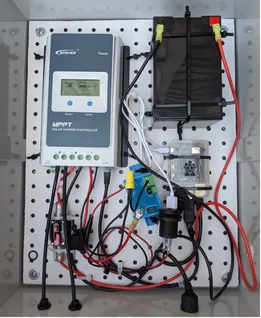
Alex Nathanson has a solar-powered server on the fire escape of his apartment in Brooklyn. He keeps that one running because it's twenty feet away and, as he puts it, he's highly motivated.
Solar Protocol, which he built with Tega Brain and Benedetta Piantella, is a website hosted on solar-powered servers distributed around the world. Whichever server is receiving the most sunlight serves you. On a clear day the load simply travels around the planet; when it rains in New York, the work moves to Toronto, or Nairobi, or wherever the weather is better.

"One of the questions we would often get is, how big do you want it?" Nathanson told me. "And it's like — we actually don't want it to be infinitely big. We want it to be appropriately big." That meant roughly a server per continent — enough distribution to produce the cascading handover as the earth turns, and no more.
"We could have a giant battery and a giant solar panel, but that wouldn't actually be technically or aesthetically different than just plugging into the grid in many ways." Each site carries just enough to run for twenty-four hours; if tomorrow is wet, the work goes elsewhere. "It's through this collaboration and aggregation, and its kind of distributed nature, that it becomes hyper-resilient — even though each individual site might be a little bit more precarious than it might be if we had a giant battery."
What he says he actually learned has less to do with energy than with people. The network expands and contracts for reasons that are, in his words, "geopolitics and roommate politics and everything in between." A site in the Kalinago Territory on Dominica ended because the island's internet was too unstable to maintain. A site in Beijing became too much maintenance given the workarounds the firewall demanded. "Sometimes the thing that gives you a problem is somebody breaks up with their partner and they move, and the apartment they move into no longer has roof access — and now there goes our solar server."
Outside this project, Nathanson works in rooms full of engineers who don't concede that humans are part of systems, or that maintenance and care are load-bearing. "The cloud — even for many people who are experts — it's not material to them," he said. "Solar Protocol is all about making it as material as it can be. To actually debug something, you have to go and look at the weather. Maybe it's not working because it's raining in that location."
Asked what a solar server teaches that a grid-powered one can't, he starts personal — he's a workaholic, not a morning person, ideally working eleven to ten. "If I'm on a solar server and it's December, I'm done with work when the sun sets." Then he zooms out: "What does it mean to make addictive products? If Instagram ran off solar with a small battery or no battery, then it means you're no longer stuck in your feed until you snap out of it, because it just stops working at some point." Energy constraint, in his account, isn't primarily an environmental intervention. It's a business-model intervention — the extractive design of consumer software is downstream of an assumption of unlimited power, and removing the assumption removes the design.
"Every device in our homes doesn't need to be smart," he said. "AI doesn't need to be in everything. It shouldn't be in everything. What would it mean if our world was designed where people were trying to do the appropriate amount, instead of maximize shareholder returns by some kind of data accumulation?"
The AI Race and the Future of Resource Intensive Computing
If the argument is that we should compute less, on machines we understand — where does AI fit?
Gartner projects global data center electricity consumption reaching 565 terawatt-hours in 2026, and says power availability is now the actual ceiling on AI capacity. AI-optimized servers alone are expected to draw 175 terawatt-hours this year, up 84% from 2025, and the IEA projects the global total nearly doubling again by 2030. More than 75 data center projects worth a combined $130 billion were blocked in the first half of 2026 by local opposition over power and water.
When asked about where the current AI debate fits into permacomputing practices, viznut responded: "It seems to me that many Permacomputing-adjacent people categorically oppose anything 'AI' (that's a politically easy choice after all), but I'm not one of those. The use of any computing technology (AI or non-AI) is justifiable if it reduces resource use elsewhere." His 2020 essay already argues that "intense non-urgent computation" like long machine learning runs should happen when there's surplus energy, or a need to convert electricity into heat — an idea he calls an information battery: spend surplus energy now on computationally demanding results, bank them for when energy is scarce.
He is clear that, by classical definitions, most high-level compilers count as AI, since they run complex problem-solving heuristics. Model size varies by orders of magnitude — some tasks need only tens of parameters, and models that small "may even train almost instantly, with a negligible use of energy." A model that fits on a microcontroller and a model that requires a county's worth of electricity share a marketing category and nothing else.
He runs lightweight open-weight models locally, "especially in winters when my room needs heating anyway," and rejects the purity argument: "Running a model created by a big and sinister company is no different from using a scavenged CPU from a big and sinister company. The harm is already done, and often it's even stupid to redo something resource-intensive from scratch because of some ideological purity."
Stella Biderman, who runs EleutherAI — the open-source lab built specifically to keep frontier-scale AI research out of the hands of a few companies — doesn't defend the scale her own industry has reached. Asked what the technology has actually delivered — better photo search, better OCR, better translation — she said: "Do these kinds of advances... justify a $5 trillion investment in the field? Probably not. I don't think that the long-term steady state is at the scale that it currently is."
When it comes to AI, though, viznut points to an adjacent problem — one Stella has approached from another angle in her own public push against the privatization of AI research and its concentration among a handful of well-funded labs. For viznut, the issue isn't energy but dependency. He cites two examples: a multilingual community with no shared language that has come to rely on machine translation, and a community that depends on custom software but no longer has anyone who can program without AI assistance. These dependencies, he argues, can set off the same feedback loop already visible in hardware upgrades and black-boxed technology — making intensive computing the default condition for society to function, rather than a choice.
Whatever shape that reckoning takes, viznut doesn't think the incentives will resolve on their own. The same corporations racing to make AI indispensable have little reason to make it legible — a black box is easier to sell, and harder to walk away from, than a tool you understand. As he puts it, bluntly: "Intelligent and knowledgeable users are bad for business."
Across this pluriverse of permacomputing communities — cyberdecks, demoscene machines, self-hosted stacks, small stubborn programs that ask nothing of the cloud — the building continues. None of them promises a definitive solution. Their importance lies elsewhere: in proving that an alternative is possible at all.
I want to be among the builders of a better world." viznut writes on his website, “to replace the one that is currently falling apart."

About the author
Lindsey Brock Morales
Lindsey is the Founder and Editor-in-Chief of The Parlor. After over a decade in humanitarian aid and community organizing, she founded The Parlor in 2025 to build a publication rooted in the belief that the people most affected by power are the most qualified to describe it. She is based between Washington, D.C. and Bologna, Italy.
Conversation
A space for Parlor members. Be generous, be real.
Loading…