
My desk faces the Atlantic. Not directly. There is a wall, a stretch of dry grass behind it, then the road to Quarteira town centre, then the beach. But the air arrives unfiltered, and on the days when the wind comes off the water I can taste salt on my upper lip while I write. It is May. The orange tree outside the kitchen has fruit on it.
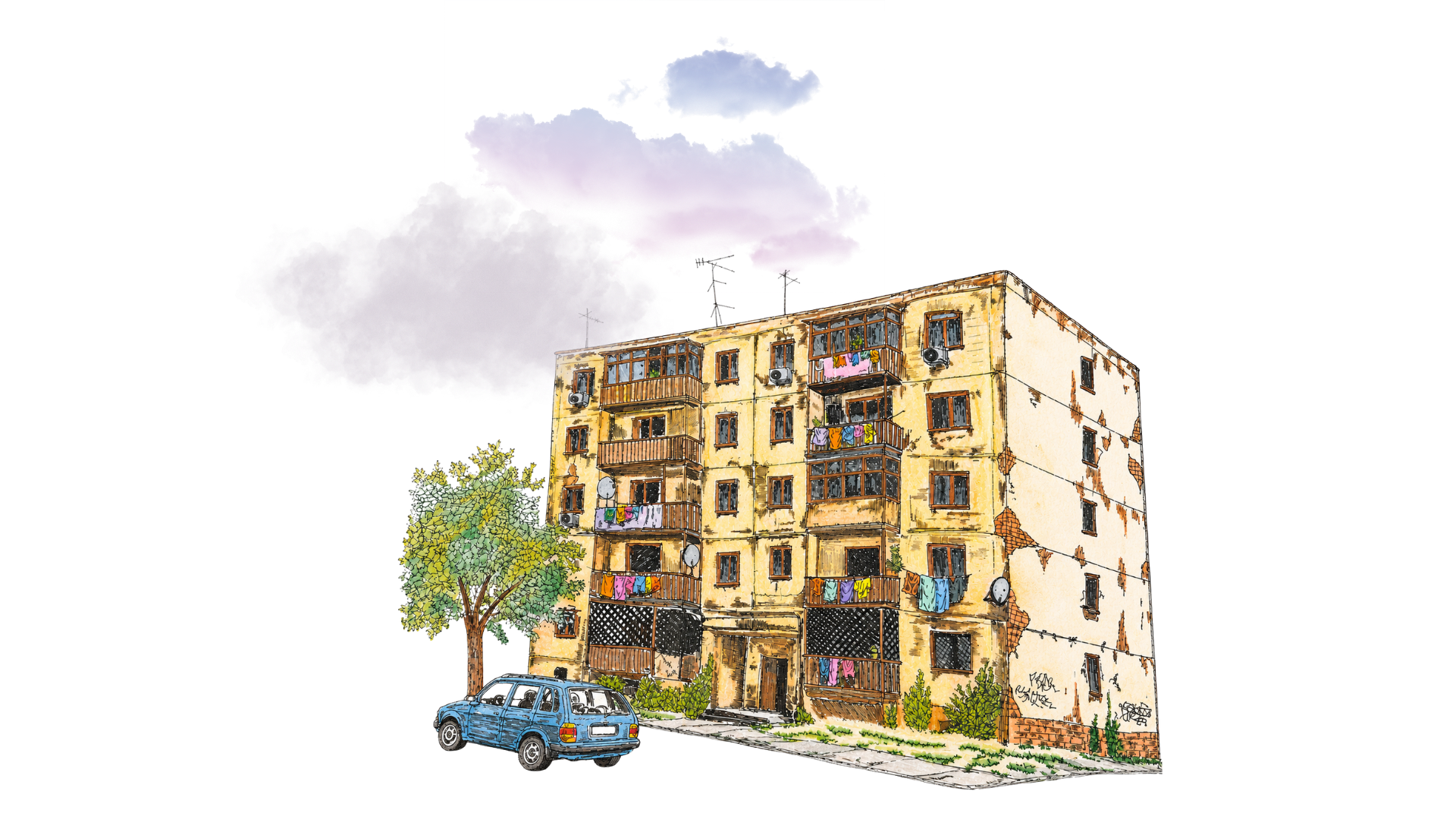
I am trying to write down something nobody recorded. The world keeps inventories of what it can count. Square meters. Registered residents. Utility connections. Tax filings. By every metric the world uses to assess a community, Berceni in the 1990s was a deficit. An unregulated peripheral settlement in the south of Bucharest. Three kilometers of identical grey concrete blocks built by Ceaușescu's regime to house factory workers who had been pulled off their grandparents' farms and dropped into a city they did not understand. After 1989 the factories closed. The workers stayed. But by every measurable indicator they were producing nothing. But the world cannot count what Berceni actually produced because it does not have the measurement tools. What Berceni produced was a social technology. A horizontal civilization built from necessity, running on honor, maintained by obligation, defended by collective intelligence.
The kind of infrastructure that only exists when the official infrastructure has completely failed and the people inside the failure decide, without ideology or design, to build something that works.
I am going to write the inventory the state never kept. Not the square meters. The technology. The system. The invisible ledger of a civilization the global order classified as garbage, and that, in response, built a more functional social system than the global order ever provided.
I grew up inside this civilization. I left it. I am writing its history before the last people who remember it die, because Tanti Nuța is already dead and her bowl economy died with her, and nobody has written the obituary.
In January 1996 the heating failed for the third time that winter. The municipal pipes had rusted
through somewhere under Strada Constantin Rădulescu-Motru. The Regia de Termoficare phone rang in an empty office. Official complaints disappeared into a void that did not even have the decency to send back a rejection letter.
The building did not file a report. The building knocked on the water pipe in the basement with a stone.
Three sharp taps: electrical short. Continuous rattle: burst water main. Single heavy thud: elevator cable jam. Within ten minutes you would hear the heavy dragging stomp of Nea Nelu's work boots on the stairs.
He was a man of about sixty, though he might have been forty-five worn hard or seventy worn lightly. Blue jumpsuit. Always. industrial oil had settled under each thumbnail in a way that no amount of soap would remove. He carried a rusted adjustable wrench he had taken home from the IMGB plant the week before they sold the plant for scrap in 1993, after twenty-five years on a lathe there. He had no telephone. He had no blueprints. He had memorized the building's infrastructure the way a cardiologist memorizes the vascular system. When a valve burst on the fourth floor he would walk down to the basement, find the right shut-off without looking at it, walk back up, replace the gasket with a strip of inner tube cut from an old Dacia tire, and walk away without speaking.
No money changed hands. Currency was too volatile. The leu had collapsed twice that decade and was about to collapse a third time. Payment ran on an exact choreography of mutual utility. My mother could sew, which meant she altered Nea Nelu's wife's winter coats every November. My father had a strong back, which meant he helped haul potato sacks from the market truck on Sundays. The arithmetic was never written down because writing it down would have ruined it.
It was an economy of debts that were never meant to be settled, only maintained. The moment a debt was paid in cash, the relationship was dead. The ongoing, unresolved exchange was what held the walls up.
Nea Nelu died of a stroke ten years ago. In the same kitchen where Nea Stan once held court, under the same forty-watt bulb. The building has a maintenance contract now with a company from Cluj that charges by the hour and sends workers who do not know the pipeline telegraphy and do not need to, because the pipes have been replaced and the residents are new and nobody knocks on anything anymore.
The Bowl Economy
The civilization moved on a faded blue plastic Tupperware bowl. There were dozens of them in the building. Mine carried a mismatched porcelain plate on top to keep the steam in. The plate had a small chip on the rim that I could find by touch.
These bowls moved between families. The movement was not charity. Charity acknowledges the hierarchy between the giver and the receiver. It requires the receiver to bow their head, and the bowing of the head is the actual cost of the meal. The bowl economy of Berceni was built on a specific refusal of that hierarchy. Tanti Nuța did not offer food. She appeared at the threshold with a pot of ciorbă de perișoare and announced with an irritated sigh, as though my mother had been making her late for something: “...Ia de aici că mi-a rămas și mi se acrește în frigider, n-am ce face cu ea.” (Take this. I have leftovers and they're going to sour in the fridge, I have nothing else to do with them.)
You accepted the bowl without bowing your head. The fiction of the surplus protected the dignity of the recipient. You were not receiving charity. You were doing her a favor by preventing waste. That was the contract.
You never returned the bowl empty. Even if it took three weeks. Even if all you had was three apples from a sister-in-law's village and a handful of walnuts wrapped in a piece of newspaper. To return the bowl empty was an admission of permanent poverty. It was an exit from the civilization, a declaration that you could no longer maintain the exchange. To return it with something inside, no matter how small, was an assertion of continued membership.
The bowl was not a vessel for food. It was a token of social currency, and Tanti Nuța was the central node through which the currency moved. She had four children of her own and an uncanny, almost predatory sense for who in the building had nothing in their pot that night. She could read a kitchen by the smell from the landing.
The world has a word for what Tanti Nuța did. It calls it informal welfare, or community food sharing, or social capital. It writes papers about it at universities in Vienna and Boston. It does not understand that what it is describing is an economy with its own currency, its own contract law, and its own enforcement mechanism, and that the enforcement mechanism was not punishment but shame, which is more effective than any court that has ever existed.
Tanti Nuța is dead. I do not know who has her bowl. I suspect it was thrown away in 2009 when her apartment was cleared and sold. The new resident, an investment consultant from a town near Timișoara, would not have known what the bowl was. To him it was a piece of old plastic from somebody's kitchen.
The Perimeter
The grandmothers sat on the broken wooden benches outside the block entrance from dawn until dark. Dark cardigans even in August. Static posture. They were not waiting for anything. They were the perimeter.
They knew every footstep in the building. They knew whose son had not come home the night before, whose daughter had been crying on the third-floor landing, who was sleeping with whom in apartment 84. They were not gossips. They were a radar system, and gossip was the data layer they used to keep track of the field they were monitoring. A subtle shift, the entrance of an outsider in the alleyway, a debt collector or a truant officer or a man from another sector with the wrong kind of jacket, produced a single vocalization. A name called across the courtyard at the wrong volume. Every adult in the building knew what it meant.
When the white Dacia police van turned into the parking area in front of the block, the fifteen-year- olds dropped their football. They drifted to the center of the asphalt with their hardened jaws and their oversized tracksuits and they blocked the lane with their bodies. They created five minutes of chaotic theater. Insults thrown loud enough to be heard from the cab. Deliberate aggression, just below the threshold of arrest. This was not for themselves. It was for the eight-year-olds who needed those five minutes to scatter into the basement crawls and the spaces behind the heating substations on the back side of the block, where the police never bothered to look.
Nobody organized it. Nobody trained for it. The grandmothers provided the intelligence. The teenagers provided the delay. The children were the protected resource.
Everyone knew their role because they had been watching the system run since they were old enough to walk.
Nea Stan held court on a plastic beer crate beside the transformer box. Retired engineer. Lived in the block since the concrete was poured. He had no title. He had no authority the state would recognize. When two families had a dispute, a leaking pipe, a stolen tool, a contested boundary at the storage cage in the basement, they did not go to the police. To involve the state was communal treason. They stood before Nea Stan at twilight.
He smoked his cigarettes down to the yellow stain on his fingers and listened without interrupting. He did not cite laws. He cited lineage and historical debt:
“...Voi uitați că bunicul tău i-a ținut spatele lui când s-a dărâmat uzina? Să-i repari tavanul până sâmbătă și să nu mai aud un cuvânt.” (You forget that your grandfather had his back when the factory collapsed? Fix his ceiling by Saturday and let me not hear another word about it.)
His verdicts were enforced by the building's social infrastructure. Defy him and your water stopped working. Your trash was not collected. Your children lost the protection of the perimeter. His archive was entirely oral. He held the memory of every family's historical obligations going back to 1982. When he died, that archive died with him.
There is no equivalent document anywhere in the legal system of Sector 4. The families whose disputes he resolved do not appear in any court record. They appear only in each other's memories, which are also dying.
The world has a word for what Nea Stan provided. It calls it dispute resolution. It calls it community mediation. It calls it informal justice. It does not understand that it is describing a legal system, complete with precedent, enforcement, and an archive, that operated without a single written document for thirty years.
The Clipboard
In November 2001 the main sewage pipe in the basement collapsed.
Black, fetid water reversed through the system into the ground-floor apartments. I was twelve. Someone's grandmother lived on the ground floor. She was eighty-one and could not walk well, and the water came up over the threshold of her kitchen at around nine in the evening. The smell reached the fourth floor within an hour.
My father called the municipal utility company at nine-thirty. The line was answered by a woman who told him the repair would be scheduled in approximately sixteen days. Category: unregulated peripheral settlement. Priority: low.
At eleven the landing cleared out without announcement.
Fourteen men descended into the flooded basement. Nea Nelu led. No protective gear. Old factory boots. Faces wrapped in rags soaked in white vinegar to block the stench, vinegar from the kitchen pantries of their wives. Two men had been gone for forty minutes earlier and returned with a section of industrial plastic piping they had stolen from a construction site three kilometers away near Piața Sudului. Another brought an old gas-powered welding kit. The women stood on the stairs in a chain passing buckets of sludge up the staircase. Hot mint tea with sugar in glass jars passed back down.
Nine hours. Waist-deep in the dark. The collapsed iron section cut away with a hacksaw, the stolen plastic fused into the building's spine, the joints sealed with a paste made of plumber's putty and a chemical agent whose origin nobody asked about. By six in the morning the water ran clear into the city drain. By seven the basement was being scrubbed with bleach and the lime was being spread across the floor.
Two weeks later the inspector arrived. The basement floor was dry. The smell was gone. The new plastic line was visible, but the inspector was not paid enough to be curious.
He looked at the line. He looked at Nea Nelu. “...A curs de la natură, șefu. S-a reparat singură.” (It flowed from nature, boss. It fixed itself.)
The inspector signed his clipboard and left.
The civilization had solved in nine hours what the official system was prepared to leave for sixteen days. It had sourced materials, organized labor, maintained a supply chain across three kilometers of the city. The cover-up afterward was so complete that the official record shows nothing happened. The world cannot see this repair because it was not authorized, not contracted, not invoiced, and not reported. It does not exist in any database. But the building is still standing. The pipe still runs. The civilization fixed itself and disappeared the evidence.
Unmarked Envelopes
When someone in the building died, the first sign was the wooden wedge in the elevator door.
A young man from the dead person's floor would jam a sanded block of wood between the outer doors and the cab frame, locking the elevator at the ground floor. The body would be carried down the stairs on a stretcher of doubled blankets, and it would not share its passage with a stranger pressing the button for the seventh floor. The elevator stayed locked for three days.
The second sign was the flag. A square of black cotton, sometimes cut from an old funeral dress, nailed to the exterior mortar above the building entrance. No name. No date. The grandmothers on the benches did not need to be told.
The third sign was the doors. Every apartment on the dead person's floor, and on the floors above and below, was left unlatched for three days. You did not knock. You walked in. You sat at the kitchen table without speaking, drank what you were given, and left. If the widow was asleep you did not wake her. If she was staring at the wall you did not interrupt the staring. The family of the dead was never alone for seventy-two hours, and was never asked to perform grief for the comfort of visitors.
The colivă was stirred in an enameled pot in the dead family's kitchen by whichever women happened to be there. Boiled wheat, walnuts, sugar. A wooden spoon, the same one the family used to stir their morning mămăligă, passed from hand to hand without instruction. By the third day perhaps forty women had stirred the pot, and the prayer was absorbed into the grain. On the porcelain plate in the entryway, visitors left unmarked white envelopes. No names. No amounts written. The widow did not open them in the presence of anyone. Whatever was inside paid for the priest and the cemetery and the seven black candles, and when the seven candles ran out the envelopes were gone. There was never a reckoning.
The dignity was in the silence. Nobody asked the widow what she needed. Everyone already knew.
The world calls this traditional mourning practices. It writes papers about it in journals of folkloric studies. What it is describing is a complete municipal funeral service, operated by the dead person's neighbors for three days, free of charge, with no application filed and no bill rendered and no body left alone in the dark.
The Knock
In September 2008 I was nineteen. I had spent the summer indoors with a stack of photocopied articles from the British Council library on Calea Dorobanți. Economic journals in English. The kind of prose I was teaching myself to write in.
My mother had cooked plum compote on a Tuesday afternoon. She gave me the faded blue plastic Tupperware bowl with four large purple plums inside, sealed in syrup. The law of the return. “...Du-le la Tanti Nuța.” (Take them to Tanti Nuța.)
I stood at the threshold of apartment 126. The landing was hot with trapped mid-day heat. From the roof vents came the sour tang of cabbage fermenting for the winter pickling.
I knocked. With my knuckles. A polite, metered rap.
A child of that landing would have knocked with the flat palm of the hand against the wood. I did not know I had stopped doing that. I only learned later, watching myself in retrospect, that I had been knocking like a tax inspector for two months.
Tanti Nuța opened the door. Apron. Stained headscarf. Fingers wet from peeling potatoes.
She looked at my hand. Not the bowl. My hand.
Under my left arm: the photocopied journals. My fingers: smooth, uncalloused, the skin white and scrubbed. The black rims under my cuticles, which had been there since I was old enough to play in the courtyard, were gone. I had spent the summer indoors mutating my syntax, training my tongue to sit lower in my mouth for the English vowels. My posture had straightened.
She took the bowl slowly. Avoiding skin contact. She adjusted her apron. She stepped back half a step, creating a distinct pocket of personal space between us where there had never been one before. “...Mulțumesc frumos, Andrei. Să-ți fie de bine. Succes la scoală.” (Thank you very much, Andrei. May it do you good. Good luck at school.)
In the horizontal civilization of Berceni, formal politeness was the language of tax inspectors, housing managers, and enemies. It was not respect. It was exclusion. It was the border control of a community that protected itself from outsiders by freezing them out with correct grammar. A child of that landing was greeted with the obscenity of the family. “...Bă, ai mâncat? Intră, ce stai în prag ca prostul?” (Hey, did you eat? Come inside, why are you standing in the doorway like an idiot? ) A stranger was greeted with Mulțumesc frumos.
She had looked at the clean hands and the English papers and the straightened posture and she had recognized something I had not yet recognized myself. I was no longer an asset in the horizontal trench. I had become a legal subject. I had become an individual. I had become the kind of person the civilization was built to defend itself against.
***
I went back last year, and what I saw then is what I am describing now.
The trees in the courtyard had grown. Someone had thrown white paint on the asphalt to mark out parking spaces. The council charges a sum equivalent to one month of the minimum wage to park a car for a year in front of the block where my parents lived. Many of the old residents are dead. The others were evicted or sold when the 2008 housing market exploded and the new buyers moved in. A new generation, with no sense of community, and no need for one. I watched two neighbors pass each other in the hallway and not speak. They have lived in the same building for five years. They were waiting for the elevator together. They looked at their phones.
No children played on the asphalt. The broken wooden benches where the grandmothers sat are gone, replaced with concrete planters that nobody can sit on for long. The landing between the second and third floors has a motion-activated light now that clicks off after thirty seconds, and nobody stands there in the dark, because nobody has anything to negotiate that requires darkness.
Tanti Nuța's apartment was sold in 2009. The new owners renovated. The Formica table is gone. The kitchen is now open-plan, white tile, an induction cooktop. I did not go inside, but a friend of my mother lives one floor below and has been inside, and that is what she described to me.
The world did not demolish Berceni with a bulldozer. It demolished it with a housing market. It did not arrive as an enemy. It arrived as an opportunity. Rising property values. New investment. Integration into the European urban economy. The residents who sold made money. The residents who stayed got parking spaces. The civilization that had held the building together for thirty years, that had fixed its own pipes and fed its own hungry and defended its own children and judged its own disputes and buried its own dead, was erased not because it failed but because it was invisible. The world bought what it could count, which was the square meters, and discarded what it could not count, which was the ledger.
The world Berceni was building was never going to be recognized by the world it was built against. It left no treaties, no manifestos, no architectural drawings. What it left was a pipeline that fixed itself in the dark and a bowl that was never returned empty and a grandmother's bench that is now a parking space costing a month's wage. The technology of survival at the bottom of the world is not preserved in any archive that I know of. I am trying to write it down before the last person who remembers the pipeline telegraphy dies in a hospital with a motion-activated light in the hallway and a neighbor who does not know their name.

About the author
Andrei Romanov
Andrei Romanov is a Romanian-born writer and independent historian based in Portugal. He is the author of Masters of the Ocean Sea (2026), winner of the London Book Festival Award for General Nonfiction, held in the Caird Library at the National Maritime Museum, Greenwich. His work appears or is forthcoming in Thin Places Literary Journal, Quibble Lit, Wordpeace, and Twisted Vine Literary Arts Journal. He is the second-place winner of the 2026 Hollowpoint Press fiction prize.
Conversation
A space for Parlor members. Be generous, be real.
Loading…