
Asterix in Adjuntas: Power, Story, Resistance
Energy Sovereignty and Communities United Against ICE in Puerto Rico
Iñaki Estivaliz
March 25, 2026
Ricardo Arduengo/Getty Images
In 50 BC, all of Gaul lay under Roman occupation—or so it seemed. One small village of unyielding Gauls continued to resist, sustained by a mysterious potion that gave them the strength to endure.
More than two thousand years later, the empires have changed, but the struggle over energy endures. Governments track oil markets instead of Roman legions, and every missile launched in the Middle East sets off a familiar scramble to predict the next surge in crude prices.
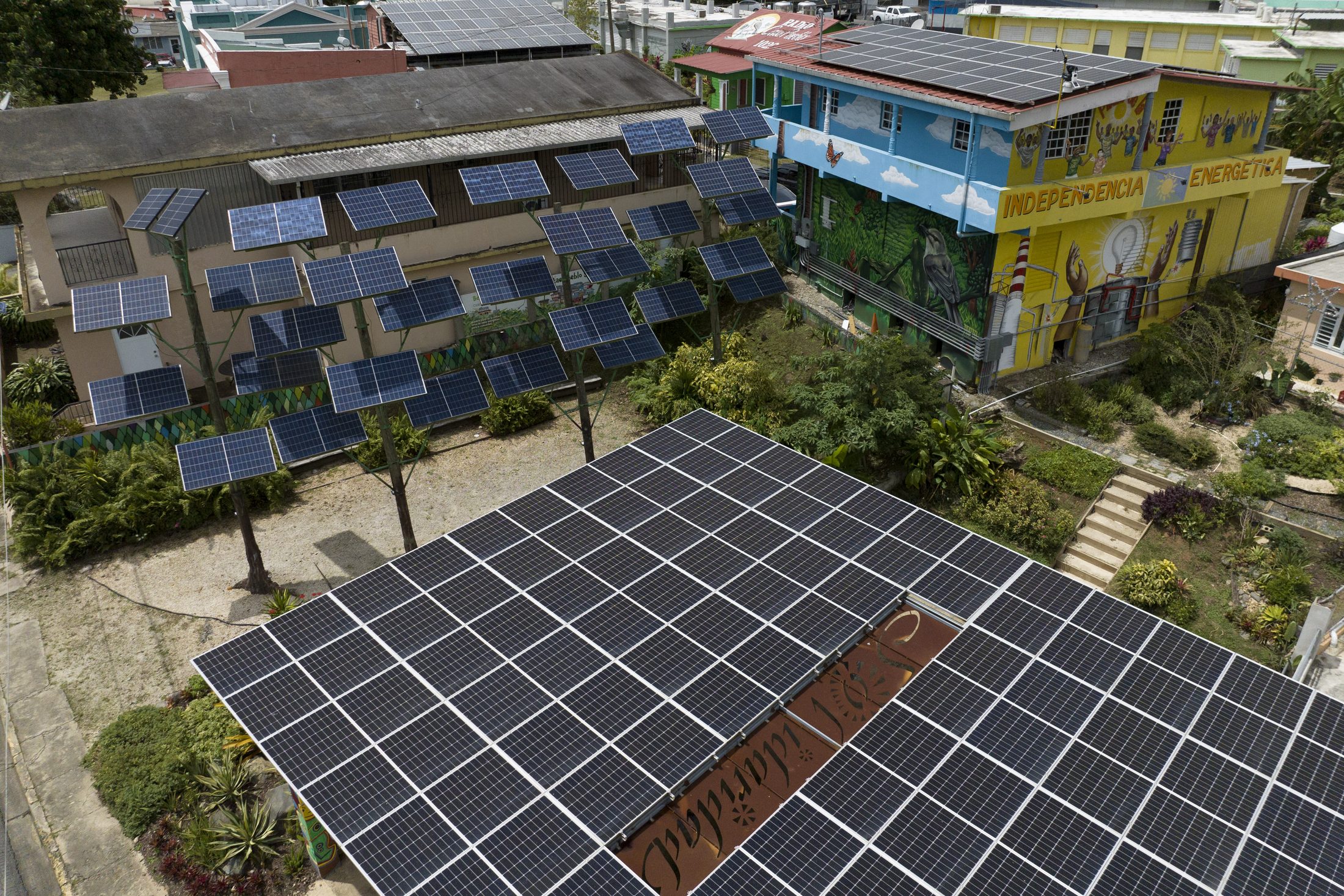
As the world studies those charts—wondering how many dollars a barrel the latest war will cost—there is a small town in the mountains of southern Puerto Rico that doesn’t need to check the news to know whether its lights will turn on tomorrow.
Like that stubborn Gallic village, Adjuntas has found its own source of strength, but this time it doesn't simmer in a druid's cauldron. It arrives every morning without fanfare, without a pipeline, without a price — just light, falling on rooftops.
Dr. Arturo–Arturix–Massol Deyá is the Caribbean Asterix. Though trained as a microbiologist, his work extends far beyond the confines of his degree. He carries himself with a quiet pride and unwavering determination, grounded in the belief that sovereignty is not something one requests—it is something one exercises.
Watching him move through Casa Pueblo—greeting neighbors and explaining solar panels with the enthusiasm of someone unveiling a shared secret—it’s easy to imagine him wearing Asterix’s winged helmet. But unlike the mythical hero, he doesn’t lead battles with swords and shields. Instead, he defends his village with sunlight captured from the Caribbean sky.
But the resistance he now leads did not begin with him.
Casa Pueblo was founded in 1980 by his parents, Alexis Massol González and the unforgettable Faustina “Tinti” Deyá Dìaz. Decades ago, when Adjuntas was threatened with the prospect of becoming an open-pit mine for precious metals, they fought to preserve the forest, and keep its ecosystem intact.
Alexis became the chief of this unlikely village of resistance. He understood something that many governments still struggle to grasp: true independence begins with energy. For that vision, he was awarded the Goldman Environmental Prize in 2002, one of the highest honors an environmentalist can receive.
When Arturo explains the achievements of Casa Pueblo—from its solar-powered movie theater to its community radio station—his enthusiasm spreads like sunlight across a plaza. It is contagious precisely because it does not come from ego. It comes from the quiet victory of a community that refuses to disappear.
The object he most enjoys showing visitors, I suspect, is the sundial that speaks Spanish. But I will not explain it here. Some things are better experienced in person.
Energy Independence as Survival
When Hurricane Maria struck Puerto Rico in 2017, it brought down the island's electrical grid almost overnight. Power lines snapped. Transmission towers collapsed. For months, Puerto Rico endured one of the longest blackouts in modern history.
The silence of machines carried real consequences. Dialysis clinics shut down. Refrigerators stopped. Respirators that depended on electricity measured life in minutes. Thousands of people died in the long shadow of that outage.
In Adjuntas, the lights never went out.
Casa Pueblo had spent years building energy independence through solar infrastructure — and when the grid failed, that decision became the difference. Neighbors began arriving with coolers and cardboard boxes carrying insulin, heart medications, antibiotics. They placed them carefully inside Casa Pueblo's solar-powered refrigerators, labeling each item with tape and handwritten names. Others came with oxygen machines and medical devices that needed power to run. They plugged into outlets powered by the Caribbean sun.
It was, in the middle of an island-wide blackout, an act of collective survival built on years of prior preparation — not emergency improvisation.
As Arturo himself puts it: "Energy independence is not a technological luxury. It is an act of survival and respect for our dignity."
Adjuntas does not wait for Washington or San Juan.
Its people understand that as long as they have their forest, their diverse community, and their sun, no Caesar—no matter where he comes from—will ever bend their spirit.
Support independent journalism
Enjoy reading The Parlor?
Become a paid subscriber to get full access, early releases, and subscriber-only extras.
Become a paid subscriberThe Other Front of Resistance: Marimix and Kilómetro 0
In this village-oasis of critical thought, I met Marimix—Mari Mari Narváez. As the executive director of Kilómetro 0, she has dedicated her career to documenting state violence and advancing police accountability in Puerto Rico.
Kilómetro 0 is a human-rights observatory. It tracks police use of force, analyzes data to identify patterns of misconduct, and provides support to victims of state violence. Where official reports often go uncontested, the organization works to surface independent documentation and build an evidentiary record of what actually happened.
That work has helped place police reform on the public agenda — grounding the conversation in data and centering the principle that community safety must be built on equity and respect, not on the criminalization of poverty or dissent.
Kilómetro 0 also invests heavily in civic education. The organization publishes practical guides on how to interact with law enforcement, what rights you hold, and how to document abuses safely. Their presence in Adjuntas for the recent workshop reflected that commitment directly.
Casa Pueblo's model of energy autonomy and Kilómetro 0's work on police accountability share a common thread: both are building the conditions for communities to govern their own lives. The freedom to generate your own energy and the freedom to move through your street without fear are, in that sense, the same struggle.
Storytelling as a First Line of Defense
Two weeks ago, this mountain village of Adjuntas hosted a gathering of community leaders, organizers, and journalists committed to building narratives of justice around migration.
Migrant Roots and Kilómetro 0 convened what was officially described as a "training of trainers" — in practice, a communications workshop teaching community leaders how to use journalistic tools to tell their own stories on migration.
The composition of the room was itself significant. Roughly eighty-five percent of participants were women. The group brought together young LGBTQ+ Latino activists with deep fluency in digital storytelling alongside longtime community matriarchs from Puerto Rico and Latin America — organizers who have been doing this work for decades.
Firuzeh Shokooh Valle, a social scientist and veteran journalist, led sessions on interviewing techniques, walked participants through ethical dilemmas from her own career, and examined how the language of power works to erase migrant identities. A peacock on the property took a particular interest in her sessions, appearing at the window each time she taught and occasionally interrupting with its own commentary.
Roxana Bendezú, founder of Migrant Roots Media and a key architect of the project, framed the retreat as an effort to equip migrant communities with the tools to tell their own stories—on their own terms, and in response to systems that seek to silence or distort them.
Luis Trelles guided participants through audio storytelling and narrative construction. Mariana Surillo focused on strategic communication — how to build a pitch, how to craft a message that travels.
The central challenge the workshop addressed was concrete: how do you build an effective narrative when Latino communities are under intensified political pressure and information about immigration is increasingly controlled and distorted?
The workshop's answer took shape through the group itself. Participants exchanged strategies, tested messages against each other's realities, and built a shared framework out of their
The gathering took place at the Villas of Sotomayor in Adjuntas — a cluster of cabins surrounded by Caribbean vegetation so dense it seems ready to swallow the asphalt. Participants stayed there throughout the workshop, and the setting shaped the tone. The coquí provided the soundtrack for late-night conversations about human rights, food sovereignty, and the politics of language.
Sleeping in the mountains of Adjuntas, on the slopes of the Bosque del Pueblo, is to feel the coolness of elevation and the quiet of a forest that exists because a community once decided trees were worth more than gold. In that landscape, alliances were formed that are only now beginning to take shape.
Each evening, the workshop closed the same way — after full days of sessions on narrative strategy, interviewing, and the politics of migration, participants gathered for karaoke.
Because like every good Gallic story, the seriousness of the daily battle against injustice required a release. An aquelarre, you might say.
About the author
Iñaki Estivaliz
Iñaki Estívaliz is an independent journalist with 25 years of experience publishing in both major and alternative media across several continents, focusing on stories of human interest. He lived in Puerto Rico for 17 years, writing for a wide range of media outlets on the island. His reporting has taken him to border regions in Panama and Colombia, El Paso and Ciudad Juárez, Standing Rock, and Iceland, as well as to elections and conflicts in Venezuela, Bolivia, and Mexico. Over the past year and a half, he has reported from Libya, Syria, and Palestine.
Conversation
A space for Parlor members. Be generous, be real.
Loading…