
Growing Something That Lasts
Inside the EarthGang Foundation with Dr. Jazz

Lindsey Brock Morales
August 16, 2026
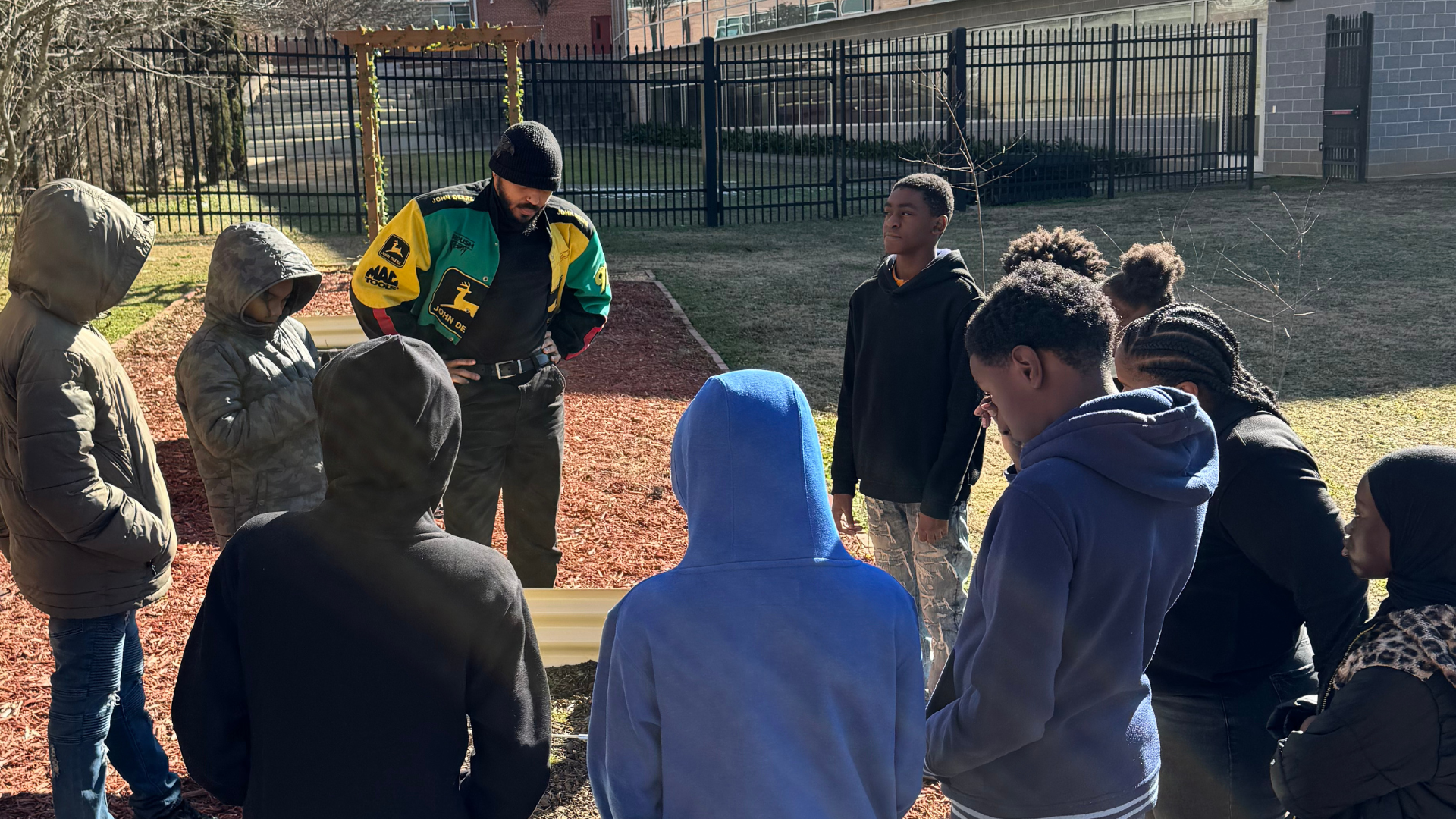
The Earthgang Foundation inaugurates one of it's community garden in a local middle school. Image provided by Dr. Jazz.
In 2023, the Atlanta hip-hop duo EarthGang was granted land in the city for a community garden. What could have stayed a one-off gesture became something more deliberate: the group wanted to build a foundation around it, with growing food, health, and wellness serving as one pillar and environmental justice as the other. The EarthGang Foundation was formally established that March.
The name embodies the mission. As executive director Dr. Jazmine Alexander explains it, the group's core belief is that "we are all earthlings" who need to figure out how to live together, regardless of who you are. That idea has now transformed into three community gardens, a mentorship platform for teenage girls, and a growing list of partnerships across the country.
The Music and The Mission
The foundation and the artists operate on parallel tracks. EarthGang isn't involved in day-to-day operations. The foundation is headed by Dr. Jazz —as she's known by community members — who holds a PhD in environmental science from Florida A&M and came to the role already steeped in food security and environmental work. But the duo shows up where it counts: attending events, making introductions, and lending their platform to causes they care about personally. "This is something that they're passionate about as well," Dr. Jazz said. "They love the environment." EarthGang also serves as ambassadors for Oceanic Global, the organization behind the UN's World Oceans Day — another cause the group backs with its name, separate from the foundation's own relationship with UN Live.
EarthGang's fan base gives the foundation a reach and credibility a brand-new nonprofit wouldn't otherwise have — Dr. Jazz describes it as "a cult-like following" that has translated directly into donations, engagement, and turnout at the foundation's activations around the country. One of the clearest examples of the music and the mission converging: a project with Sounds Right and UN Live for New York Climate Week, built around an original track credited to "Mother Nature," an artist the UN created out of recorded natural sound. Streaming and purchase proceeds from the track flow directly back into the foundation's environmental programs.
Three Gardens, One West Side
The foundation's core program is its gardens. The newest commitments bring the total to three: two at schools, one at an apartment complex. They're all located on Atlanta's west side, an area that Dr. Jazz describes candidly as a food desert. The land for the two newest sites was donated by a separate organization, the Growth Park Foundation, which asked EarthGang Foundation to step in and manage them. Both gardens were already planted by the time the foundation got involved; the work now is curriculum and ongoing care rather than building from the ground up. One of the two is at a K–8 school, which Dr. Jazz was especially glad about because most of the foundation's work so far has been geared towards middle schoolers. The K–8 site lets them get in front of much younger kids. The gardens come with curriculum, currently built out for sixth through eighth grade, with K–5 and 9–12 versions in development.
For Dr. Jazz, the stakes are personal. She traces the urgency back to the first middle school garden, working with kids she describes as looking like her — Black kids — and running into how disconnected they were from where their food actually comes from. "It really breaks your heart," she said. "We've gotten away from that in society, in western society," she said. "It's almost foreign." The gardens are meant to interrupt that disconnect early, to make it ordinary for a child to know that a strawberry comes out of the ground before it comes out of a package.
Building in a Hostile Climate
Not everything the foundation touches has been easy to build, or safe to talk about. A climate-change reporting portal developed with Microsoft which allowed users to upload photos and video of environmental changes they observe around them hit a wall of legal review before its planned relaunch. "A lot of it felt like bureaucracy," Dr. Jazz said, describing the difficulty of getting permissions to track exact geographic location data. She brought in lawyers to make sure the portal was legally protected. "Nobody can take it from us," as she said. The foundation is now working with a new designer on the platform itself, with a relaunch planned for January.
Dr. Jazz is also careful about how loudly the foundation talks about climate change itself. "I also was told that you shouldn't be too loud about it, because the Trump administration is taking foundations' 501(c)(3) [status] for focusing on issues like that," she said. It's not an unfounded fear — environmental nonprofits nationally have spent much of the past year bracing for exactly this, after reports that the administration considered redefining IRS rules to exclude conservation and climate groups from tax-exempt status, and some groups have already scrubbed language like "climate resilience" from their own sites preemptively. So the foundation's public messaging leans on adjacent framing instead: "I definitely focus it around like human issues, health issues, really just for security," she said, rather than climate language on its own.
Support independent journalism
Enjoy reading The Parlor?
Become a paid subscriber to get full access, early releases, and subscriber-only extras.
Become a paid subscriberThat caution sits alongside real momentum. 2026 was the foundation's biggest fundraising year yet — "backed by grants," she said — even as federal support for environmental and climate work has been gutted at the source: the administration's FY2026 budget proposed cutting EPA funding by more than half and stripped roughly $1.3 billion from NOAA, eliminating the bulk of its climate research. ("Who's gonna tell us the weather?" Dr. Jazz asked, only half joking, when the subject of NOAA came up.) It's not impossible to fundraise in that environment, she said, "but it's definitely become a lot more difficult, and we've been getting a lot more creative in terms of fundraising as well" — leaning less on large federal grants and more on the kind of grassroots and philanthropic funding the foundation has built up on its own.
The foundation's newest initiative, Green Girls Rising, a mentorship platform connecting girls aged 13 to 18 with mentors and internship opportunities in environmental science, launches with an inaugural event on November 7 — the same day the platform itself goes live. Dr. Jazz also sits on the City of Atlanta mayor's office advisory board for sustainability and resiliency, co-chairing its net-zero committee, and is leading public education for a new city campaign, ATL Net Zero Connects, launching in August and running through December.
What Comes Next
The foundation's partnerships have expanded well beyond Atlanta's city limits — activations at Afro Tech Climate Week, LA Climate Week, and UCLA, alongside coalition work with organizations including Brown Girl Green, Green Jobs Board, and Black Girl Environmentalist. Expanding the foundation's hands-on, on-the-ground presence to other cities is next on Dr. Jazz's list, with New York at the top of it. "Not necessarily in other states, like on the ground," she said, is something she'd love to build out — "we've definitely been more hands-on" in Atlanta so far, "but that's something that I hope to grow into."
Atlanta itself remains the model she points back to. She credits the city's leadership with pushing sustainability forward even as federal support for that work disappears: "Atlanta is really showing that it's possible, and the people want it. The people can have it," She said. It's a line that doubles as a mission statement for the foundation itself — proof, in her eyes, that this work is buildable city by city, regardless of what's happening in Washington.
About the author
Lindsey Brock Morales
Lindsey is the Founder and Editor-in-Chief of The Parlor. After over a decade in humanitarian aid and community organizing, she founded The Parlor in 2025 to build a publication rooted in the belief that the people most affected by power are the most qualified to describe it. She is based between Washington, D.C. and Bologna, Italy.
Conversation
A space for Parlor members. Be generous, be real.
Loading…