
Not a Patient Woman
Yuliya Klochan's Beaded Art for Social Justice and Inclusivity
Elisa Shoenberger
August 16, 2026
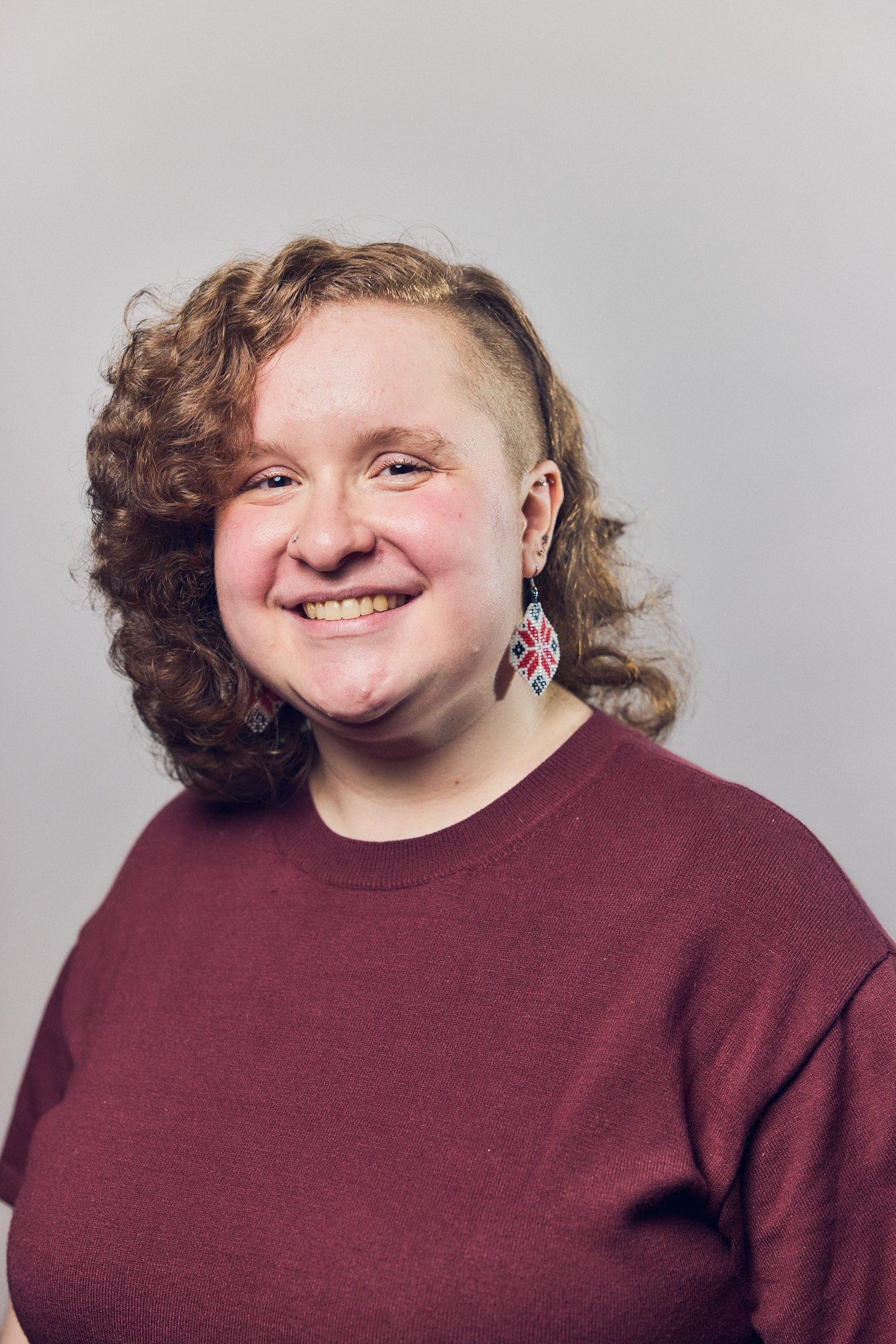
When I first saw Yuliya Klochan’s beaded work, I was astonished. I love beadwork, but I had never quite seen anything like her work before. Ukrainian-born Chicago based artist Klochan creates evocative narrative pieces using beads as her medium.
While working as a communications manager in 2023, Klochan began beading because she wanted a hobby. She decided to choose beading because it had a connection to her Ukrainian culture. Klochan explained that there was a Ukrainian beading tradition called gerdany (also spelled herdany in some sources) that are loom woven necklaces. Website Korali further explained that the practice goes back to the 19th century and “served more than a decorative purpose—they were imbued with sacred meaning.”
However, when Klochan started learning and making beaded pieces, she realized that she had done it as a child, but had forgotten. “Old memories started appearing and I kept making stuff,” she said. “Whenever I display my beading, I will have people coming over saying that there is similar tradition in their cultures… and I just think that's really cool that it kind of developed independently.”
From Journalist to Full-Time Artist
Klochan began making so much work that she could not store everything so she began selling her work at local artisan stores. In addition to jewelry, she began making the artworks bigger and bigger, which gave her more “canvas” to make her characteristic narrative pieces.
She decided to take her beading career full-time. “Because of health reasons, I wasn't really able to maintain the same output at work,” Klochan said, “I just thought I would take the plunge into art and dedicate more to it.” She’s been exhibiting her work in more shows and markets and has found a steady stream of work. “It’s been an amazing transition.”
While Klochan now works as a full-time artist, she has found translatable skills from her prior career as a journalist and multi-media writer. “I still use a lot of my writer's brain for my pieces. I try to tell a story with each one and convey a specific message,” she said. Plus her writing skills have proved useful for filling out applications for exhibitions and markets. She sold her work at stores and markets starting in 2024 and began exhibiting in galleries in 2025.
When asked about the importance of art, Klochan explained that she believes “art has a really important role to play in social justice.” She sees herself as a storyteller and uses beading to tell the stories that she finds valuable. Much of her work explores issues of body positivity, women’s rights with a focus on reproductive rights, queer joy, and other issues of social justice and inclusivity.
Not a Patient Woman
Klochan had her first solo show “Not a Patient Woman” through NEW Gallery at its Lincoln Park-based location Art City, from July 10th to August 8th. It’s “sort of a nice mix of a journey through all the ways in which people involved in social justice movements get to express themselves and have both issues to think about and joy to have,” Klochan says. As the gallery describes it, Not a Patient Woman "urgently presents viewers with stories of social justice and amplifies marginalized voices." Defiant and bold, the figures in Klochan's work represent the diverse experience of "other," eliciting joy while also portraying visceral pain.
The show also thoughtfully plays with the meaning of being patient, a nod to Klochan's identity as a disabled person. She spent years striving to be a "good patient," but has since shed that goal — choosing instead to empower herself to feel, be, and exist as she truly is.
She highlighted several pieces in the show. Her piece “Joy” (5” x 9”, 2026) starts the show. It depicts five women with larger bodies dancing. “That was really important for me to make because whenever I try to find reference images for personal plus size, fat, whatever word that I input, a lot of the images don't feature a face and are in some sort of exercise or food context,” she said. It was critical for her to show women with larger bodies who are having fun and dancing.
Another joyful piece is “Sirens in Love,” (9.5" x 5", 2026) which is one of her bigger pieces. It depicts a Black mermaid (or siren) embracing a large bodied white mermaid/siren. It’s such a beautiful depiction of love between two women.
Support independent journalism
Enjoy reading The Parlor?
Become a paid subscriber to get full access, early releases, and subscriber-only extras.
Become a paid subscriberIn many of Klochan’s works, she uses “different bead finishes to convey contrasts.” For instance, “No More” (6.5” x 4.5”, 2026) uses beads to describe the differences in women’s roles over the years. There’s a woman in a kitchen who is sort of split into two sides. One side has monochromatic matte beads, representing her limitations on options in decades past; the other side uses bright colors showing the woman with blue hair with a protest sign in pink gloved-hand, signalling how things have changed and what she wants to change.
The piece “Protected” (7" x 5", 2026) also makes use of the differences in shine of the pieces. The artwork depicts a knight who is holding an IUD in one hand, almost like a torch, and on the other hand, she’s got a blister pack of birth control pills. Klochan created the knight with metallic beads as well as black beads that have an amethyst tint to them, which helps make them stand out.
In addition to her narrative pieces, Klochan also likes to take famous paintings or images and reimagine them in feminist, body, and queer positive ways. For instance, “Venus” (5.5” x 8.5”, 2026) is a recreation of Sandro Botticelli’s “The Birth of Venus.” Instead of a naked white Venus in the half-shell, she’s got a large bodied woman of color clothed in an orangish-yellow dress. She said in an artistic statement, “Today's Venus embodies the ocean's vastness and beauty.”
Klochan is very intentional about the materials she uses. She has worked with a variety of looms, but as her work has gotten bigger, she’s needed bigger and bigger looms. She uses a Mirrix 12” Little Guy Loom because she can make bigger pieces, and it’s vertical which makes beading less physically demanding. She also noted on the Mirrix Loom blog, “the sturdy structure has prevented disasters, even with cats.” (Full disclosure: She’s also become an Ambassador of Mirrix).
In her works, she uses Toho Aiko beads, which she finds to be the most consistent beads she’s found. But the beads also have an important story behind them. After the devastation of the atomic bomb in Hiroshima, founder Yamanaka Ichiji decided the world needed color again. He spent 8 years creating his first beads, all the while his wife Aiko supported him. After the first batch, he designed the perfectly cylinder bead that he named in his wife’s honor, acknowledging his wife’s support. It’s making that invisible labor of supporting her husband visible.
Finding Community in Chicago
Chicago has played a big role in her development as an artist. She cited that it has an amazing community of artists and lots of galleries. She appreciated that many galleries have open calls for artists, “which allowed me to enter without barriers, without having to network.” She has found the Chicago art scene to be supportive and not competitive. Klochan noted that more experienced artists than herself are “all just really excited to help. They're excited to tell you about an exhibit or market they went to. They want to invite you to that so they can share the space, and I just found that so lovely.”
Plus people really love Chicago. Her most popular piece is a beaded version of the CTA map. “You can tell people really care about the city,” she said.
Besides learning about the welcoming Chicago art community, beading has had other unexpected consequences; she’s better at estimating quantities since she has to be so careful and keep track of tiny beads. Her pieces can have over 10,000 beads; “Sirens in Love” has 12,150 beads in it!
But it also helped train her “creative brain.” She said, “I find the process so relaxing and meditative, where I really look forward to it…whenever I get to do it.” She’s grateful to be part of the Chicago art community, which has welcomed her with open arms. “It’s not something I have or will ever take for granted,” she concluded. “It's a dream come true to be able to do something like this.”
About the author
Elisa Shoenberger
Elisa Shoenberger is a freelance writer and journalist in Chicago. She also has written for the Boston Globe, Huffington Post, WIRED Magazine, Slate, and others. She writes regularly for Book Riot, Murder & Mayhem, Library Journal, and Cheese Professor. She’s obsessed with dogsledding, murder mysteries, and cheese.
Conversation
A space for Parlor members. Be generous, be real.
Loading…