
Mama Jay: Feeding Beirut's Forgotten
A trans woman who survived civil war, occupation, and a lifetime of violence is still standing at the stove, and feeding the masses.

Iñaki Estivaliz
June 7, 2026
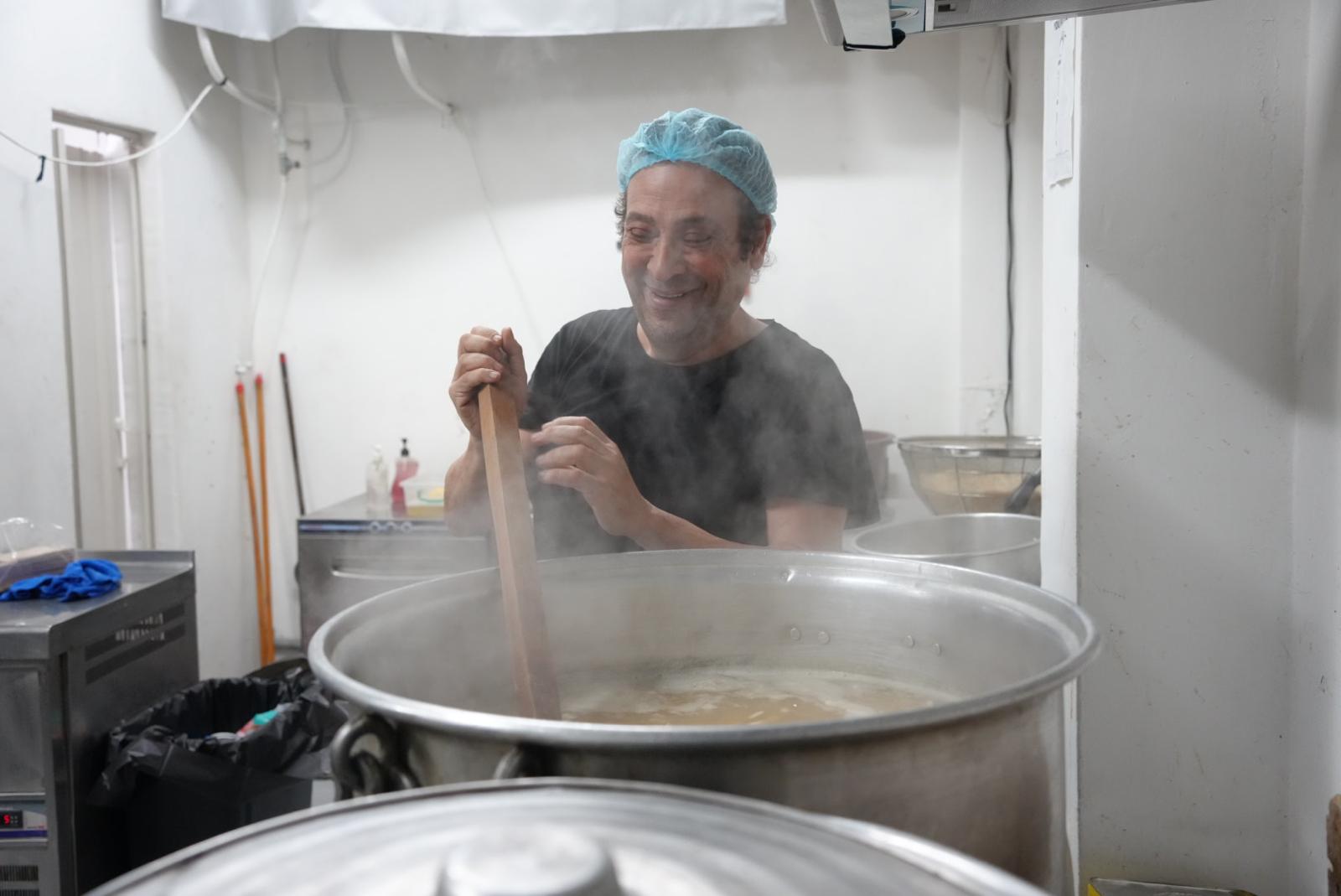
Mama Jay stirs a pot of stew. | All Photos: Nelson Scandela
“It was very difficult; it was never easy. They beat me, they locked me up, I suffered enormous harassment. I was imprisoned for three months and ten days somewhere I still don’t know. I suffered abuse from my family and from society because they did not accept me. Once they tied me to a tree for three days. I slept on the streets, ate from the garbage, drank rusty water, drank my own urine… It was never easy.”
Mama Jay is a transgender woman in her seventies who embodies the living chronicle of a city seemingly condemned to destroy and rebuild itself endlessly upon its own rubble. She cooks beneath the buzzing of drones over Beirut and does not step away from the stoves even during the low flights of Israeli supersonic fighter jets that shatter windows, nor when bombs rain down. On April 8 alone, one hundred bombs fell on the Lebanese capital in ten minutes, and that day this woman still cooked for dozens of people.
When the latest and ongoing Israeli invasion of southern Lebanon began on March 2, Mama Jay immediately started cooking for displaced people and the most vulnerable communities in Beirut, leading the community kitchen at Nation Station in the Christian neighborhood of Ashrafieh. She already had experience running other community kitchens in different districts of the city, always focused on caring especially for the LGBTQ+ community.
More than one hundred people arrive every day at the doors of this emergency kitchen against hunger. Entire families come carrying only what they managed to flee with, young people displaced from conflict zones, and the eternal outcasts of Beirut’s night streets. All of them extend their hands to receive the same plastic container filled with hot stew and rice prepared by a trans woman whom, under other circumstances, many of them would rather not even look in the eye.
In a country devoured by foreign wars, economic collapse, political assassinations, and chronic governmental corruption, some people struggle enormously just to eat. Mama Jay does not have it much easier when it comes to providing food. Of the forty thousand dollars they hoped to raise in order to launch and sustain the project in the short and medium term, they have managed to collect only five thousand. Yet the fire at Nation Station does not go out. On the day Claridad of Puerto Rico visited the community kitchen, Mama Jay was happy because after the interview with the Puerto Rican newspaper she was expecting the arrival of a group of potential donors.
Asphalt Safe Passages and the Whistle of Burj El Murr
To understand the natural authority with which Mama Jay manages Beirut’s contemporary panic, one must go back four decades, to the bloodiest years of the Lebanese Civil War. In that map fragmented by sectarian militias, where the Green Line divided the capital into two irreconcilable halves and crossing the wrong street could mean summary execution, trans women invented a form of clandestine diplomacy rooted purely in survival.
The trans community of that era was instrumentalized by the various factions because of its marginal status. Military tribunal authorities and roadblock commanders called upon them whenever they needed someone who could move between divided zones without raising the strictly military suspicions directed at young men.
Mama Jay and her companions thus became improvised human couriers, carrying bags full of traditional food, freshly baked bread, and bottles of soda for fighters entrenched in the front lines. When their silhouettes appeared, the militiamen would shout for a ceasefire, creating an almost surreal parenthesis in the middle of the slaughter: snipers and soldiers would lower their weapons for ten minutes to eat breakfast and speak with those same people whom society rejected but war used as release valves.
That gender ambiguity functioned as a fragile shield in a city without laws. The same men holding rifles sought Mama Jay’s company in the secrecy of guard posts.
There is nothing romantic about it. In the upper floors of Burj El Murr, a gigantic concrete structure dominating Beirut’s skyline that had become the city’s most feared sniper tower, Mama Jay encountered the darkest side of that relationship.
One sniper invited her to climb to the upper levels of a surveillance post, filled with unfinished rooms and a carpet of spent shell casings covering the floor.
With his telescopic sight aimed toward the avenues below, the militiaman told her to crouch so enemy snipers would not hit her. He never stopped firing the entire time. Not when he told her to pull down his pants, not when he ordered oral sex, not while he enjoyed it. He only stopped shooting for a moment to pull his trousers back up.
That was how Mama Jay learned that in a world ruled by armed criminals, one’s own body was the only currency available with which to negotiate survival.
Sovereign Identity Against the Colonial Mirage
Despite growing up on the margins of a deeply transphobic culture, Mama Jay’s political consciousness rejects any form of external tutelage or instrumentalization.
Within Beirut’s queer discussion circles, especially after the escalation of regional tensions, debates frequently arise regarding civil legislation in the Middle East and the apparent openness of Israeli institutions toward sexual minorities — a strategy systematically denounced by Arab left-wing movements under the term “pinkwashing.”
Mama Jay’s position on this phenomenon is unequivocal. She vividly recalls an argument with someone defending the normalization of relations with the neighboring state, Israel, claiming that its laws guaranteed protections and civil rights that the Lebanese legal system continued denying dissident identities.
Her answer summarized the dignity of a generation that does not confuse sexual liberation with political submission: if obtaining basic human rights requires sheltering under the legal framework of an occupying power that destroys homes throughout the region and bombs neighboring populations, she would rather renounce those rights entirely. She recognizes no moral legitimacy whatsoever in a military apparatus offering catalog freedoms while simultaneously exercising structural violence on the ground.
Mama Jay, who has survived wars, invasions, and man-made catastrophes, understands that the liberation movement for trans identities cannot be separated from anti-colonial struggle and the defense of territorial sovereignty. She outright rejects the condescending rhetoric of Western organizations portraying local communities as passive or helpless subjects awaiting rescue by foreign powers.
With pride polished by decades of marginalization, she states that she would rather endure daily beatings, institutional harassment, and contempt from her own country’s authorities than accept the hypocritical validation of those bombing her homeland.
Support independent journalism
Enjoy reading The Parlor?
Become a paid subscriber to get full access, early releases, and subscriber-only extras.
Become a paid subscriberThe Scars of Childhood and Clinical Violence
Long before Mama Jay possessed the language to define her transition, at the age of seven, while spending vacation at her grandparents’ house, she was raped so brutally by one of her brothers that she had to be taken to a clinic with severe rectal hemorrhaging.
When the doctor determined what had happened, her father, mother, and even the doctor himself began beating her in an attempt to force her to reveal who had raped her. Her brother had threatened to slit her throat if she spoke.
Thirty-five years passed before she finally told one of her sisters that it had been their brother, thus expiating the silence that had buried her childhood beneath guilt.
At seventeen, her family married her off in a desperate attempt to force her behavior back within heterosexual norms. During the months that the marriage lasted, Mama Jay was subjected to forced sedation.
In another episode of familial incomprehension, her father caught her wearing makeup and dragged her to a psychiatrist, who prescribed a powerful chemical inhibitor designed to numb the nervous system and suppress sexual impulses, with the additional risk of severe dependency.
At the pharmacy, she asked her mother: “Are you going to accept me as I am, or do you want your child turned into an irreversible addict through psychiatric medication?”
Her mother tore up the prescription.
The Asphalt of the Corniche and the New Confessional Militias
The relative freedoms and civil organizations enjoyed today by younger generations of Beirut’s queer community are not the natural result of an evolving Lebanese legal framework, but rather the product of physical resistance paid for with blood in public spaces.
Before the first formal associations emerged at the beginning of this century, the only territory of socialization and refuge for trans people was the asphalt of the Corniche, the city’s seaside promenade.
During the 1990s, existing visibly as a trans woman in Beirut’s streets meant accepting the possibility of dying in any alleyway. When one of their companions was murdered, security forces routinely archived the cases under the category of honor crimes, effectively legitimizing the killers as men defending the decency of their families or neighborhoods.
Victims’ bodies frequently ended up dumped in municipal landfills without any investigation ever being opened.
Mama Jay also recalls the brutality of the local gendarmerie, which systematically enforced Article 534 of the Penal Code — criminalizing “unnatural sexual relations” — through forced anal examinations conducted in police stations.
To avoid prison cells and medical humiliation, trans sex workers organized mutual aid networks in which they collectively gathered money to bribe police officers or pay forensic doctors willing to draft false reports clearing detainees of accusations.

In present-day Beirut, in districts such as Ashrafieh, the LGBTQ+ community now faces harassment from far-right Christian parapolice formations such as “Jnoud el-Rab” (“Soldiers of God”), groups patrolling the streets while destroying diversity symbols and assaulting nightlife venues under the rhetoric of defending the faith.
Faced with this resurgence of fundamentalism and the passivity of ministerial authorities, Mama Jay insists that the World Health Organization removed homosexuality and trans identity from the list of mental illnesses decades ago, concluding that the truly sick are those who dedicate their lives to persecuting diversity in the name of religion.
An Intimate Conversation Between Cauldrons
Part of this interview took place while lunch was being prepared.

1 / 5
Mama Jay smiles while stirring a large industrial pot.
As I listened to the inventory of pain, persecution, and prison cells that has shaped her life, I decided to share with her a vulnerability accompanying me throughout my stay in Lebanon: my real fear, as a father, for the future of my own fifteen-year-old child, a trans teenager beginning to carve out a place in a world I know can be merciless and hostile toward his existence.
Mama Jay pauses for a moment. She looks at me with the serenity of someone who has inhabited the margins of history and learned the secrets of surviving exposure to the elements.
A tender and understanding smile appears on her face. There is no pity in her expression, only direct lucidity — a streetwise wisdom translated into a mandate of absolute protection.
With the authority of someone who has served as a communal mother to generations of Beirut’s outcasts, she dictates the exact words I must tell my child when I return home, so he may internalize them like a prayer:
“I decided that instead of waiting for society to accept me — because society did not accept me — I decided to accept society myself.”
Mama Jay explains that dignity is not requested on one’s knees before state institutions, nor begged for at the lunch tables of families that discriminate.
It is exercised standing upright, keeping the doors of a popular kitchen open in the middle of a bombing campaign, guaranteeing that food reaches anyone who needs it, and demonstrating that beyond military borders and political truces, sexual dissidents form an inseparable part of the very structure of this country.
At the end of the day, she removes her cooking gloves while summarizing her ethic of resistance with a lucidity that dismantles any attempt at external victimization:
“We must be sociable and love the world because we are part of this world. And even though the world may not accept us, we must love these societies because we are part of them.”
Published in Partnership with Claridad. You can read the spanish version here: https://claridadpuertorico.com/mama-jay-fogones-de-resistencia-lgbtq/
About the author
Iñaki Estivaliz
Iñaki Estívaliz is an independent journalist with 25 years of experience publishing in both major and alternative media across several continents, focusing on stories of human interest. He lived in Puerto Rico for 17 years, writing for a wide range of media outlets on the island. His reporting has taken him to border regions in Panama and Colombia, El Paso and Ciudad Juárez, Standing Rock, and Iceland, as well as to elections and conflicts in Venezuela, Bolivia, and Mexico. Over the past year and a half, he has reported from Libya, Syria, and Palestine.
Conversation
A space for Parlor members. Be generous, be real.
Loading…