
The Distance of War
Rethinking Conflict Fatigue in an Age of Endless Bombardment
Luqmaan Zeerak
April 12, 2026
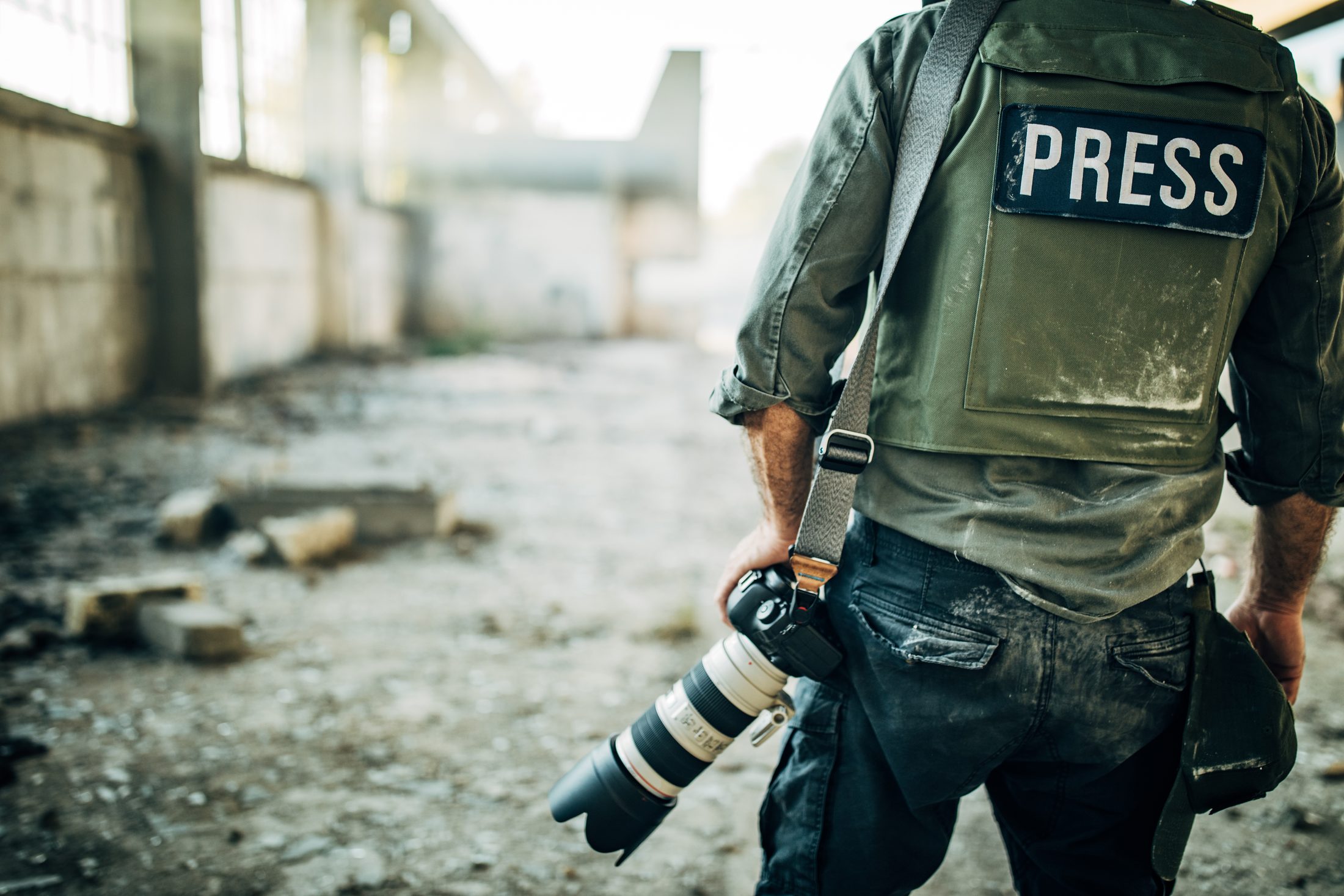
South_agency/istock
For years, Abdaljalel Shabib, a Syrian journalist who has spent much of his career documenting conflict from within the country, has photographed war not as a distant headline, but as something that unfolds daily, without pause or distance. Working through years of bombardment in Idlib, a rebel-held region in northwestern Syria, and beyond, he has witnessed destruction, displacement, and the slow reshaping of ordinary life under extraordinary strain.
There are moments, he suggests, that do not leave easily, standing in the aftermath of an airstrike, the dust still unsettled, unsure for a brief second whether to keep photographing or to simply take in what remains. It is within such moments that the weight of the work becomes most visible, not just in what is documented, but in what must be carried afterward.
Over time, he suggests, continuing to work required a difficult adjustment. The intensity of what he was witnessing did not lessen, but his way of holding it had to change. War, for him, is not an event that begins and ends. It lingers, evolves, and settles into the rhythms of everyday existence.
Yet beyond the front lines, something else is taking shape. As images from Gaza, Ukraine, Sudan, and rising tensions involving Iran, each representing different phases and scales of conflict, move relentlessly through digital feeds, many audiences describe a growing sense of exhaustion, an inability to fully absorb yet another unfolding crisis. The term often used is “conflict fatigue.” But what does that fatigue really mean, and who does it belong to?
For those living through war, fatigue rarely takes the form of disengagement. It becomes endurance, adaptation, a way of continuing despite the weight of what surrounds them. For those at a distance, however, repeated exposure, compressed into endless streams of images, can begin to dull the immediacy of response. What is seen constantly risks being felt less intensely, even as its reality remains unchanged.
The Scroll and the Disappearing War
In Sudan, where a devastating conflict between rival military factions has displaced millions and triggered a severe humanitarian crisis, Ammar Yasir, a 24-year-old photojournalist documenting the ongoing war, describes a different kind of exhaustion, not from witnessing violence itself, but from watching it go unseen. “I remember that many times I felt I was contributing to educating the global community about the war in Sudan,” he says. “But the conflict is ignored on purpose and has no attention.”
For Yasir, the frustration is not only in documenting violence, but in what happens after. Images that carry immense weight on the ground can dissolve almost instantly once they enter the digital stream. There are moments, he suggests, when photographs taken under immense pressure, images that feel urgent and undeniable in the moment, receive little to no response once published. “It’s just a scroll that takes you away from the photo,” he explains.
This mode of consumption reflects a broader shift in how conflict is encountered globally. Digital platforms, built for speed, immediacy, and constant engagement, compress even the most devastating images into fleeting encounters. Over time, repeated exposure to violent imagery can lead to desensitisation, where suffering is processed less as lived human experience and more as abstract information.
The result is a quiet paradox. Never before has the world had such immediate access to war. Yet this same accessibility may be undermining the ability to engage with it meaningfully. Repetition, combined with speed, transforms moments of suffering into a continuous stream, one that is difficult to fully absorb.
As Yasir suggests, people may not stop caring entirely, but they begin to move on more quickly. Some conflicts dominate attention, while others fade into obscurity, producing a fragmented and uneven global awareness. Yet despite this, he continues to believe in the power of images. “Photography has the ability to change realities,” he says, even in an environment where attention is fleeting.
Living Through What Others Scroll Past
For those working within conflict zones, however, war resists this fragmentation. It does not arrive in brief intervals or isolated images. It persists. Shabib recalls how, in the early years of covering the Syrian conflict, the scale of destruction and displacement made every assignment emotionally overwhelming. Over time, he learned to maintain a certain emotional distance, not as detachment, but as a way of continuing. Without it, the work itself would become impossible.
The weight of what he witnesses never fully disappears. Even as the nature of the conflict has shifted over time, it has not truly ended, it has simply changed form, while its human impact remains deeply present. War evolves, but it does not conclude.
What he has observed, however, is a shift in how audiences outside conflict zones respond. Repeated exposure to similar images can create a sense of saturation. But for those living within these realities, there is no such saturation point. Each moment carries its own urgency. What appears repetitive from a distance is, in reality, continuous.
This contrast reveals a fundamental divide. Fatigue may belong, in part, to distance, the ability to step away, to disengage, to close a screen. For those without that option, what remains is not fatigue, but continuation.
The Psychology of Numbness
To understand this divide more fully, it is necessary to consider the psychological effects of prolonged exposure to conflict. According to Abrar Nazir, a PhD scholar from Kashmir researching the psychological impact of prolonged conflict, such exposure reshapes emotional and cognitive responses in profound ways.
Nazir’s work is informed by prolonged conflict within Kashmir itself, where the conditions he describes are not abstract, but part of everyday life. In such environments, the presence of uncertainty is not occasional, but constant, woven into routines, conversations, and even moments of stillness. “Prolonged conflict produces chronic stress and complex trauma,” he explains. “It leads to anxiety, depression, and a persistent sense of insecurity.”
Over time, people begin to live in a constant state of vulnerability, where the anticipation of danger becomes embedded in daily existence. It is not always marked by visible crisis, but by a quieter, ongoing awareness, an alertness that does not fully recede, even in ordinary moments. Within this context, emotional numbness emerges not as indifference, but as adaptation. “This numbness develops over time through sustained exposure,” he says.
This process, often described as habituation, helps explain why repeated exposure to conflict may evoke less immediate emotional response. As violence becomes normalised, people adjust in order to function, even as the internal psychological burden deepens. Initially, responses are marked by shock and grief. Gradually, however, they become more cognitive than emotional, a shift that reflects not a loss of empathy, but the limits of sustaining it. What once felt overwhelming begins, over time, to feel familiar, not because it is any less severe, but because it is continually present.
Research supports this understanding. Studies on trauma and media exposure suggest that repeated encounters with violence can reduce emotional intensity while reinforcing a sense of inevitability. Research from institutions such as the Dart Center for Journalism and Trauma, along with broader mental health research, shows that repeated exposure to violence, whether experienced directly or through media, can lead to emotional exhaustion, anxiety, and trauma-related symptoms across populations.
Studies by UNICEF have further highlighted that children growing up in conflict zones often experience toxic stress, affecting their emotional development and long-term well-being. Prolonged instability also disproportionately affects civilians, particularly women and children, intensifying psychological stress and everyday insecurity.
Crucially, none of this implies a loss of empathy. Rather, it reflects the limits of sustained emotional engagement. When exposure becomes continuous, the mind adapts not to forget, but to endure.
Art, Humor, and the Work of Feeling
In Ukraine, where the Russian invasion has reshaped everyday life in profound ways, Maryna Brodovska, a Ukrainian artist and writer, offers a different perspective, one rooted in creativity.
“Before the war, I was interested in identity, family, friendship,” she says. “After the beginning of the war, topics of war and displacement became more relevant.”
For Brodovska, this shift is deeply personal. As the war altered the conditions of daily life, art and humour became not only forms of expression, but ways of navigating that reality. At times, she suggests, this takes shape in quiet, almost ordinary ways, returning to a piece of work, reworking an idea, or sharing something small that allows a momentary pause from the weight of events unfolding outside. They provide space to process experiences that might otherwise feel difficult to articulate. “People need some escapism from traumatic reality, and space for reflection,” she explains.
Support independent journalism
Enjoy reading The Parlor?
Become a paid subscriber to get full access, early releases, and subscriber-only extras.
Become a paid subscriberThis perspective complicates the idea of fatigue as disengagement. Rather than withdrawing, individuals may be seeking alternative ways to remain connected to themselves, to others, and to the realities they inhabit. Where continuous news coverage can feel repetitive or numbing, art offers a slower, more reflective form of engagement.
“Art can make people more empathetic,” Brodovska says. At the same time, she acknowledges a difficult truth: those who have not lived through war may never fully grasp its emotional reality.
In this way, art becomes a bridge, sustaining emotional connection even as attention shifts elsewhere.
The Automation of Distance
While war continues to saturate digital feeds, its very nature is also beginning to shift, becoming faster, more automated, and increasingly difficult to fully grasp. Alžběta Dvořáková, an arms control and AI warfare expert based in Prague, has been studying how emerging technologies are reshaping modern conflict. She suggests that while these developments may not necessarily make wars more likely, they are fundamentally changing how they unfold.
“Decisions that used to involve long political or military processes can now be supported, or even partially shaped, by algorithms and autonomous systems,” she explains. In such environments, escalation may no longer follow predictable timelines. It can emerge through technical interactions, misinterpretation of signals, or rapid responses unfolding at machine speed, often leaving little room for human judgement. This compression of time introduces a new form of distance: not only geographical, but temporal and cognitive.
From an arms control perspective, this shift presents new challenges. Traditional mechanisms were designed around visible capabilities and clearly identifiable systems. Today’s conflicts, however, are embedded within complex socio-technical environments, where responsibility and intent are far more difficult to assess. At the same time, the visibility of war itself is changing. Many contemporary forms of conflict, cyber operations, AI-enabled targeting, and space-based systems, operate in domains that are difficult for the public to observe or even comprehend. Their effects are often indirect, delayed, or ambiguous. “When risks are less visible, they are also harder to communicate,” she notes.
This creates a widening gap between what experts identify as urgent and what societies perceive as immediate. And within that gap, attention can falter.
Dvořáková also points to a broader pattern of desensitisation, not only among the public, but within policy and expert communities themselves. Constant exposure to multiple, overlapping crises can gradually shift ongoing conflicts into the background, turning them into a kind of ambient noise. This, she warns, can weaken the sustained attention required for prevention, arms control, and risk reduction.
Remote warfare further complicates this dynamic. When military action is mediated through screens, sensors, and autonomous systems, its human consequences can appear distant or abstract. Framed in terms of systems, precision, or efficiency, conflict risks being understood in technical rather than human terms, reducing the sense of moral urgency that often drives accountability.
Repeated cycles of violence and media exposure can also contribute to a sense of normalisation. What would once have been shocking begins to feel routine, not because it is less severe, but because it is constantly present. In arms control discussions, this shift is rarely addressed directly, but it carries significant implications. These frameworks have historically relied on a shared perception that certain risks are unacceptable. If societies begin to perceive instability and violence as normal, the political momentum for restraint may gradually weaken.
This has implications beyond perception. “If societies become fatigued or disengaged, it becomes easier for escalation dynamics to unfold without strong pressure for restraint,” she says. In such conditions, responsibility can also become harder to assign, and international responses slower to mobilise, particularly when events are complex, ambiguous, or poorly understood. By the time consensus forms, the situation may already have evolved.
Conflict fatigue, in this sense, becomes not only a social condition, but a structural challenge, affecting political will, international response, and the long-term mechanisms designed to prevent conflict. At the same time, she emphasises that this trajectory is not inevitable. The same channels that contribute to saturation, social media and digital platforms, can also be used to sustain awareness. Journalists, researchers, and civil society actors continue to play a critical role in keeping these issues visible, ensuring that even as war evolves, it does not disappear from public consciousness.
The Idea of Peace in an Age of Bombardment
Amid continuous cycles of violence and fragmented attention, the idea of peace becomes increasingly complex. It is invoked frequently, yet often feels distant from lived reality.
In contexts of ongoing bombardment, peace is not simply the absence of war. It becomes an abstract horizon, something imagined, deferred, and difficult to grasp in concrete terms. For those living within conflict zones, it remains an absence rather than a condition, felt most acutely in the ordinary moments where its absence is most visible.
For those at a distance, peace risks becoming a conceptual language, spoken about alongside images that are quickly replaced by the next crisis in an endless sequence. It is acknowledged, but rarely held onto. As attention shifts, so too does the sense of urgency.
This raises difficult questions. Can the language of peace retain its meaning when violence is constant and widely mediated? What happens when images of war arrive faster than they can be processed, and disappear just as quickly? Does repeated exposure dilute not only emotional response, but also the clarity of what peace is meant to represent?
When bombardment becomes routine and attention becomes fragmented, the distance between the idea of peace and its realisation begins to widen, not only politically, but emotionally.
Beyond Fatigue
The notion of conflict fatigue, then, is less about the absence of empathy and more about its transformation under pressure, shaped by distance, repetition, and the limits of human attention.
For some, it is the frustration of being unseen. For others, it is the quiet necessity of emotional distance. And for many, it is something that must be worked through, reshaped into forms of expression, reflection, or survival.
What emerges is not indifference, but a quieter, more complicated form of engagement, one that exists between caring and coping, between witnessing and looking away. The question is no longer whether people care, but how that care endures in a world where war no longer arrives as a singular rupture, but as a constant presence, folded into the everyday, absorbed into the background, and yet never fully gone.
Because while many may scroll past, close a tab, or turn away, for millions living through conflict, there is no such distance. There is no moment of exit, no pause between images and reality, only the ongoing negotiation of life within it.
And so the gap remains: between those who can step away, and those who cannot. Between the image and the experience. Between the idea of war, and the lives that continue within it, long after the screen goes dark.
About the author
Luqmaan Zeerak
Luqmaan is a multimedia journalist dividing his time between Kashmir and Delhi. Through visual, audio, and written reporting, he documents the human impact of conflict and the evolving dynamics of society.
Conversation
A space for Parlor members. Be generous, be real.
Loading…