
Women at the Frontlines of the Future
Osprey Orielle Lake on dismantling extractive systems and building a relational future

Lindsey Brock Morales
April 12, 2026
Pacific Press Media Production Corp. / Alamy
At a moment when climate discourse is increasingly dominated by technocratic solutions and market-driven frameworks, Women’s Earth and Climate Action Network (WECAN) offers a radically different approach. For more than a decade, WECAN has worked to center women, particularly Indigenous women, as leaders in the global movement for climate justice, recognizing that those most impacted by ecological breakdown are also those advancing some of the most effective and enduring solutions.
At the center of this work is Osprey Orielle Lake, an international advocate whose writing and organizing challenge the dominant narratives shaping climate policy today. Her work insists that the climate crisis is not merely environmental or technological, but deeply social, political, and spiritual—intertwined with systems of colonialism, patriarchy, and economic exploitation.
In this conversation, Lake reflects on the interdependence of gender justice and climate justice, the leadership of Indigenous women, and the urgent need to move beyond extractive worldviews toward models grounded in reciprocity, kinship, and care. What emerges is not just a critique of the present, but a framework for transformation—one that asks us to rethink not only how we address climate change, but how we understand our place as both inhabitants and stewards of Earth and its resources.
***
The Parlor: To begin, for readers who may be new to your work, how do you describe the core mission of WECAN and the movement you’ve helped build?
Osprey: At the Women’s Earth and Climate Action Network (WECAN), our mission is to uplift women in all of their diversity as powerful agents of systemic change in the face of climate chaos. Since 2009, we have been dedicated to building a global movement rooted in the understanding that women are disproportionately impacted by environmental degradation, yet are also at the forefront of climate solutions from protecting forests, waters, seeds, and communities to transformative socio-ecological agendas and policies. Our work spans advocacy, political strategy, direct action, and on-the-ground solutions: from protecting the Amazon, to advancing forest defense in the Congo Basin, to divestment and policy change locally and globally.
At its heart, WECAN is about transforming the dominant extractive paradigm and asserting a new story based on care, reciprocity, and justice. This transformation requires dismantling not only colonial and patriarchal systems, but also the supremacy constructs that have justified exploitation of land and people—particularly Indigenous, Black, Brown, and frontline women.
The Parlor: Your advocacy places women—especially Indigenous women—at the center of climate solutions. When did you first understand that gender justice and climate justice are inseparable?
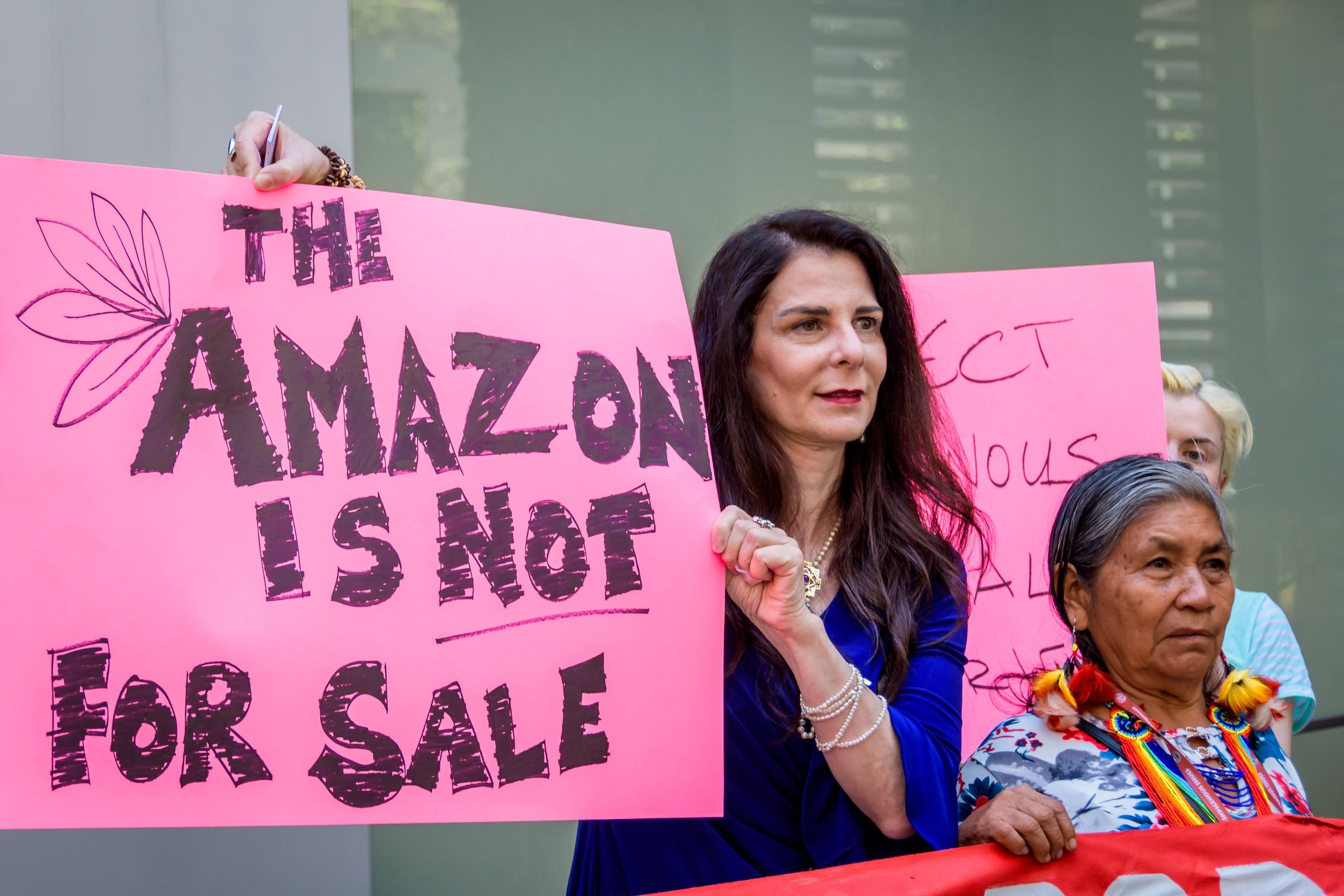
Osprey: I understood this deeply when I began working closely with Indigenous women in the Amazon and in communities across North America who were defending their homelands from fossil fuel extraction and deforestation. In each place, I witnessed how the violence enacted against Earth was mirrored in the violence enacted against women’s bodies and communities. The same extractive industries that polluted rivers, clear-cut forests, and ruptured landscapes were also fueling human rights abuses, displacement, and gender-based violence. It became impossible to separate ecological devastation from the social and political systems targeting women and Indigenous Peoples.
As our work at WECAN evolved, we documented these connections again and again through research, reports, community testimony, and international advocacy. These experiences made visible supremacy systems—patriarchal, racialized, and colonial—that underpin both violence against women and violence against land. Gender justice and climate justice are inseparable because both require dismantling these interlocking systems of domination and rebuilding a world rooted in relationship.
Ecofeminism, Worldviews & Climate Justice
The Parlor: What do dominant Western worldviews get wrong about climate solutions—and what shifts in consciousness are required to build the just, relational future you describe in your work?
Osprey: Dominant Western worldviews treat the Earth as an object, something inert, available for extraction, and valued primarily through economic metrics. This worldview frames climate solutions in technocratic, market-driven terms such as carbon markets, geoengineering, offsets, and profit-oriented “green growth” narratives. What these approaches fail to grasp is that ecological collapse is not merely a technological glitch, it is a spiritual and cultural crisis rooted in the severing of human relationships with land, water, and one another. These worldviews are built upon supremacy constructs that elevate certain humans over others and place humanity above the rest of the living world.
The shift in consciousness we need is toward relationality, recognizing Earth as a living being and humans as participants in a vast web of interdependence. This includes those of us who are not Indigenous reconnecting with the land stories of our own ancestors, remembering that every lineage once had intimate ecological knowledges shaped by place. Reclaiming these lineages is part of transforming the colonial and patriarchal conditioning that has normalized domination. A relational worldview asks us to center care, reciprocity, kinship, and collective well-being—not as abstract ideals, but as practical principles guiding governance, economy, and daily life. Without this cultural shift, even well-intentioned climate action risks reinforcing the same harmful systems we must dismantle and transform.
The Parlor: From your perspective, what does a feminist climate framework look like in practice? Where do you see it already emerging?
Osprey: A feminist climate framework prioritizes communities most impacted by ecological degradation and simultaneously recognizes their leadership in driving transformative solutions. In practice, this means centering Indigenous rights and sovereignty, land rights, gender justice, and community-led decision-making in every climate policy and initiative. It also means confronting the root systems of harm—colonialism, patriarchy, racism, and endless economic growth models—rather than treating climate change as a narrow technical issue. Feminist climate frameworks uplift care economies, rights of nature, just transitions, and regenerative land stewardship.
At WECAN, we see this framework emerging vividly in our global networks. For example, women leaders in the Amazon are advancing forest protection grounded in Indigenous governance and matriarchal stewardship. In the U.S.,WECAN uplifts frontline women resisting pipelines and organizing for fossil fuel phaseout. Our policy briefs translate these values into actionable strategies for governments and financial institutions. These are not aspirational ideas; they are living practices being led by women on the frontlines every day.
Indigenous Women’s Leadership and Knowledge Systems
The Parlor: What makes Indigenous women uniquely positioned to guide global climate solutions?
Osprey: Indigenous women carry intergenerational knowledge systems rooted in thousands of years of land stewardship, biodiversity protection, and community care. Their teachings are grounded in place-based relationships with territory, which is why Indigenous lands and lands stewarded by Indigenous peoples protect most the world’s remaining biodiversity. Indigenous women are often cultural knowledge holders, seed keepers, and defenders of governance systems that prioritize long-term ecological balance. Their leadership is derived from long-standing Indigenous science and lived practices of reciprocity with Earth.
Indigenous women are at the frontlines of resisting extractive industries, making them critical experts on the impacts of fossil fuels, mining, and deforestation. In their leadership, they are confronting not only ecological harm but also colonial, corporate, and patriarchal systems that endanger their communities and lands. Indigenous women are generating and practicing regenerative futures that the world urgently needs. We all really need to listen to, respect and invest in Indigenous women’s leadership.
The Parlor: What do policymakers and environmental organizations most often overlook about Indigenous women’s ecological knowledge?
Osprey: Policymakers often overlook that Indigenous ecological knowledge is not a set of “practices” to be extracted or consulted. This knowledge is part of sophisticated governance systems rooted in sovereignty and longstanding relationships with land. Too many institutions want the benefits of Indigenous knowledge without respecting Indigenous land rights, political authority, or cultural continuity. These systems of disregard are part of colonial and capitalistic constructs that are extractive and assume Western models of science, economy, conservation, and governance are superior. They treat knowledge as data rather than as a living system connected to ceremony, identity, and community.
The political wisdom of Indigenous women bring to climate solutions is also often undervalued. These women understand not only ecological thresholds, but also the geopolitical realities of extractive industries, state violence, and corporate power. It is important to continually emphasize that Indigenous knowledge needs to be paired with structural change—protecting land demarcation, respecting treaty rights, upholding Indigenous Peoples’ right to Free, Prior, and Informed consent, ending fossil fuel and mining expansion, and advancing Land Back efforts—not just symbolic inclusion.
Violence Against Women as Violence Against Land
The Parlor: In what ways does criminalization, state violence, or corporate violence show up when Indigenous women defend land or water—both in the U.S. and globally?
Osprey: Indigenous women defenders face staggering levels of criminalization, harassment, and violence when resisting extractive industries. Around the world, women who stand against logging, mining, and fossil fuel projects are targeted with surveillance, threats, false criminal charges, and even assassinations. This violence is not incidental—it is a structural tool used by corporations and complicit governments to silence resistance and clear the way for extraction. In the U.S., we have seen the militarized response to water protectors and ongoing criminalization of pipeline resistance across multiple states.
Support independent journalism
Enjoy reading The Parlor?
Become a paid subscriber to get full access, early releases, and subscriber-only extras.
Become a paid subscriberThese attacks are manifestations of systems that have long sought to suppress Indigenous sovereignty and women’s leadership. Some of my Indigenous sisters have been attacked and even murdered in their fierce dedication to land defense. Patricia Gualinga, who is a Kichwa leader of the Amazonian Women Defenders of the Jungle in Ecuador, and a dear friend and WECAN project coordinator says, “We have been criminalized, we have been persecuted, many times threatened and sometimes murdered. This has to stop because our country and the world needs to be conscious that our fight is not an isolated fight of the environmental defenders or the Indigenous peoples. It is a fight that allows the world to survive.”
What keeps her from giving up, she has told me is knowing that if she and her community yield, the rainforest that sustains their people would fall silent. And so she has kept speaking out, insisting that the world recognize what the Kichwa already know: that the forest is alive and worth defending with every breath.
The Parlor: How can global feminist movements and climate movements better protect women land defenders?
Osprey: Protection must extend beyond emergency response to include structural interventions that address the sources of harm. First, climate movements must advocate for binding international protections for environmental defenders, including full implementation of the Escazú Agreement across Latin America and the Caribbean, and strengthened mechanisms at the UN. This includes legal protections, rapid response systems, and accountability measures for states and corporations that perpetrate violence. Movements must also support land back initiatives and Indigenous sovereignty, because security for defenders is inseparable from control over territory.
At WECAN, we emphasize building global networks of solidarity, ensuring defenders are resourced, connected, and visible (if they choose to be) in international policy spaces. Through WECAN’s Escazú Agreement Campaign for Women Land Defenders, we highlight how environmental defenders in Latin America face some of the highest rates of violence globally. We have created toolkits that provide resources for rights-based advocacy, safety strategies, and legal frameworks to protect defenders’ lives. When the bodies of women and the body of Earth are targeted simultaneously, we see clearly that colonial and patriarchal constructs are driving this violence—and that transforming them is essential for both human and ecological survival.
The Parlor: How can ecofeminism help people understand the interconnected crises of land dispossession, gender-based violence, and environmental collapse?
Osprey: Ecofeminism reveals that the same logic that treats land as a resource to be extracted also treats women’s bodies as sites of control and exploitation. These are not parallel issues; they stem from the same systems of domination. Ecofeminist frameworks show how patriarchal and supremacy-based power structures rely on hierarchies that devalue care, community, and ecological systems, making both women and landscapes targets of exploitation. When we understand this connection, we recognize that ending gender-based violence requires ending the extractive economic models that fuel ecological destruction.
Ecofeminism also offers a pathway to transformation. It uplifts models of governance rooted in care, reciprocity, cooperation, and collective well-being. It encourages non-Indigenous people to remember their own ancestral stories of land stewardship, helping all of us heal the fractures created by colonial and supremacy systems. In our work at WECAN, we see these principles lived every day by Indigenous women resisting extraction and cultivating regenerative solutions. Ecofeminism helps movements understand that justice for women and justice for Earth are not separate agendas, they are one and the same struggle.
"The Story Is in Our Bones"
The Parlor: In your book The Story is in Our bones, you often emphasize that colonialism, capitalism, patriarchy, and ecological destruction are not separate forces but interlocking systems. How do you see these systems reinforcing one another in the climate crisis?
Osprey: Colonialism established the worldview that land and people could be owned, exploited, or destroyed for profit, laying the groundwork for both environmental devastation and social oppression. Colonialism means acquiring full or partial political control over another country or region, occupying it with settlers, and exploiting it economically. Patriarchy reinforces these dynamics by institutionalizing hierarchies of power that marginalize women, Indigenous peoples, and other communities. Capitalism intensifies this logic by transforming ecosystems and human communities into commodities for perpetual growth. And all of these systems are buttressed by supremacy constructs that justify dominance over those deemed “inferior,” including the natural world itself.
In the climate crisis, fossil fuel expansion on Indigenous lands, gender-based violence near extractive zones, forced displacement, and economic models that prioritize corporate profit over ecological survival all working in tandem. These systems also work to sever people from their ancestral ecological knowledge, making it harder to challenge the narratives of supremacy that created the crisis. Recognizing these interconnections is crucial because climate solutions must address the root causes as well as treat symptoms. This understanding is central to WECAN’s policy work and the frameworks we advocate for internationally.
The Parlor: Is there an excerpt or section from your book that feels especially relevant to this moment of political and ecological crisis?
Osprey: From my book The Story is in Our Bones:
“What I have come to learn is that the current dominant social mindsets and systems are incapable of addressing the crises we face or providing a flourishing way ahead. Consequently, in this tenuous moment, understanding worldviews is vital to entering new thresholds of living—some worldviews need radical dismantling and re-imagining, and others need to be thoroughly bolstered, remembered, or rescued. What I hold to be true is that another world is possible, and the portal exists within this one to build the world we seek.
Networks of change-makers, systems thinkers, activists, writers, and artists from every background have recognized the need for systemic change because we know that while installing solar panels and recycling are paramount, these alone cannot address the deep layers of societal evolution that this moment demands. We are striving in our work to transform oppressive systems and processes into radically beneficial and thriving cultural configurations. In the emergent societal scaffolding and cultural story that seeks to disentangle itself from a violent colonial and patriarchal stronghold, there can be no throwaway people, lands, or species. Instead, we are weaving life-enhancing worldviews and new ways of being and thinking into our projects, narratives, and programs. The core focus is to transition from an extractivist paradigm of exploitation, hyper-individualism, and supremacy to a relational Earth-conscious understanding of respect, reciprocity, and restoration.”
Leadership, Movement Building, and the Future
The Parlor: If you envision a world where Earth communities truly thrive, what role do reciprocity, kinship, and relationality play in shaping that world?
Osprey: Reciprocity, kinship, and relationality are essential to any thriving future. They are not poetic aspirations, they are beautiful and necessary governing principles that sustain life. In a world guided by reciprocity, we would understand that every action we take must honor the web of relationships that sustain us: the waters that give us life, the forests that breathe for us, the soils that feed us, and the communities—human and more-than-human—that nurture us. This worldview shifts everything from economic systems to daily behaviors, moving us away from extraction and toward regeneration.
When we recognize our place within the living web of life, we begin to see that humans, too, can be a keystone species—not by dominating ecosystems, but by supporting and enriching them. In healthy stewarded landscapes around the world, humans play an active ecological role: tending, pruning, shaping, and giving back. These practices create more abundance, not less. They increase biodiversity, strengthen resilience, and help ecosystems flourish. Our species’ greatest potential is not in what we can take from the world, but in how thoughtfully and caringly we can contribute to the Earth.
Indigenous peoples have modeled this reciprocal relationship with the land for millennia. Their knowledge systems teach that care is a responsibility— the land provides for us, and we must provide for the land. One example is the traditional tending of camas prairies in parts of the Pacific Northwest in the US. For generations, Indigenous communities cultivated these meadows by aerating the soil with digging sticks, replanting smaller bulbs, and harvesting in ways that ensured future abundance. Rather than depleting the camas, this practice expanded the prairies, increased pollinator habitats, nourished wildlife, and strengthened food security. Human activity didn’t degrade the ecosystem, it enhanced it.
Kinship extends this understanding by reminding us that humans are not separate from nature. We are part of a vast family of beings. For those of us who are not Indigenous, rebuilding kinship also involves remembering our ancestral ties to land and rekindling ecological knowledge once held by our own lineages. Restoring these intergenerational relationships helps create new narratives that can help us compost and transform dangerous ideologies of separation from over superiority over nature.
The Parlor: When you talk about “building thriving Earth communities,” what forms of governance, economy, or social structure do you imagine could make this possible? What needs to be dismantled—and what needs to be rekindled—to transition from extractive economies to regenerative ones?
Osprey: Building thriving Earth communities requires governance rooted in participatory democracy, Indigenous sovereignty, rights of nature, and community-led decision-making. We must dismantle the structures that uphold extraction, namely fossil fuel dependency, colonial land frameworks, corporate capture of political institutions, and GDP-driven economic models. These systems are reinforced by supremacy constructs that create hierarchies between people and between humans and nature. As a steering committee member of the Fossil Fuel Non-Proliferation Treaty, I work alongside others to push for binding agreements to end fossil fuel expansion and ensure a just and equitable transition. These kinds of international mechanisms are essential for structural change.
What we must rekindle are relational economies that prioritize care work, ecological restoration, local sovereignty, and intergenerational responsibility. Regenerative economies center the health of ecosystems and communities rather than corporate profit. They uplift community-owned energy, food sovereignty, forest guardianship, and rights-based frameworks.
I am honored to serve on the Executive Committee for the Global Alliance for the Rights of Nature. The Rights of Nature framework offers a vital governance structure for healthy and just communities. Building thriving Earth communities begins with rekindling our deepest understanding that we are part of a larger living family—one where forests, rivers, soils, and skies have their own voices, stories, and rights.
The Rights of Nature movement invites us to imagine governance and economies rooted not in extraction, but in reverence and reciprocity, where laws protect the right of ecosystems to flourish. When we honor nature as rights-bearing, we step into a regenerative way of being—one that nurtures life, possibility, and hope for generations to come.
About the author
Lindsey Brock Morales
Lindsey is the Founder and Editor-in-Chief of The Parlor. After over a decade in humanitarian aid and community organizing, she founded The Parlor in 2025 to build a publication rooted in the belief that the people most affected by power are the most qualified to describe it. She is based between Washington, D.C. and Bologna, Italy.
Conversation
A space for Parlor members. Be generous, be real.
Loading…