
Following the Foodways
Josmine Evans on Culture, Community, and the Sacred Work of Seasoning
Elisa Shoenberger
April 1, 2026
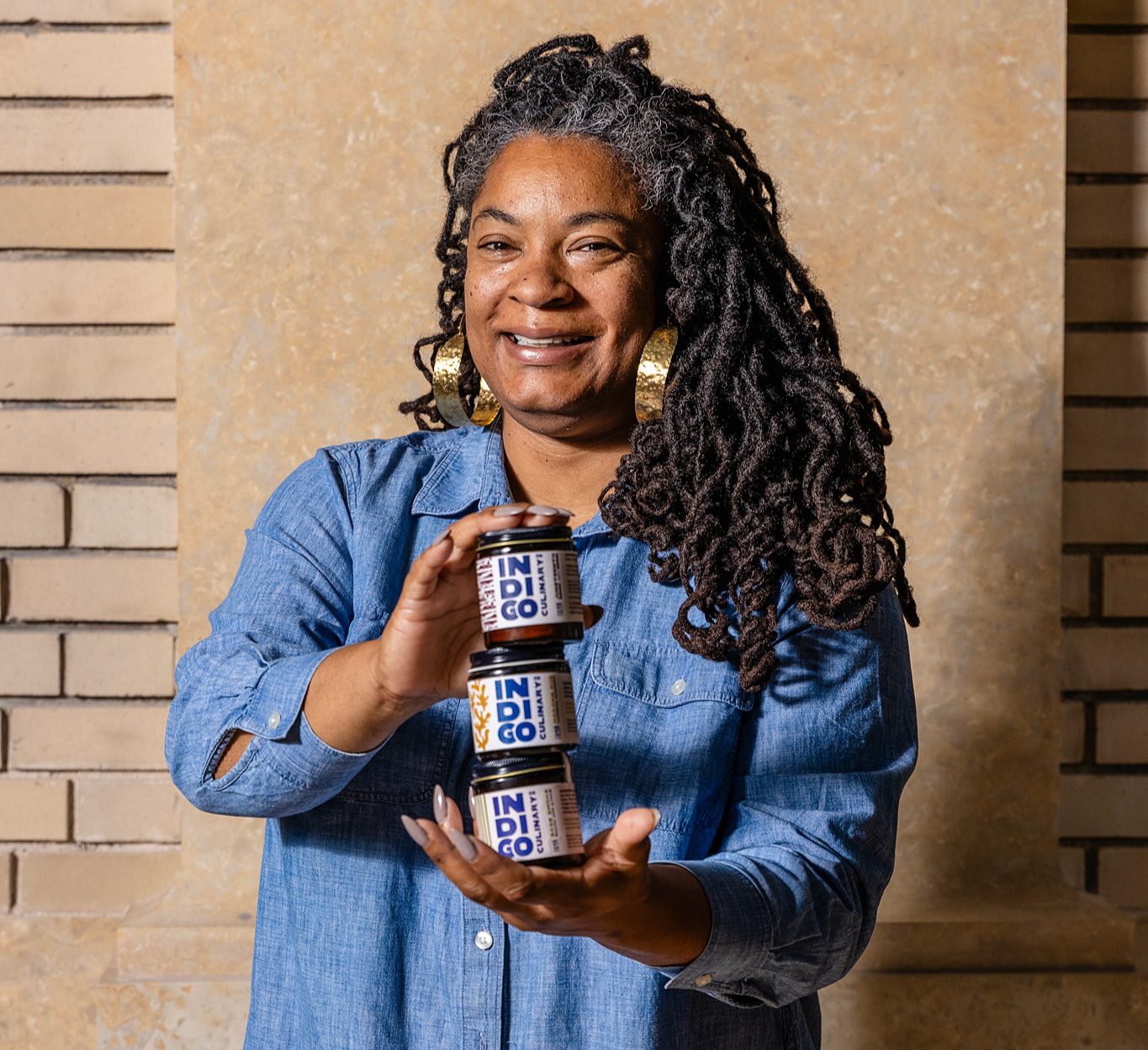
Photo by Taylor Higgins
When Josmine Evans first made the spice blend “Juneteenth Jawn,” she saw it as a one-off thing. Little did she know that it would be the spark to start her own company Indigo Culinary Co that brings together foodways and storytelling. Based in Michigan, Indigo Culinary just celebrated its one year anniversary earlier this year in January 2026. Evans is also the curator and steward with theJOYproject.
In this conversation with Parlor Magazine, Evans contemplates the road to running her own business and her efforts to share and celebrate stories.
The interview has been edited for length and clarity.
***
The Parlor: Why is the work of Indigo Culinary so important? Why food and storytelling?
Josmine Evans: For me, it is a tool. It is a technology towards self-actualization, self-confidence, and all the things that one would need to have about themselves to be a free person. All of those lessons, stories, and culture can be accessed through food. Everybody has their own special interests, but we can follow human movement, human interactions, human exchanges, and evolutions back thousands of years by following foodways. I'm sure we could do that with music or something else. But food is one of those things that serves as a bridge and gives a space for conversation about the entire human experience.
The Parlor: How did it all start? I saw that Juneteenth Jawn was the first spice blend you made.
Josmine Evans: Juneteenth John was a collaborative situation. A friend of mine established a concept and a container called “Hello Black Brunch.” It brought human beings together over food to have conversations and to have a check in with one another.
During COVID-19, there was this conversation about continuing the Black Brunch experience on a virtual platform. My friend pulled in a bunch of brilliant minds to figure out how to do this. People came up with ideas and collaborated on a menu together. Recipes were made for it. This idea emerged to have a seasoning blend as a tangible thing that people could have to experience something that was fully somatic and fully immersive on a virtual platform, but still have some of that tangible shared experience.
The seasoning was named after the event, which was a virtual Juneteenth Jawn. It was really intended for that event. I had no thoughts beyond that point. I wasn't even considering a career in food work. It was more so a passion project, but people enjoyed it. So we did it again.
We did a limited release as a holiday pack for the feasting season at the end of the year. People liked it and we did it again. It kind of grew on its own, gaining an audience, a fan club, that made me curious about what other stories we can tell with these seasoning blends.
I eventually joined a small business cohort in Michigan called BasBlue, which is a woman and non-binary small business network. They did a cohort for women with food businesses over a six to nine month period. In the first half, we did everything together as a cohort. Then in the second half of it, we were assigned our own individual mentors to do our own individual projects. Out of that we birthed the entire concept for the Indigo Culinary Co with a line of spices. Now we're up to 14 different products.
The Parlor: How do you create the spices and the teas and the products? Do you start with a story or an ingredient?
Support independent journalism
Enjoy reading The Parlor?
Become a paid subscriber to get full access, early releases, and subscriber-only extras.
Become a paid subscriberJosmine Evans: I’ve spent a lot of time, energy, and financial resources into exposing myself to particular experiences for learning, opportunities for collecting and gathering stories. What I really wanted to be able to do was to figure out how to translate all of these things in an easily consumable way and share them with people. It wasn’t a thing that I wanted to commodify.
For me, it was sacred work and putting a price tag and the pressures of turning a profit still feels like a battle. Initially moving down this path, I was really opposed to creating products, but when I decided to make products, one of the agreements that I made with myself was that everything has to be story first, and then product second as opposed to introducing a product with a little bit of the story behind it.
People ask me all the time: why don't you have a lemon pepper blend or why don't you do these other things? I don't feel 100% comfortable just following whatever the trend of the market is saying. The seasoning has to be something that has a very specific purpose and story.
For example, my California Creole Blend is really the only hyper-personal seasoning blend I have. It's the story of my paternal line's migration out of Louisiana into California. It's your quintessential Cajun/Creole blend. If you come to my website looking to shop for that, you're going to see a description about the Great Migration. You're going to see information that's talking about the difference between Cajun and Creole identities and the way those things do and don't work together.
You're going to see and also see ingredients like lemongrass, cilantro, and ancho chilies, which aren't particularly Louisiana favorites in terms of spices and seasonings. But for me, they represent the brightness of California foodways with its fresh fruit and vegetable markets. Not that they don’t have those in Louisiana. I also have smoked sea salt there because it’s out of the Pacific Ocean from the San Francisco Salt Company.
So that additional layer of California is being infused into these Creole or Cajun spices, which is how I feel about my paternal line, my family's cuisine. It is New Orleans food, but it is interpreted through a California lens. Every blend starts as a story, and then I figure out what the story would taste like.
The Parlor: What are your plans for the future?
Josmine Evans: Indigo Culinary was always a container for me to be able to provide services, to do storytelling, maybe bringing some food along with me, or something like that. Selling consumer packaged goods (CPG) wasn't my initial thought, but now it is more than 30% of my business and growing. The process of producing, marketing, selling and running a product business is entirely different, and what I hope to achieve is a stable CPG business that can provide my basic needs and upkeep and well-being as a human.
I want to provide some employment for some community members in a way that allows me to do more of the speaking, teaching, and showing up in community spaces without having the pressure of revenue attached to them, because the CPG business is providing revenue for the business.
This year's experiment is on how to expand this thing's reach without being gross. As a small brand, how do I build relationships with retailers that go beyond just giving them a product. Is it possible? This year, I’ll be trying to have more conversations with people and look for opportunities to expand people's understanding of what this product is.
People need to have an opportunity to understand why this product is important, beyond the fact that it's just a seasoning blend that tastes good. People had to be met immediately with the storytelling. So I’m figuring out ways to do that. There used to be like a single blurb on every jar to introduce the blend to people. This year, we reworked it so that every product has an individual story on it. They all have QR codes now that will take you to the website for more storytelling.
I’m trying to figure out those particular things that will hopefully give way to more opportunities to get the stories out, tell the history, and affirm these foodways.
About the author
Elisa Shoenberger
Elisa Shoenberger is a freelance writer and journalist in Chicago. She also has written for the Boston Globe, Huffington Post, WIRED Magazine, Slate, and others. She writes regularly for Book Riot, Murder & Mayhem, Library Journal, and Cheese Professor. She’s obsessed with dogsledding, murder mysteries, and cheese.
Conversation
A space for Parlor members. Be generous, be real.
Loading…