
Grief, Glitter, and the Business of Staying Alive
Inside Kalma, Port Townsend's Death-Positive Third Space and retail store

Lindsey Brock Morales
August 30, 2026
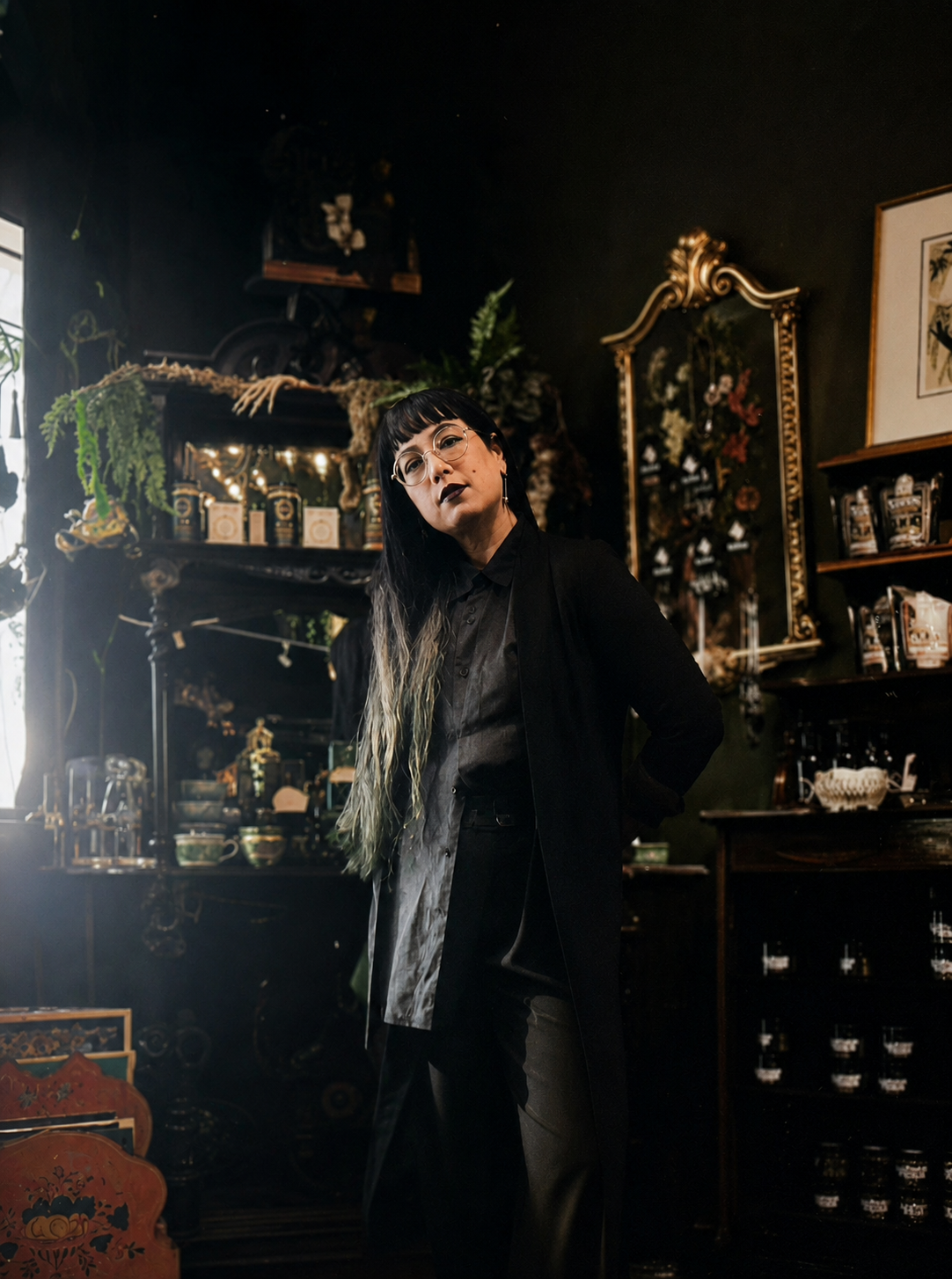
AJ Hawkins inside Kalma, surrounded by the shop's curated apothecary shelves and antique décor. (Photo courtesy of AJ Hawkins)
Ten years ago, AJ Hawkins started a fine art project called The Reclamation — a piece of scientific-research-meets-sculpture about what happens to bodies after death and how they return to the earth. The research pulled Hawkins into the science of the necrobiome, then into a series of hybrid sculpture-paintings processing their own relationship to mortality, then into the Order of the Good Death, the organization that helped found the modern death positive movement, and felt an immediate alignment with its values. It came at a point in her early adulthood when she was looking out at a world that felt full of broken things, without a clear sense of where to direct her energy.
"Doing death work is so inherently human that it's also inherently very intersectional," Hawkins said. Green burial ties into humans' relationship to the earth. Who gets to care for a dying or dead loved one touches disability justice and queerness. How a body is presented in death raises questions of identity and dignity. "By choosing this one topic, I have been able to still be in service to all of these other movements that I really care about."
Around the same time, Hawkins — a custom fabricator who'd been building toward a career in film props and special effects — became disabled and lost that career path. Nobody would hire her into a new field. So she built her own.
"If no one will accommodate me, I have to figure out how to accommodate myself," Hawkins said of that turning point. The question that followed shaped everything that came after: "If I have to be a small business owner, how do I survive capitalism in the least harmful way possible?"
What Kalma Actually Sells
Kalma opened online, built around a single design Hawkins created: "It's Okay to Decay". That one motto struck enough of a nerve to become a store. Today it stocks goods from roughly 60 small businesses, curated secondhand and vintage pieces, and Hawkins's own work, alongside what she describes as the shop's real product: "tools for self-care and self-expression."
That means explicitly death and grief-centered inventory: books on the anthropology of death, on how different cultures care for their dead, on the death-adjacent professions, alongside grief literature for people tending both their own loss and a loved one's. And it means the rest of it too: the sparkly shoes, the "weird clothes," the green hair dye that confuses customers who came in expecting a grief store and only a grief store.
"That's part of the joy of aliveness," Hawkins said of the disconnect. "Death and life is like one can't exist without the other."
Fashion, for Hawkins, is its own grief tool, a way of metabolizing what it means to live in a body that causes chronic pain. "I love fashion as a grief tool because a lot of us have some form of body grief that shows up when we try to put on clothes," she said. Tending her relationship to mortality reshaped small daily choices, too: "I want to live my life as myself. It's a Tuesday and I want to wear sparkly shoes, and I thought, well, there's no occasion for it — but being alive is the occasion for it. Just put on some sparkly shoes."
Hawkins has a name for the store's operating philosophy, pitched at what she calls "teenager-accessible" register: "It's kind of like if social justice and YOLO had a baby", a pro-social, altruistic hedonism.
The Force Field at the Door
Ask Hawkins what happens when people walk in, and she sorts it into three rough categories.
Support independent journalism
Enjoy reading The Parlor?
Become a paid subscriber to get full access, early releases, and subscriber-only extras.
Become a paid subscriberThe first is an overwhelmingly common — and overwhelming — emotional response. Hawkins is working on merch stickers that read "I cried at Kalma." Strangers tell her about their loved ones and start crying mid-conversation, which she's come to understand less as an anomaly than as a release: "My hope and my theory is that what they're feeling is the release of pressure to be hiding parts of themselves. You kind of realize that you've been holding your breath for a really long time."
The second category doesn't make it past the door. "It's almost like a force field," Hawkins said. "Sometimes it's because a loss is just too tender. Sometimes it's because what we're doing is too taboo." She doesn't read that as failure. "They're not ready for our space, and that's okay."
The third group is the one Hawkins finds most interesting: people who connect with what Kalma is trying to do, and also see the risk in it — the fact that offering unconditional help and normalizing hard conversations means breaking from how most of society operates. Kalma runs, by design, on a different set of social norms: staff will help a stranger draft a hard email just because they can, and needing help is treated as ordinary rather than something to hide. But that disruption creates its own confusion. "A lot of people are not sure if that is truly welcome or if it's an intrusion, because in our culture we often say yes to things that we don't want to say yes to," Hawkins said. "We are not supposed to ask for help with things that we're supposed to be able to do independently."
Undoing that takes trust, and for Hawkins, trust is a responsibility the space carries, not something visitors owe it. "There's a lot of responsibility that comes with that — from our perspective, and just to each other," she said. "When we sometimes get it wrong, it’s because we're people and we're all just trying to figure things out together, that we're responding to that with care as well, and not with shame and blame and punishment."
A Third Space, By Necessity and By Design
When Hawkins launched the store, she was in the early stages of an illness that would leave her housebound and bedbound for years. Running an online business meant building a social media presence, and Hawkins decided early that the presence would carry education and advocacy alongside the marketing.
When the business eventually grew enough to support a physical location, the same logic applied to the new resource: rent, and the staffed hours that came with it. "If I have a business that needs to pay for rent for the resource of space, how do I maximize community access to the resource of that space?" Hawkins asked. Rather than paying someone to fold t-shirts for the eighth time to look busy, she built a model where a staffed shop is also, simply, a place a person can be.
"We live in a world where we have a loneliness epidemic," Hawkins said, and she's watched third spaces erode in real time. Having been isolated by illness herself, she knows the texture of that loneliness directly, and she remembers being "a weird kid who doesn't really have a place to hang out and meet other weird kids." Kalma, she said, is partly an attempt to build the space she wished she'd had.
“The Parlor”, as she calls the third space within the shop, is open whenever the store is staffed. People read, study, do homework, wait for a bus or a ride. Staff will help someone draft a difficult email, add a name to the memory tree, or just talk through grief resources. The bathroom, something often taken for granted, is a stated community resource — a place Hawkins says is accessible and safe to use even for people who are just passing through.


Beyond open hours, Kalma runs regular programming: an open grief group, a grief group specifically for queer and trans people, one being introduced for Black, Indigenous, and people of color; a death dialogue modeled on the death cafe format; a disability dialogue that functions as peer support for disabled and chronically ill people; and CARE, which stands for "Club for Abolitionist Reading and Education," focused on skills for reducing dependence on carceral systems.
Last year, with SNAP benefits set to lapse the day after Halloween, Hawkins folded a mutual-aid response into Port Townsend's existing tradition of a downtown trick-or-treat parade. The result, All Hallows Feed, stocked the store with candy plus pantry staples, school-lunch fillers, and produce gleaned from local farms — available to any family that came through, no application required. "It felt like we just expanded the generosity of an established tradition," Hawkins said. She's planning to bring it back annually.


Limits, By Design
Hawkins is explicit that Kalma is not trying to scale into something bigger. "That's really disappointing to a lot of people," she said, "but franchising is not the goal for the business.”
The reasoning runs through disability justice. "The imperative to be infinitely scaling is a big part of why capitalism is inherently disabling," Hawkins said. "Part of disability justice is the moral neutrality of having limits — that it's natural to have limits. I don't believe that there's such a thing as a truly accessible space that holds more than two people in it. But I do believe that accessibility, inclusivity, are points that we should be ever striving for but never quite reaching."
Her hopes for the store's future are, in her own framing, both ambitious and modest: a sustainable place where she and maybe one or two others can do joyful, accessible work as whole people, including the parts of themselves that have limitations. She's begun to notice the shop's culture take on a life beyond her own presence in it — visitors striking up conversations with each other, offering to make each other tea, quietly cleaning the back room without being asked. "One of my kind of goals for this space is to have it be a place that people love enough that they want to be stewards of it," she said. "Both social and physical stewards."
Why In Person, Still
Hawkins spent much of her housebound years in online spaces having exactly the kind of political and theoretical conversations Kalma now hosts in person — and she's come to value the strengths and limitations of both. In-person conversation, she said, carries a kind of accountability that's hard to replicate on a screen: you're going to run into people again, at work, at the grocery store, at the next community event. "You can't just put somebody on blast and then block them."
That accountability changes the emotional register of hard conversations. Kalma's groups take a grief-work approach to talking about injustice and oppression. The conversations often feel connective rather than divisive. Hawkins attributes this in part to the fact that showing up in person is itself evidence that people want the world to get better, even without agreement on how to get there.
Hawkins doesn't see this as an argument against digital organizing, which she considers a genuinely different and necessary tool. But she's clear about what in-person space offers that online space structurally can't, and she hopes more people build versions of it wherever they are — a park, a library, a coffee shop, a Discord server with a regular meetup — whether or not they happen to own a storefront.
Her working framework for who she can be in community with, online or off, has simplified over time: "Does this person share values with me? Do they share my goals? Then it's probably okay if we don't share methods." Shared methods make someone a collaborator. Shared values and goals are enough to make someone community.
Kalma is located in Port Townsend, Washington, on the Olympic Peninsula. You can check out their online shop here.
About the author
Lindsey Brock Morales
Lindsey is the Founder and Editor-in-Chief of The Parlor. After over a decade in humanitarian aid and community organizing, she founded The Parlor in 2025 to build a publication rooted in the belief that the people most affected by power are the most qualified to describe it. She is based between Washington, D.C. and Bologna, Italy.
Conversation
A space for Parlor members. Be generous, be real.
Loading…