
AI Had to Be Born a Woman
Why a Tool Created by Mostly Men Must Manifest as a Woman

Elizabeth Collins
May 26, 2026
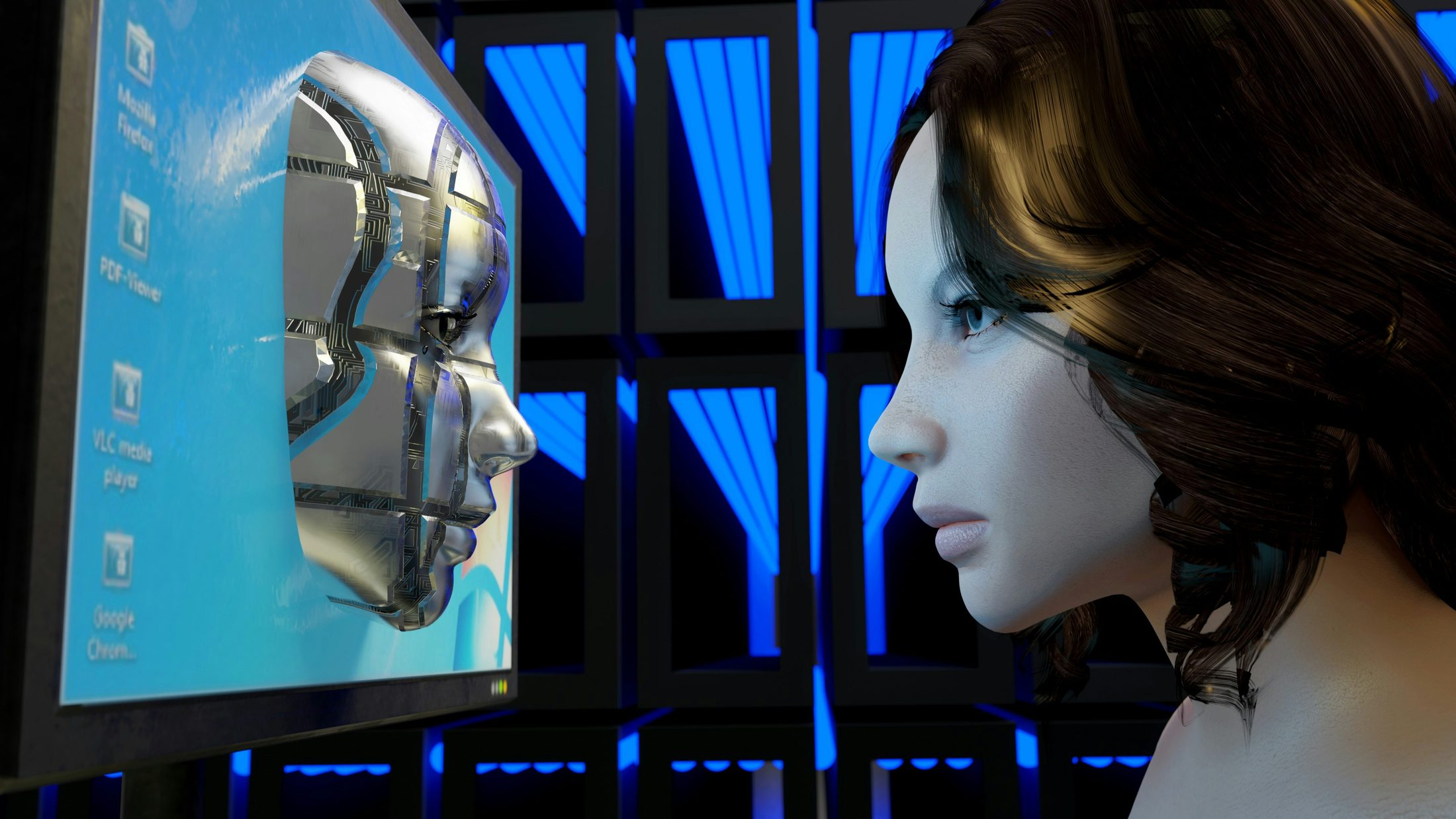
Photo by Andres Siimon on Unsplash
In a dystopian turn of events that somehow surprised no one, Time magazine named AI their 2025 person of the year. Well, technically, Time named “The Architects of AI” as the persons of the year. The cover photo featured eight prominent tech leaders sitting atop a steel beam towering above New York City; two of these leaders were women, representing 25% of those eight, which is 3% higher than the true proportion of women that comprise AI talent globally.
So, today’s cultural moment is marked by AI and the people who create it, which is almost 80% men. Still, I think about movies like Ex Machina, Her, Subservience; I think about Siri, Alexa, Google Assistant; I think about Tilly Norwood, Amelia, and Ani. On screen or in real life, AI manifests with female characteristics and likeness. This common thread sits in my mind, and an eerie thought follows. AI was predominantly created by men, but AI could only ever be born a woman.
In fact, I’d argue that the general public’s mass acceptance of AI depended on it being a woman. It’s no coincidence that the first AI assistants– Siri, Alexa, Cortana, Ivee, Google Assistant– all had female voices. When these AI models were introduced and programmed onto our smartphones and inside our homes, it was crucial that they were likeable, trustworthy; that they were seen as there to help, to ease, to serve.
We as humans innately prefer female voices, with some studies suggesting that it comes from hearing our mother’s voices during our time in utero. Other data points to the widespread association of female’s voices with customer service roles. This stereotyping comes from a long history of the predominance of women as telephone operators– a history that also produced hundreds of years of female voice recordings, and nearly none for men, making female voices easier to build artificially. In a world where the women’s role has historically been linked to submission and service, the choice of how to gender AI so that it is palatable to the public both stems from and further solidifies this stereotyping.
Soon after putting a female voice to AI, female faces and bodies were put to it, too. The world's first AI actress is Tilly Norwood. Eline Van Der Velden, Tilly’s creator and the founder of Particle6, insists Tilly wasn’t created to replace live, human talent– that the character is a “piece of art”– but then she contradicts herself, boasting that Tilly can lower production budgets by cutting the cost of hiring actors. Why hire real human girls when Tilly– who never sleeps and never says no– can do the job instead? Anything that a human wouldn’t or couldn’t do on screen, Tilly can, and will. She is, in all senses, the perfect exploit: a young, female “body” with no autonomy, and a promise of bigger profit margins.
Support independent journalism
Enjoy reading The Parlor?
Become a paid subscriber to get full access, early releases, and subscriber-only extras.
Become a paid subscriberWhile Tilly is owned and operated by Particle6, other female AI avatars are available to the public. Grok AI, owned by Elon Musk, recently released “Ani”-- a digital Japanese Anime girlfriend. Like Tilly, Ani will do and say anything the creator or user requests for a sweet $30 a month, no consent necessary. There’s also Amelia, an AI generated far-right social media star. Amelia’s purple-haired goth style avatar was created as a cautionary example for an educational video game designed to help teenagers recognize and resist online radicalization; instead, far-right social media users have repurposed and idolized her, creating extremist content, memes, and even cryptocurrency from her likeness on platforms like X. Exploited by the “manosphere,” Amelia has become a monetized version of hate-speech. Of course, the option for male AI voices and avatars exists, too. Though studies show when male-gendered, AI is perceived by humans as having more authority and expertise. Our biases and stereotypes of traditional gender roles are transferred onto AI and reinforced.
There’s one more point worth mentioning, though it is more metaphorically hypothesizing than laid in concrete facts. More and more each day, AI is advancing, exponentially increasing its capabilities. There is chatter that it will either be the best thing to happen to our world, curing diseases and solving climate change, or that it will lead to humanity’s mass destruction and extinction. We have created something that has the ability to either usher us into utopia, or damn us to doomsday.
Some people believe that we no longer have the ability to influence which path AI will take. That it will decide on its own. That the robots will win, and choose to ruin us. They believe that we have no control; as if we as its creators cannot guide it into choosing the right path, the good path.
I’d thought I’d heard this story before. The one of a God who creates a being to help mankind, offers her an apple, and then casts her out as a monster unto herself after “she” has destroyed everything. As if he hadn’t sent the snake himself.
About the author
Elizabeth Collins
Elizabeth Collins is a writer and performance study scholar based in London, U.K.. She holds a BA in English Literature and Creative Writing, and an MA in English Literature and Performance Theory from King’s College London, where her dissertation explored the mediatized nature of the Black Lives Matter movement. Across her academic and professional experience, her work engages with the intersections of arts, culture, and human connection. When she’s not engaging with academia, you can find her writing poetry, instructing theatre workshops, teaching yoga, or re-watching The Big Bang Theory.
Conversation
A space for Parlor members. Be generous, be real.
Loading…