
"From Abstraction to Humanity"
Reading Persepolis in a Time of War

Claudia Jobi
March 26, 2026
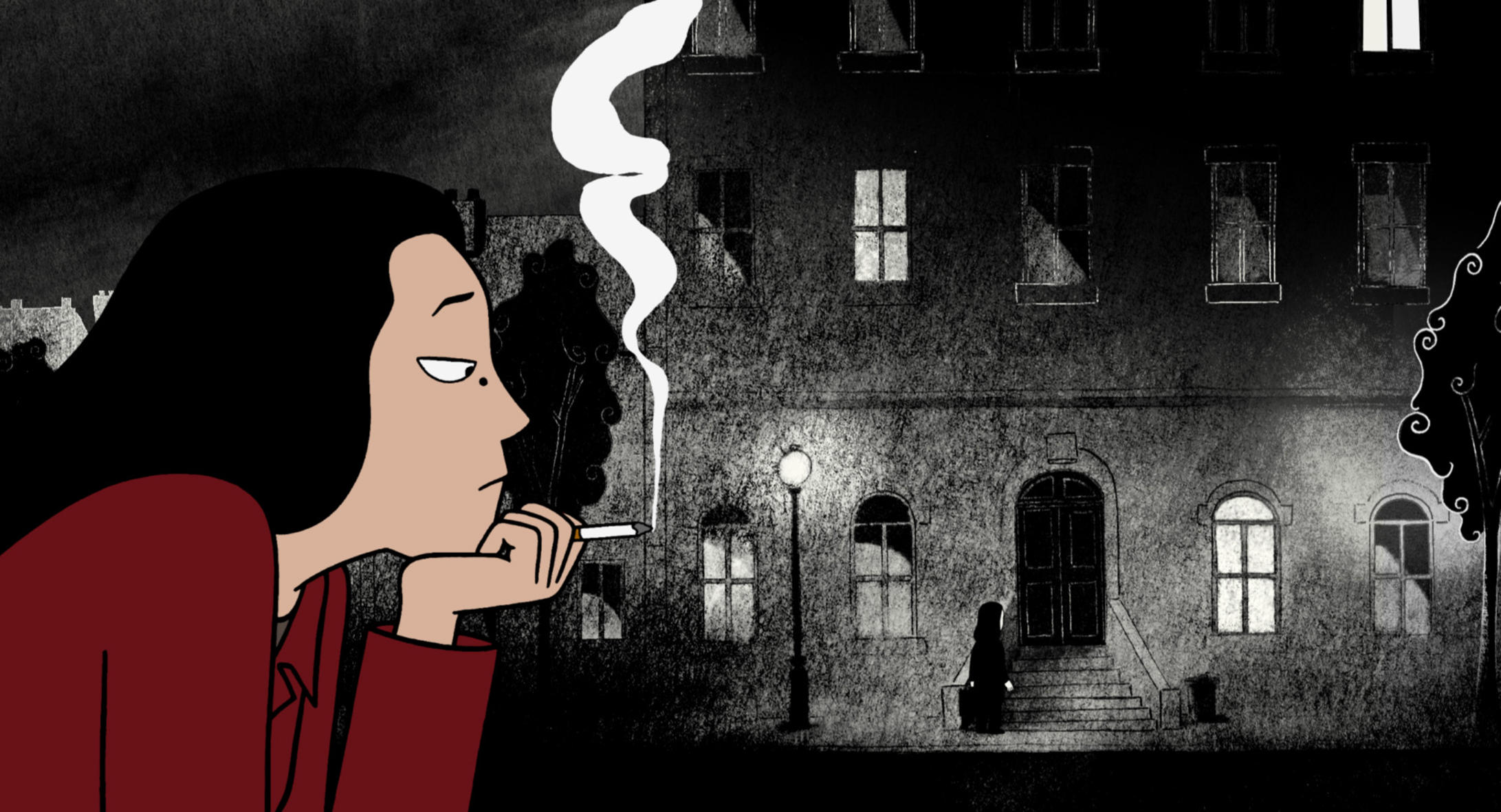
Persepolis Year: 2007 - France Director: Marjane Satrapi, Vincent Paron Animation From the comic book of Marjane Satrapi
Last month, the United States and Israel organized coordinated militarized attacks on Iran. The strikes were widespread, including various cities and major infrastructure. Additionally, long-time Iranian Supreme Leader, Ali Khamenei, was assassinated by airstrike.
Following the weeks since the US-Israel campaign, a reported 1,114 civilians have been killed, including 183 children. On February 28th, the first day of the attacks, The Shajareh Tayyebeh girls' elementary school in Minab was struck by a missile, causing the roof to collapse on over 100 children.
Unfortunately, the war in Iran rages on.
The Parlor’s book club picks are often centered on our value for human rights as a publication. The pick of Persepolis by Marjane Satrapi is no different. With the deep grief surrounding the United States’ decision to attack Iran, I encourage you to read Iranian authors—to better understand their lives, their stories, and the realities of this ongoing crisis.
Persepolis was released in 2000 and is an autobiographical graphic novel about the life of author Marjane Satrapi, who grew up during the Islamic Revolution. The novel starts with Marjane as a ten year old girl being told she should begin to wear a veil in public. Being a part of an upper-middle class family, Marjane has access to educational materials that expose her to various political ideologies.
As a young girl, Marjane is eager to learn and eager to protest, like her parents often do. As Marjane grows older, both the political violence of Tehran and her awareness of it grow. Various adults, and even her uncle, are tortured and killed by Islamic extremists.
The book is set in two parts: Marjane’s childhood and eventual departure from Iran and her return years later before leaving again.
Persepolis is a coming-of-age text in many ways, but the typical themes of identity and belonging are heightened to a degree few will ever understand. Consistently, Marjane’s innate self, her mind and her bold personality, are pitted against a regime that tells her women are less than men.
In many ways, the novel’s mixed-media approach helps readers visualize what is otherwise difficult to imagine; at the same time, it reveals how words alone often fail to capture the complexity of experience.
Support independent journalism
Enjoy reading The Parlor?
Become a paid subscriber to get full access, early releases, and subscriber-only extras.
Become a paid subscriberIn 2016, Satrapi was interviewed by Emma Watson at Vanity Fair to talk about the conception of Persepolis and its position in broader culture.
“The enemy of democracy isn’t one person. The enemy of democracy is patriarchal culture…” stated Satrapi when asked about the state of women’s lives in Iran, “If we have more educated women, then we have more educated societies. This is without any 'feminist prejudice'—it’s fact.”
A central theme in Persepolis is Marjane’s access to education. In 2016, women made up 70% of university students in Iran—a figure that remains largely unchanged today. In a regime that positions women as less important than men, many turn to education as a form of freedom. While Satrapi highlights the power of both experience and education, she also raises a deeper question: what can one do with these tools?
Right before Persepolis was written, Satrapi has discussed her experience with a deep depression. In fact, there was a time when after not being able to breathe, she fell down the stairs and broke her head. Satrapi often cites this experience as what pushed her to write her life story, to do something with her pain.
The process of making art, of trying to make sense of experience often with the aid of education, is not just a beautiful act, but has deep cultural ramifications. Often, art is an access point into other stories and lives.
This is not lost on Satrapi, who argues in her interview with Vanity Fair that the more community we forge, the better we are as humanity: “As soon as you know somebody from somewhere else, then it is much more difficult to just consider them as 'the enemy' because the person becomes real. It’s not an abstract notion anymore.”
Despite the ways this novel turns us toward humanity, there have been several attempts to ban it from libraries in the United States. In states like Chicago, Oregon and Texas, parents have questioned the book’s use in schools as well as it’s language, sexual content, and depiction of torture. Although the censorship in these places was unsuccessful, the fight against the text shows broader intolerance of differences in views and culture.
While Marjane Satrapi has not directly addressed the recent U.S.-Israel escalation in Iran, her autobiographical work remains a powerful invitation to listen and learn about the Islamic Revolution and its lasting impact. Most importantly, it moves us beyond abstraction, grounding us in a humanity that calls for empathy and understanding.
About the author
Claudia Jobi
Claudia Jobi is a poet and essayist based in the Midwest. Her work has appeared in Eunoia Review and The Pub. She plans to pursue an MFA in the coming years. You can find her on Instagram at @claudia.jobi.
Conversation
A space for Parlor members. Be generous, be real.
Loading…