
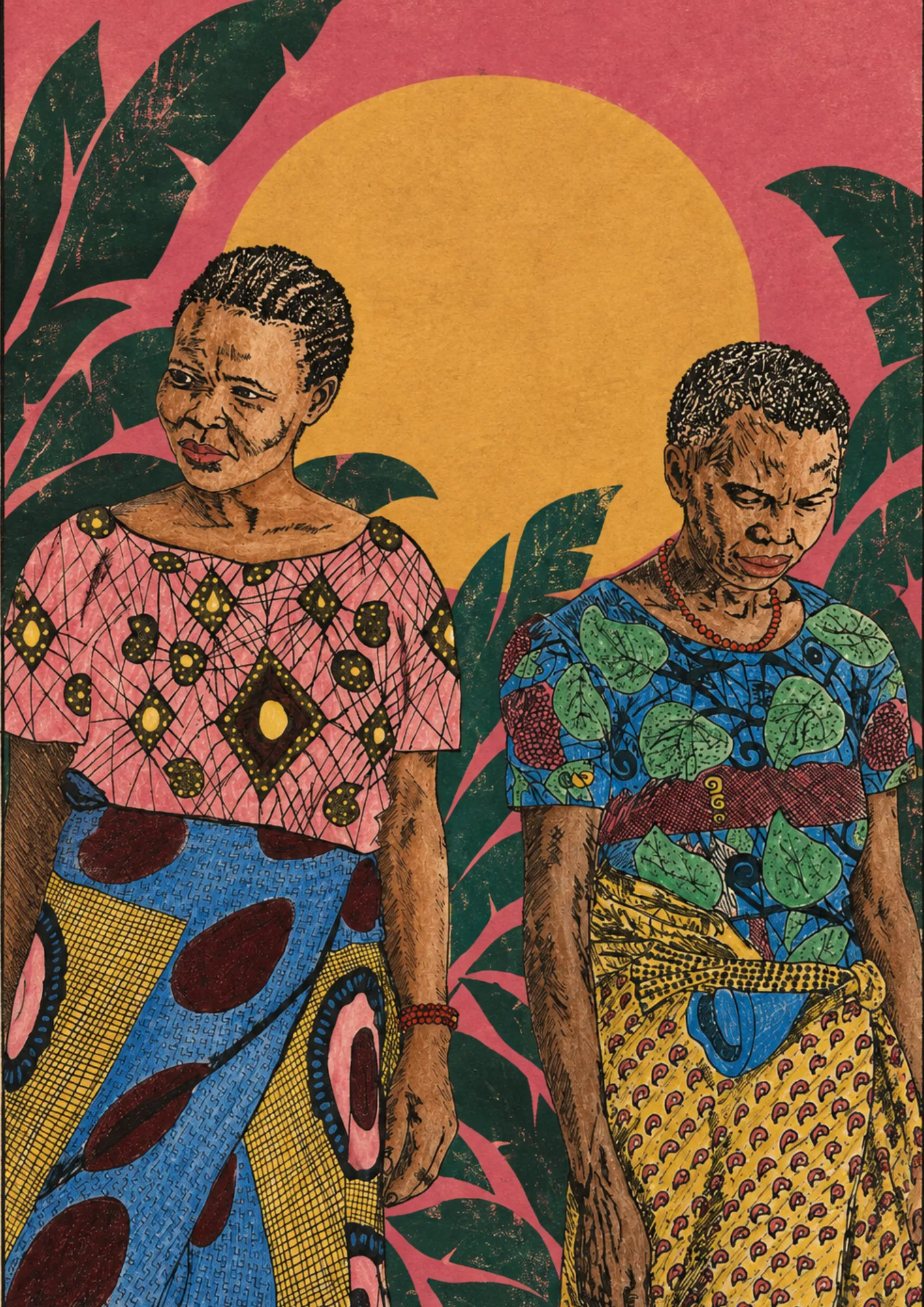
In the Mara region of northern Tanzania, in a district with one of the country's highest recorded rates of spousal violence, a widow named Robi Matiko married a younger woman named Busina Samir.
The arrangement is not a new practice; it's a named, centuries-old Kuria tradition called nyumba ntobhu, "house of women." Under Kuria custom, only men can inherit property. A widow with no sons is unprotected — vulnerable to losing her land, her home, and her standing the moment her husband dies. Nyumba ntobhu solves that: the widow marries a younger woman, who may take an outside lover to conceive children who then inherit as the widow's own. The man forfeits all paternal rights as a condition of the arrangement, and tribal elders, who recognize and defend these marriages, have historically punished any man who tries to seize property from the household. Before she married Matiko, Samir had been a second wife in a marriage where she was beaten and forced into servitude. Now she no longer suffers.
Anthropologists have documented versions of platonic woman-to-woman marriage — arrangements that reallocate inheritance, labor, and protection between women, independent of romantic or sexual partnership — among dozens of ethnic groups across the African continent over the past century, from the Igbo tradition of "female husbands" to comparable customs among Bantu-speaking peoples in East and Southern Africa. In the Tanzanian village of Nyamongo, female-headed households formed this way reportedly make up 10 to 15 percent of all households.
Across the ocean, similar living arrangements are gaining popularity: in New York City apartments and Washington, D.C. fourplexes and a Texas trailer park. Women who would never use the word ntobhu are adopting housing solutions and family structures rooted in the premise that a household of women is often safer and more economically stable than one built around a single male provider.
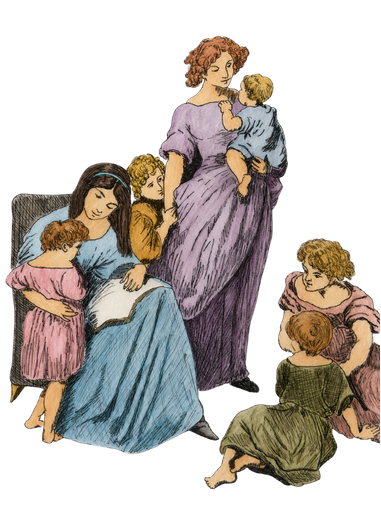
Silvia Federici, author of Caliban and the Witch, would argue that women’s dissatisfaction with the traditional setup is not a coincidence of individual bad marriages— it’s systemic. In her book, Federici locates the origin of the isolated nuclear household further back than the invention of factories: in the transition out of feudalism, when the enclosure of Europe's common lands stripped peasant communities of shared subsistence and, with it, the semi-autonomous economies women had run within that commons — herbalism, midwifery, shared child-rearing, and a body of communal knowledge about reproduction and contraception that gave women real control over their own fertility and labor. Federici describes the witch hunts that swept Europe between the
fifteenth and seventeenth centuries as a coordinated campaign to criminalize midwives and healers, waged in tandem with the land enclosures, in order to shift the control over women’s reproductive capacity into the privatized, nuclear family systems that industrial capitalism would come to depend on.
Finding the Village
A single mother of two in New York City, Bernie Sinclaire grew up watching her own mother raise six children largely alone. Recently separated from her partner, she quickly realized that the only way she could survive was by finding her village. She tried the apps — Peanut, BumbleBFF — and found they were built for playdates, not for what she actually wanted: another adult to run a home with. So she proposed the idea to her close friend Anabelle. "A mommune is an alternative family structure," she explains. "It's woman-centered and child-centered. This is not roommates. This is not ‘come move in and split the bills.’ We are running our family almost like a business."
Where a disagreement with a romantic partner might curdle into an argument, the same friction with Anabelle becomes what Sinclaire calls a long philosophical conversation about shared goals. Part of that, she says, is structural: without a romantic partnership in the mix, there's no added weight of romantic, emotional, or sexual expectations sitting on top of the logistics. The rest, she attributes to the fact that they are able to preempt each other's needs and the needs of the household without needing a list of tasks — what a 2024 University of Southern California study of 500 households named the "mental load."

"We talk about this invisible mental load," Sinclaire says. "It's like this never-ending to-do list, this delegation of tasks. There is a title for people that do this. It's called a manager. It's called a CEO."
The study found that men, on average, take full ownership of exactly one recurring household task, taking out the garbage, while women default-manage everything else.
What Sinclaire references ties directly back to Federici’s argument about the privatization of the labor of social reproduction — cooking, cleaning, child-rearing, caregiving — assigned to women, unwaged, inside the home. Wages went to men in the factory; women's labor of keeping those men, and the next generation of workers, fed, clothed, and alive was invisibilized within the domestic sphere, elevated to the language of sacrificial labor, and priced at zero.
Every mommune, platonic marriage, and senior co-housing plot not only addresses the invisible labor of care work, but the real day-to-day costs of modern living: splitting rent, the cost of groceries, a nanny, a mortgage, and water and electricity bills. For Sinclaire, it has made a real difference, putting roughly $1,200 a month into her savings. But she's explicit that the calculation isn't only financial. "You build it with your friend," she says simply. "Both people are focused on the kids, and because of that, you individually have more room to breathe."
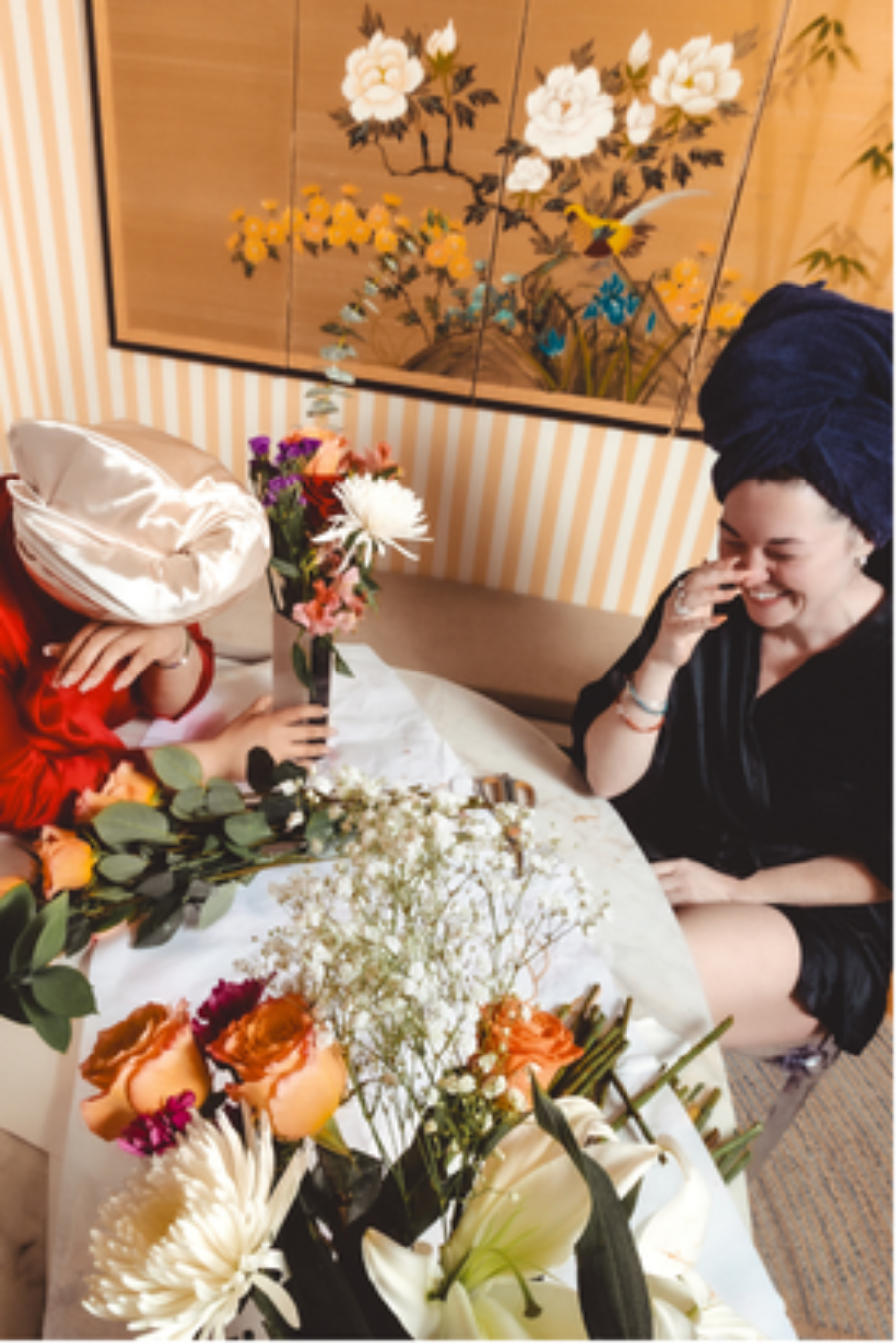
There's a term for what Sinclaire and Anabelle are doing. Feminist theorist Sophie Lewis names it directly in her book Full Surrogacy Now, which, despite its title, isn’t referring to commercial surrogacy. "I'm talking about surrogacy in the sense of gestational holding that is shared among many," she says. Her argument is that the sharp line drawn between a paid surrogate and a mother raising a child inside a nuclear household starts to dissolve once you take seriously that the responsibility following a birth — not just the labor of the birth itself — is something communities could hold together, rather than something a single body owes to a single household. Sinclaire and Anabelle, dividing the work of raising three children between them, are doing exactly that.
She's not the first to do this. In 2020, two newly divorced friends in Washington, D.C. — Holly Harper, a marketing executive, and Herrin Hopper, an attorney — pooled their finances and bought an $835,000 fourplex in Takoma Park, Maryland, eventually bringing in two more single mothers to share it. The New York Times, profiling the household in 2023, described the two women calling each other "platonic spouses"; Harper told the paper the arrangement restored something divorce tends to strip from women first — economic mobility. A year later, a Forbes piece by Elizabeth Pearson picked up the same reporting, framing it as a way for women to pursue the legal and financial architecture of marriage — insurance, tax benefits, property protections — deliberately uncoupled from romance, and asking, as she put it, whether women "really need men" for that architecture to function at all.
What Elder Women Already Knew
Meanwhile, a parallel structure has quietly formed at the other end of the life cycle. In North London, women in their fifties through nineties live independently in their own units at New Ground Cohousing, sharing a garden, common spaces, and a standing obligation to check in on each other. The idea traces to 1998, when founder Maria Brenton introduced a group of Londoners to woongroepen, a Dutch senior cohousing model built to cut isolation and ease strain on public health systems. It took the founding group eighteen years and multiple funding setbacks to open New Ground's doors in 2016; this June, the community marked its tenth anniversary.
An ocean away, in the small town of Cumby, Texas, Robyn Yerian spent the entirety of her 401(k) on land to found The Bird's Nest, a tiny-home community for elderly women renting plots at a fixed $450 a month — deliberately low, given that close to half of American seniors live on Social Security alone. Yerian, who owns the property outright, has weathered Fair Housing complaints due to their women-only policy, aimed at shutting the community down. The pushback doesn’t deter her, however, and she still gets daily messages from women who want to start something similar elsewhere.
Both communities describe the same undertow: a cultural expectation that women, once their reproductive and caregiving labor is finished, become disposable. Yerian has put the question bluntly: "Once we've hit retirement, we have no purpose… We've already had our kids, we've worked… What does society see us as now?"

It's a question Lewis has already answered, in a different register, with what she calls "the deal" — the specific social technology in which a single adult, almost always the mother, takes on near-total, privatized responsibility for another human being's survival, in exchange for a culturally sanctioned sense of ownership over that child.
"The deal is that you as a sort of single unit will be bought off by having some kind of property relation to a child of your own," Lewis says, "and in exchange for that dubious kind of sense that you own something, you will have near total responsibility for the reproduction of this human being's life." Read against Yerian's question, the other half of the deal comes into focus: once the child is grown and the debt is paid, the culture that granted a woman her sense of purpose through ownership has no further use for her. The problem, in Lewis's framing, was never caregiving, which she calls beautiful and genuinely constitutive of who we are as human beings. It's the conditions: scarcity, isolation, a single person bearing total responsibility and absorbing all of the invisible labor, leaving them empty-handed once the social contract has been fulfilled.
Being part of a community like The Bird's Nest, Yerian says, gives women back the feeling that "I matter, and people care." Both New Ground and The Bird's Nest answer the question the same way: with a garden, a shared meal schedule, and a standing expectation that everyone shows up for everyone else.
Held By Others
Sinclaire is now building an app meant to help other women find their own version of Anabelle. She's not the first to try: CoAbode, a much earlier version of the same idea, has connected an estimated 100,000 single mothers across the U.S. and Canada looking to share housing since the early 2000s. The global co-living market, a category broad enough to include both corporate-branded startups and informal arrangements like Sinclaire's, was valued at $7.8 billion in 2024 and is projected to roughly double by 2030.
None of the women in these stories describe what they've built as finished or frictionless. New Ground makes no claim to unanimous agreement among its 26 residents; Sinclaire is candid that finding the right person to build a household with is a slow, deliberate process closer to dating than to roommate-matching. What connects Matiko and Samir in Tanzania to Sinclaire and Anabelle in New York, to Harper and Hopper in Takoma Park, to the women of New Ground and The Bird's Nest, is the shared refusal, arrived at independently and repeatedly, across centuries and continents, to accept that the nuclear household is the only institution capable of being both an economically viable and sole protective unit for women and children.
This is what Lewis means when she describes her own politics as a utopianism built out of negativity — not a fixed blueprint for how a household should look, but rather "a willingness to constantly hold on to the rejection of the premise that this is how things have to be." Her own concrete proposal is that at least half a dozen adults be genuinely, structurally committed to any given child, "because one or two is nuts," and that who a person lives with or loves has no bearing on whether they can access shelter, food, or medical care. Sinclaire, Harper and Hopper, New Ground, The Bird's Nest, are all small, imperfect examples of this premise, tested against rent payments, school pickups and 401(k)s. And more importantly they are challenges to the capitalist idea that true freedom is achieved through individual property ownership, acquired through traditional family structures, isolated from community.
"Freedom is not freedom from people — it's freedom through people.” Lewis says, “You only have freedom insofar as you are with and held by others."

About the author
Elizabeth Collins
Elizabeth Collins is a writer and performance study scholar based in London, U.K.. She holds a BA in English Literature and Creative Writing, and an MA in English Literature and Performance Theory from King’s College London, where her dissertation explored the mediatized nature of the Black Lives Matter movement. Across her academic and professional experience, her work engages with the intersections of arts, culture, and human connection. When she’s not engaging with academia, you can find her writing poetry, instructing theatre workshops, teaching yoga, or re-watching The Big Bang Theory.
Conversation
A space for Parlor members. Be generous, be real.
Loading…