
Living Landscapes
A New Model for Archaeology and Climate Change Remediation
Elisa Shoenberger
May 26, 2026
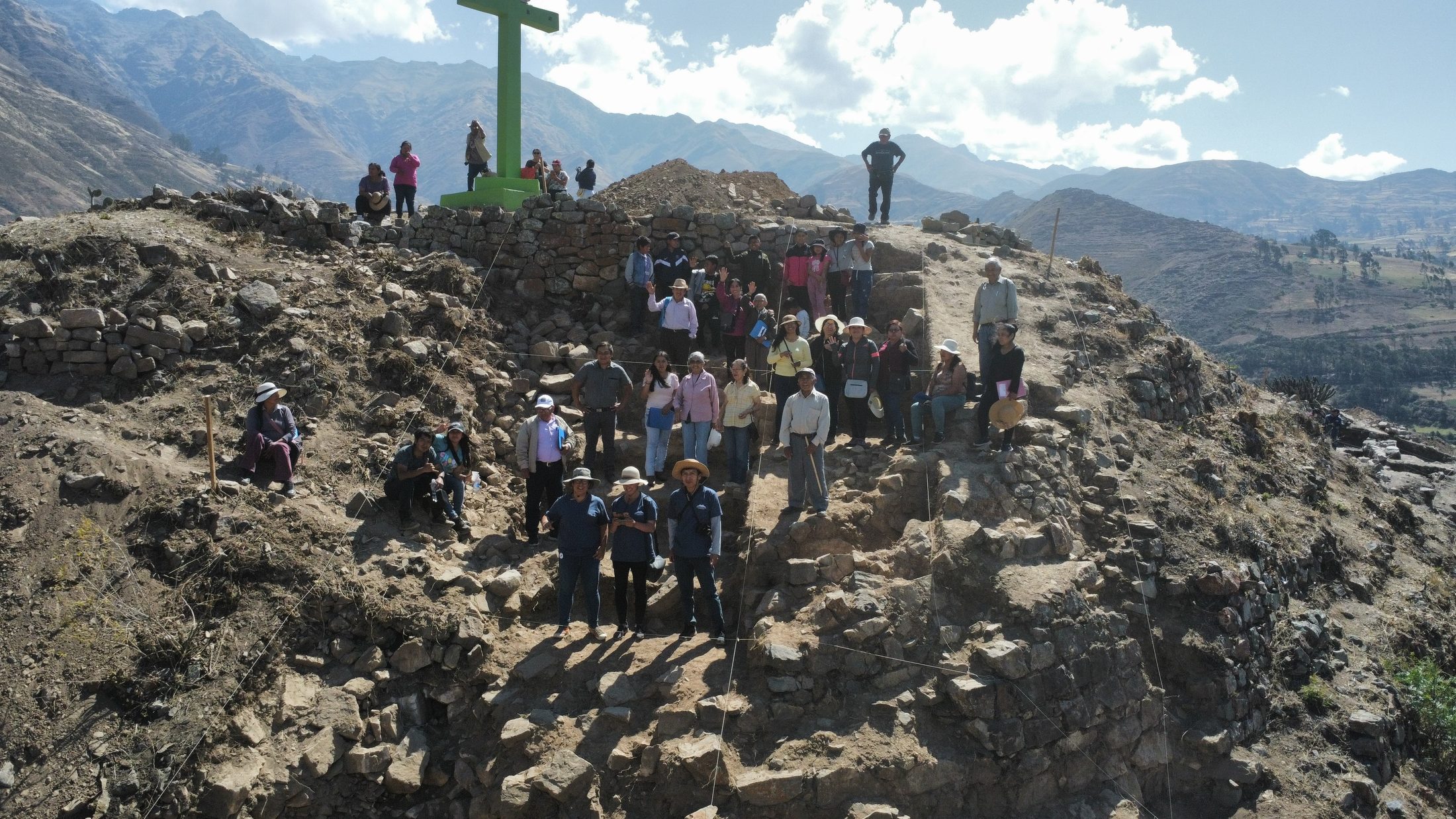
When people think of archaeology, they often think of ancient Egypt or ancient Greece. They imagine dozens of people hunched over dusty fields brushing away grains of dirt and sand with tiny brushes. People usually do not think of archaeology as something that is part of everyday life. But people do live in, around, and with archaeological sites. Unfortunately, some archaeologists treat the people living near and around the archaeological sites as a nuisance or threat to the dig instead of recognizing the site’s importance to the people living there. Plus, the objects and research are often shipped off to faraway places with little benefit or shared findings with the community.
Amanda Brock Morales, Ph.D., R.P.A. and Nat Geo Explorer is trying to change this antiquated view of archaeology with a more community-based, collaborative archaeology. Morales proposes leveraging the knowledge and stories of the local communities where the archaeological sites are located. Often in archaeology, landscapes are treated as something of the past, but “the archaeological landscapes that we work with are very much a part of a present day landscape. Present day communities…still have relationships with these places and use them in meaningful ways,” Morales explained. Her approach is a more collaborative archaeology where they work with and for communities.
She’s been working with the community in Callejón de Huaylas in western-central Peru to better understand the past, present, and possible future of the region. She’s the director of Kawsay Pacha Archaeological Project that aims to put this philosophy into practice.
“It's a novel approach in archeology that is building off and connecting with not so novel ideas. We are working with local and traditional knowledge, Indigenous knowledge practices, which have been around for many, many years, and we're trying to link that with the scientific approaches in archeology,” Morales said.
In an email follow-up, she said the title reflects this core philosophy: “Kawsay in Quechua means alive, or living and Pacha in Quechua means land, earth, but also time. This is because we both recognize that we are working in a vital and living landscape and that our pasts, presents, and futures shape one another in important ways.”
The project originally started as part of her Ph.D. research, but on a much smaller scale. She wanted to excavate the site in Huaylas but wanted to ensure that it was a community collaborative project. The first step was finding a Peruvian archaeologist to partner with in accordance with Peruvian laws. She was fortunate to find Cinthya Cuadrao Mallqui, now co-director of the Project, who shared her vision.
Starting in 2022 when COVID-19 restrictions were lifted, Morales traveled to Peru and worked on getting to know the community, before putting a shovel in the ground. It was imperative that she got to know people in the village and learn about their relationship to their home, the local stories, and their knowledge of the archaeological sites. She wanted to know the potential archaeological areas they were interested in or certain places they were afraid of, so they knew where not to excavate.
In 2023, after laying the groundwork, Morales and her co-director began excavations in the area where they found ceramics. They have a limited time to study the ceramics according to Peruvian law. There was also a need to store the objects in specific conditions to ensure further damage or deterioration would not occur. But they did not just want to take the ceramics with no benefit to the local community.
Morales and Mallqui are taking some creative steps to avoid simply extracting the objects from the site and sending them elsewhere for study and storage. They are creating 3D models of the ceramics. The idea is to digitally repatriate ceramic materials back to the community and have the materials accessible to students through 3D modeling. Morales mentioned plans to work with local artists to replicate the paint colors and decorations and bring these archaeological pieces to life.
The project also hosts workshops that Morales calls “knowledge sharing workshops.” They bring together leaders, local educators, local historians, and other community members where Morales and her collaborators share their archaeological research. These workshops are also meant for the community members to “share their knowledge of their landscapes and traditions as experts in their own culture and their own landscape.”
One project included asking people to map their heritage places in and around the town. “People did include physical places, but they also ended up including these local traditions and foods and things,” Morales said. They felt that these traditions and customs needed to be protected and were in danger of being lost. These workshops help create “spaces for different kinds of knowledge to be shared, but then also shared across generations,” Morales explained.
For instance, in the beginning of Morales’s work, the hotel owner where they were staying shared some old photos of the town from the 1960s. She decided to recreate those photos in the present day. They held a workshop where they projected the old photo with the new photo on a screen. The workshops prompted the older people in the community to start telling stories while the younger generations contributed their own experiences.
The experience sparked a photo repatriation project. In the 1970s, there was a huge earthquake which changed the landscape, so those photos depict a world that no longer physically exists. Morales wants to digitize the photos for the community so they can be incorporated into their collective knowledge of the land, before and after the earthquake. She hopes to have additional workshops to continue knowledge sharing.
The Next Generation of Archaeologists
In addition to working with the local community, Morales works with students from the relatively nearby Universidad Nacional Santiago Antúnez de Mayolo (UNASAM). They’ve brought on archaeological students to work on the digs in Huaylas. But one thing that Morales has noted is that most of the students who want to work with her and her team tend to be female. At the university, all the faculty are men but half the student body are women or non-binary. So these students do not have female or non-binary role models. So it’s been pretty powerful to see how important that has been for the students to work with a women-led team.
They’ve been able to accommodate the needs of their female students, such as make sure facilities are available to field sites. For instance, they were able to accommodate a woman who was pregnant and later on, when she had her infant, she had time to breastfeed.
When thinking about women and non-binary people’s hygiene and other needs, “I think it's just a blind spot,” Morales noted, in some excavations.
Support independent journalism
Enjoy reading The Parlor?
Become a paid subscriber to get full access, early releases, and subscriber-only extras.
Become a paid subscriberIn addition to the university students, Morales hopes to collaborate with a local elementary school I.E. Emiliano Haro Collas, which is located at the base of the main archaeological site. Morales and her team are collaborating with another Nat Geo educator to design a kit based on the ceramics found on the site. The kit would include a facsimile of the ceramic pieces that the school children can practice excavating them, just like Morales and the other people working on the various projects.. Morales hopes to engage the school with different programs as another way to encourage more knowledge sharing between generations.
Water and Climate Change
Another archaeological and community-collaborated project focuses on local water management in response to climate change. Morales explained, “archeology is already a really important discipline for understanding deep, deep time, environmental and human relationships.” She wants to connect that knowledge with the traditional and Indigenous knowledge of the people who are living in the area. The local community have their own experience with the landscape and their own experiences on how climate change is impacting their environment. The issue of water was a hot topic for everyone in Huaylas.
Huaylas is experiencing unreliable rainfall and long droughts. Part of it is the geography of the land. There are two mountain ranges; one has glacial peaks and the other is drier. Morales said that the glacier peaks are disappearing. Scientists predict that the glacier peaks will be completely gone in the next 50-100 years. The glaciers are very important for the communities who live along the mountain range, as well as providing water to the dry coast of Peru. Morales works in the land on the drier mountain, which is in a semi-arid climate and relies on rainfall.
In the past, the rainy season was more predictable. Morales explained that the first rainfall would happen, then people knew to plant their seeds and know that the rains would nourish them. But now the rain is not so regular anymore; it may rain once but then there’ll be a drought. Or the rains will come really late so people do not know when to begin the harvest season. It’s impacting their food for themselves and their animals.
The issue has come up in their workshops and Morales started seeing the different ways that the community has tried to mitigate the inconsistent rainfall, such as renting out land for grazing for folks whose land had grass.
There was another intriguing environmental factor about Huaylas. In Morales’s TEDxUNCCharlotte Talk, she recalled Community Leader Marco Reyes commenting: “Even in drought, Huaylas is Green.”
Morales wanted to find out why Huaylas remained green despite the worsening drought and inconsistent rains. She started talking directly with community members; together they began walking the landscape and noticing archeological canal systems. Community members added that there were reservoirs known as puaq qocha, which meant “8 Lakes” in Quechua. The community members believed that these older systems were destroyed when the more modern canal systems were built. Often in the Andes, the modern technology caves over and destroys archaeological technology, repurposes and reuses it, or the archeological canals are completely abandoned.
On top of that, the modern canal systems were not working as effectively either. Plus, Morales and her team also learned that there was no official map of any of these canals.
In order to better understand the various canal systems and water storage in Huaylas, the project is working with the community “to create these maps to understand the extent to which the landscape has been engineered in the present and in the past” including the canal systems, reservoirs, and terracing. People have long manipulated the landscape to “enjoy the landscape, to harvest it and to grow.”
“We're really also trying to document this process so that they can have this for the future. They could have these maps,” Morales said, “They could have their oral histories documented, so that they could also take it and use it as they're also advocating for their own rights."
But it’s not just about the water delivery technology, Morales said, “we also really want to document and preserve stories and memories and traditional practices associated with water…Water is also culture. It is part of memory and it’s also part of what connects people to each other. “
After these steps, Morales hopes that they collectively will be able to design something to deal with the water challenges in the area. She wants to work with local artisans and builders to implement the solution they come up with. Morales explained that maybe they can learn from the past and put together present day knowledge and find new solutions for the future, always working with the local community.
However, the situation is reaching a point in Huaylas where the climate is shifting so much that it’s past the tipping point. “The way that the landscape was engineered, even in the past and in the present, isn't enough to support this change in the climate,” Morales said. She sees the work as an attempt to understand water technologies in the past and present; the solution may be a combination of both current and past water practices and knowledge. But like everything else in the project, the development and implementation would be in collaboration with local leaders, local knowledge seekers, and other community members.
Ultimately, Morales wants the work of Kawsay Pacha Archaeological Project to “center community collaboration, relationship-building and care, and making sure that the outcome of these collaborations and projects not only address issues in the present, but also contribute to the desired futures of the communities that we work with.”
It’s more than research but also education at all levels, knowledge sharing and accessibility between researchers and the community, between generations to develop solutions to tackle community challenges such as climate change and other environmental changes.
About the author
Elisa Shoenberger
Elisa Shoenberger is a freelance writer and journalist in Chicago. She also has written for the Boston Globe, Huffington Post, WIRED Magazine, Slate, and others. She writes regularly for Book Riot, Murder & Mayhem, Library Journal, and Cheese Professor. She’s obsessed with dogsledding, murder mysteries, and cheese.
Conversation
A space for Parlor members. Be generous, be real.
Loading…