
No Prince Charming Required
Bernie Sinclaire wants single mothers to find their village

Lindsey Brock Morales
May 7, 2026
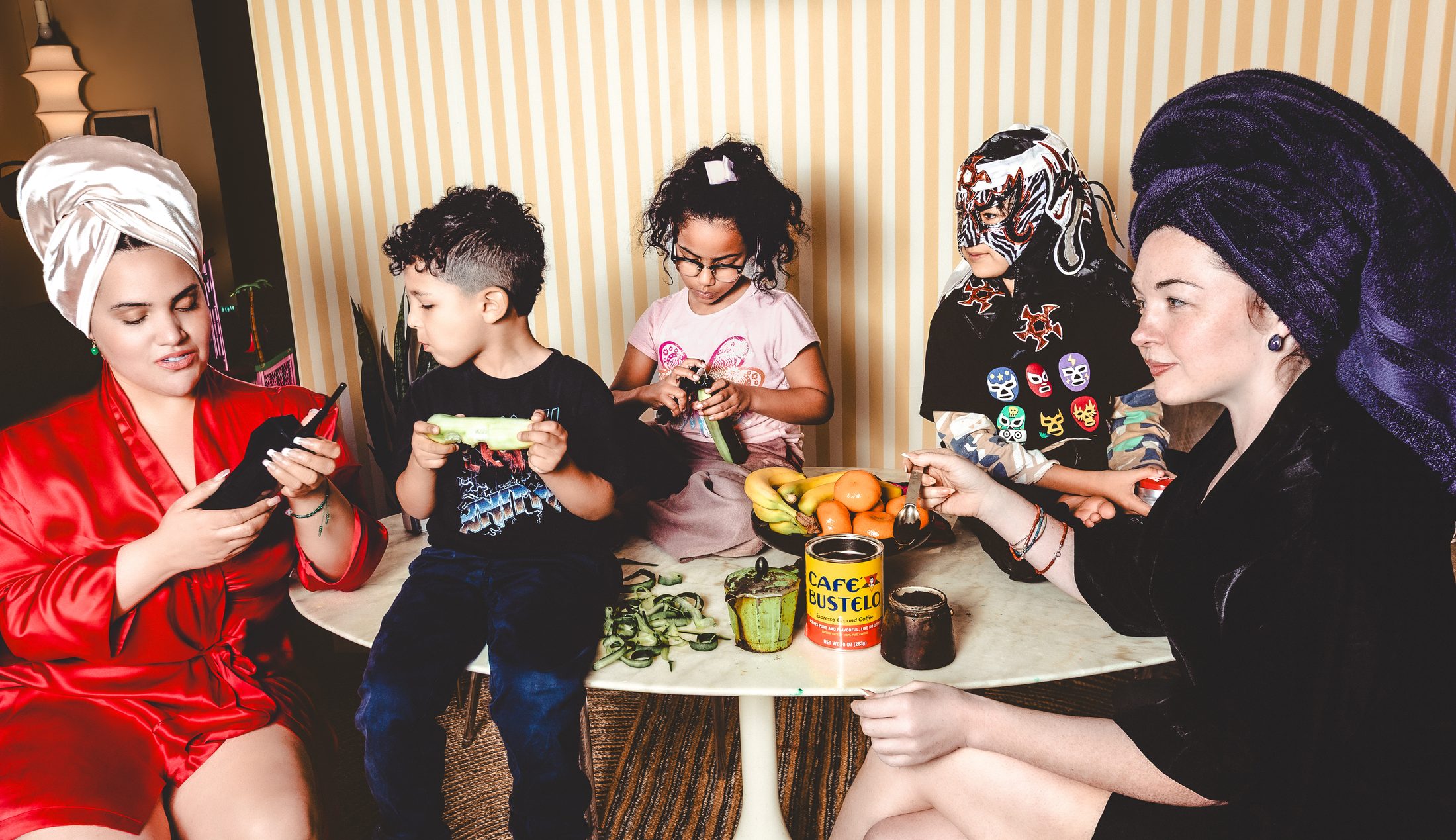
Photo byLani Lee @lanileephotography
Bernie Sinclaire grew up watching her mother do the impossible. A single mom raising six children, she did it alone, largely without help or a safety net. "My best memories are me and my siblings with my mom," She recalls. Father figures came and went— not always by choice but necessity, her mother ultimately forced to choose between poverty and partnership. Bernie vowed her life would be different.
Decades later, She found herself living a version of that story herself. A single mother of two in New York City, burning through childcare costs that rivaled her rent and carrying the full weight of domestic life on her own.
Bernie's story is far from singular. There are currently around 11 million single-parent households in America, roughly 8 million of which are led by single mothers. The poverty rate for single-mother families is 31.3%, nearly six times that of married-couple households.
And yet for many women in heterosexual partnerships, the struggle doesn't begin with single motherhood — it begins long before. A 500-person study by the Fair Play Institute at the University of Southern California in 2024 found that women take on the cognitive labor — the planning and mental load — for virtually every household task. Men, on average, assumed full planning responsibility for just one: taking out the garbage. And it’s not just cooking and cleaning, but child-rearing as well. "We talk about this invisible mental load," Bernie says. "It's like this never-ending to-do list, this delegation of tasks. There is a title for people that do this. It's called a manager. It's called a CEO."
The result, for many women, is a slow accumulation of resentment, burnout, and the creeping realization that partnership, as currently constructed, can cost more than it gives. For Bernie, that realization came with a clarity she didn't expect.
“I realized I wanted to be a single mother," she says. And when she made that leap, something unexpected happened — it was easier. Not logistically, but emotionally. The invisible managerial burden she'd carried in her partnership — the never-ending delegation, the arguing over household duties, the exhausting work of fighting gender stereotypes inside her own home — simply lifted. "Your mind is always on," she explains. "And then you're very aware of when you feel like you're sacrificing more than your partner. When I felt it, I felt it."
But choosing single motherhood didn't erase the sheer weight of doing everything alone. After about a year and a half, she hit a wall. "I'm not going to go back," she told herself, "but I can't continue like this for fifteen years."
She decided that the answer wasn't a new romantic partner. She had been thinking about this for a long time — drawn to bell hooks' argument that one way to alleviate poverty broadly is to invest in housing for single mothers. "That idea always stood with me," she says.
The Architecture of a Shared Life
The road to her current living arrangement wasn't straightforward. Before, Bernie had exhausted nearly every avenue available to her. She tried Peanut — the app designed for finding mom friends — but found that it was geared toward a different stage of motherhood than where she was. She tried BumbleBFF. She tried going on dates, only to realize what she actually wanted was to go out with her girlfriends. "I was calling every freaking girl I've ever met in my life," she says. "I was doing the outreach and I was like, how are there no systems to connect mothers?" What she was looking for wasn't a mommy-and-me class or a support group that meets once a week. Instead she wanted something that felt intuitive and “built-in.”
"A mommune is an alternative family structure," she explains. "It's woman-centered and child-centered. This is not roommates. This is not 'come move in and split the bills.' We are running our family almost like a business."
In practice, that looks like two single mothers — Bernie and her close friend Anabelle — sharing a home, sharing meals, sharing a nanny a few hours a week, and enrolling their kids in the same school. They celebrate holidays together. They cook for each other. They've built what is, by any real measure, a family.
"You build it with your friend," Bernie says simply. "Both people are focused on the kids, and because of that, you individually have more room to breathe."
So what does a typical day look like in a mommune?
On any given Tuesday morning, life looks deceptively ordinary. The kids get breakfast. Someone runs them to the bus. The women go to work — both at the same all-girls school.
"It does look really similar in many ways," Bernie admits. The differences, though, are significant. When an issue arises between her and Anabelle — financial tension, parenting disagreements, the small friction of shared space — it plays out differently than it did with a romantic partner.
"Things that perhaps in a hetero partnership might be an argument, me and my mommune, they're long philosophical conversations. It's a very different approach, even when it comes to money. When we talk about finances and what our goals are, it's never like, 'you need to save more, you're overspending.' It's like: what's going on? How are we feeling? What are our goals? Are you feeling tight? Is there anything we need to change?"
There's also the financial aspect. In New York City, childcare costs nearly as much as rent — meaning a single mother is effectively paying double. The mommune cuts that math in half. With two cooks in the house, they rarely eat out. They share a nanny. They share the load.
The financial logic is hard to argue with. In New York City, center-based infant care averages $26,000 a year — and childcare in NYC can eat up to 29% of a family's income, more than four times the federal affordability benchmark. For Bernie, the mommune has translated to roughly $1,200 more in savings each month — money that now goes toward an emergency fund, retirement, and her kids' college accounts. Meanwhile, communal living is quietly on the rise across the US. There are now close to 200 cohousing communities across the country, with hundreds more in planning stages, as Americans increasingly seek an antidote to the isolation of modern life. The global co-living market, valued at $7.82 billion in 2024, is projected to reach $16 billion by 2030. The mommune sits squarely within that trend, but with a sharper, more intentional focus: women and children first.
The Matriarchy as an Antidote
There's a broader argument underneath all of this, and Bernie doesn't shy away from making it. Feminist scholars like Silvia Federici have long argued that the isolated nuclear family was never a natural arrangement, but an industrial and capitalist construction designed to privatize the labor of women in the home — and Bernie's lived experience maps closely onto that critique. For her, the mommune isn't just a lifestyle choice. It's a political one.
"Marriage basically functions as ownership of women in order to ensure a home, ensure family memories, ensure a safe place to rest your head and fill your stomach, and continue your lineage," she says plainly. "This for me is a lifestyle that I'm choosing, but it's also a rebellion. Men have turned their backs on us in this country. We have lost our right to our own bodies."
In a climate where a months-long CNN investigation recently exposed a global online network of men sharing tips on how to drug and assault their partners, and where the manosphere continues to radicalize young men at scale, the question of safety at home is not abstract. "A lot of our fears about the welfare of our children is rooted in their interaction with people we don't know, specifically with men we don't know," Bernie says.
Support independent journalism
Enjoy reading The Parlor?
Become a paid subscriber to get full access, early releases, and subscriber-only extras.
Become a paid subscriberIt's a fear that lurks in the back of most mothers' minds, but the mommune, almost incidentally, dissolves it. "The only real commitment that we made before we moved in was no outside men in our home. Period," she says. "This is our space. This is our retreat from all of the madness happening out there."
The practical benefits ripple outward in ways she didn't anticipate — including something as simple, and as increasingly rare, as sleepovers. "No one else can do sleepovers, but we can," she says. Because the unspoken fear that haunts so many parents when sending their child to spend the night somewhere — who else is in that home? — simply doesn't apply.
When people ask what would happen if she fell in love — what about introducing a new partner into the home? To this she responds, "What would be the benefit of introducing an outside father figure to my children? Statistically, separation rates are quite high. And then to have the whole step-parent dynamic to manage — why? Why does love have to mean that my role is cooking, cleaning, managing everything again? What does that have to do with love?"
She's careful to distinguish between systemic critique and personal attack — she has boys, she loves men, and she's not interested in vilifying individuals. But she is interested in naming structures. "I am not going to raise my family with a man that participates in that culture. And I don't want to say every single man participates in that culture, but if you're not participating, it's very likely that you are complicit."
She's clear that the mommune as she defines it is women and children centered — and that even the most well-intentioned man brought into that space would, given current socialization, shift the dynamic in ways that undermine what makes it work. The mommune, she argues, can be "one antidote to the patriarchy." A matriarchy as a quiet corrective.
"I'm investing in my female friendships. That's a secure investment. My romantic relationships are not where I'm putting all my eggs."
Building the Village
Bernie is clear that joining a Mommune isn't something you rush into. Finding the right person to build a mommune with, she says, is a lot like dating. "You need to go on play dates together. You need to hang out. You need to have a girls' night. You need to understand the emotional temperature of the person you're thinking of inviting into your home."
She tried once before and it didn't work — not because anything went wrong exactly, but because the lifestyle fit wasn't there. The other mom liked going out more, was a little more social. Bernie, who describes herself as "a cozy nesting kind of person 90% of the time," saw the incompatibility clearly before it became a problem.
With Anabelle, it was different. They'd lost touch after a time, reconnected, and started doing regular play dates and family dinners. Then one evening, standing together in the kitchen while their kids played, something clicked.
"I felt such ease with her," Bernie recalls. "The kind you feel with a true friend. I just knew."
Bernie knows not everyone can stumble into their Anabelle. Which is why she's building an app designed with the interface of a dating app but pointed toward something different: women finding their people.
The need is real and measurable. Single mothers represent one of the largest, most economically vulnerable demographics in the country — and one of the least served when it comes to community infrastructure. "I am the daughter of a single mother and I am a single mother, and I have never felt a demographic so important to society, so large, and so neglected," she says.
In the comments of her social videos, she sees the hunger: I'm in Houston, anyone interested in building a village? Atlanta over here. Connecticut. Women calling out across the internet like they're looking for something that should already exist — a system, a structure, a way to find each other.
The app will offer two paths: a social connection for women who want community but aren't ready for cohabitation, and a more intentional track for women genuinely exploring a mom-une. Because, she's clear, the mom-une isn't the only goal. The village is.
"The intention is really simply to help build women's villages. Single mothers' villages in particular. The broader scope is to normalize women living together as a way to build economic security without having to enter a romantic partnership that you might be hesitant about — if you were in a different financial situation, perhaps you would not enter that partnership at all."
She pauses, then adds with a smile:
"No Prince Charming required."
Bernie Sinclaire is building mommune.co, a platform connecting mothers in search of community and village-building. Follow her work to stay updated on its launch.
Watch the Full Interview:
About the author
Lindsey Brock Morales
Lindsey is the Founder and Editor-in-Chief of The Parlor. After over a decade in humanitarian aid and community organizing, she founded The Parlor in 2025 to build a publication rooted in the belief that the people most affected by power are the most qualified to describe it. She is based between Washington, D.C. and Bologna, Italy.
Conversation
A space for Parlor members. Be generous, be real.
Loading…