
Thrift Stores and Feminine Rage
The Los Angeles DIY punk band dishes out on girlhood, their pandemic beginnings and what it means to keep showing up for each other.
Lindsey Brock Morales
November 28, 2026
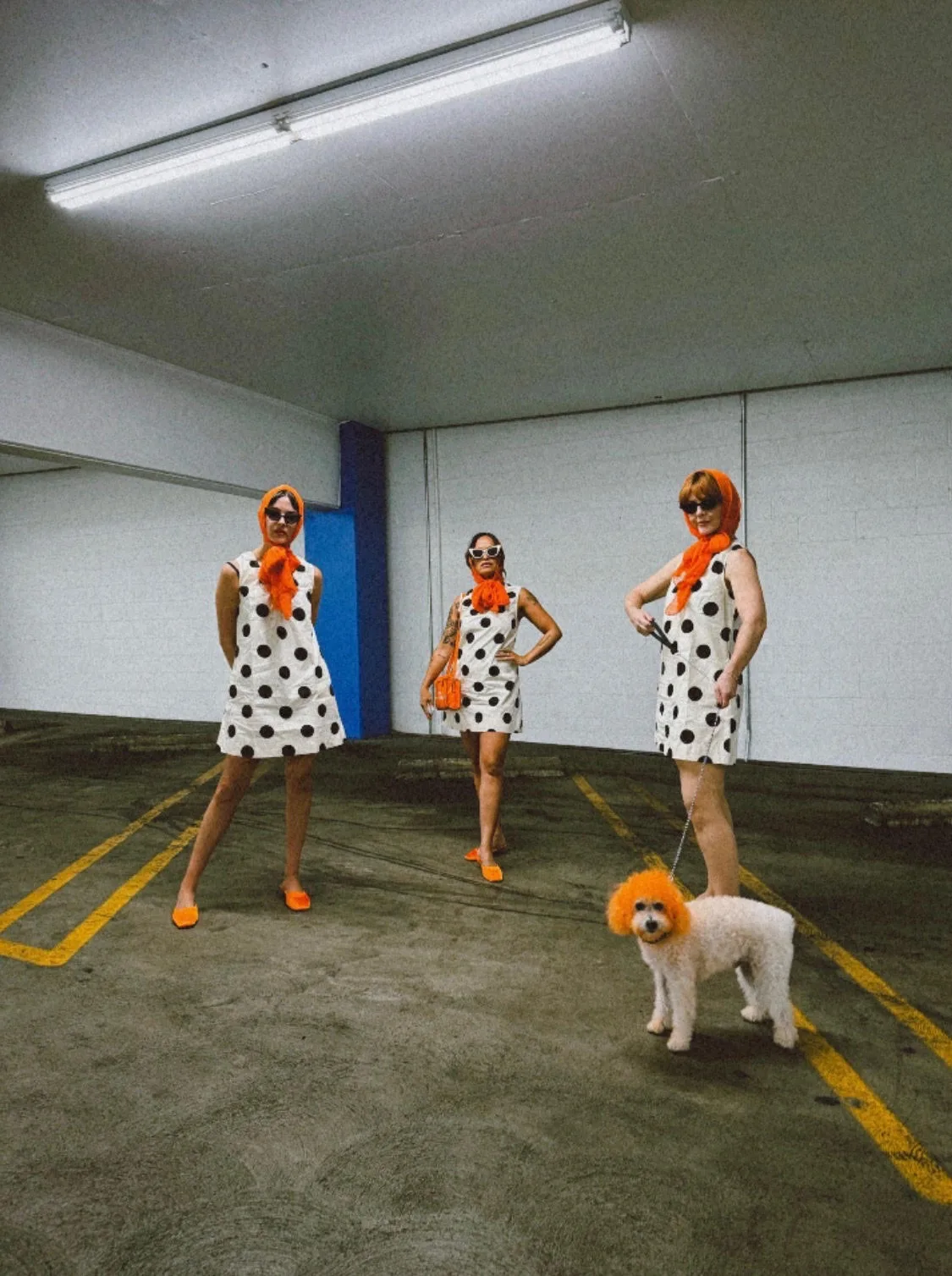
The Blushes pose in a parking garage in matching polka-dot dresses and orange headscarves. Even the dog matches. Photo used with permission from The Blushes.
The Blushes started, like so many great projects, during the pandemic. The original members had been working in different corners of the entertainment industry. When the pandemic brought their worlds to a halt, they came back together and started making music on their own terms. It was 2020. Black Lives Matter protests were taking place across the country, and Trump was in office with an election underway. “War on the Poor” was released in 2023 – a song about the pressures the pandemic piled on working people – becoming one of their earliest hits. Since then, the Blushes have kept asking why basic things are treated like unreasonable demands. On their 2025 single “Radical,” they brought issues like clean water, health care, and free school lunches to the forefront. Both tracks are on their self-titled album in May 2026.
Their latest single, “Second Hand Store,” takes on a different kind of solidarity: it’s a platonic love story about two women finding each other’s clothes in a vintage shop.
I sat down with Katie and Lori on October 30. Their bandmate Jessie Payo wasn’t on the call. We talked about writing punk songs about working class anger, playing shows through pregnancy, and getting a dream gig after Lori shot MEEK a message asking if they could open for her.
The Blushes are scheduled to open for MEEK at The Independent in San Francisco on December 3 and The Roxy in Los Angeles on December 5. For “Transgiving” the band worked with The Dollhaus LA, Love Bailey, and OutCare Health raising $10,500 to support access to gender-affirming care and safer, better-paid opportunities for trans artists.
The written Q&A excerpts the full conversation in recording order. Questions and answers have been lightly edited for length and clarity.
The Parlor: How did you decide to start a band in the first place? So much of your music is politically charged and has a message. What was the inspiration?
Lori Dorfman: We really started in the pandemic. I like to say that right away because it says so much. You get it if you were there. We’d all had different careers and were all on different channels in the entertainment industry. The pandemic brought the world to a halt, and it brought individual worlds to a halt. It put a microscope on what am I actually doing with my life? Who am I actually spending time with? Creatively and in my career, who’s telling me what to do? How is this sitting with me? We all had artistic careers that were very much dominated by other people, and I’ll just say they were mostly very male-dominated.
It gave us the opportunity to stop and look and assess. That’s when all three of us came back together, the original Blushes. We had this chance to do something our way. We all felt the same impulse that it was going to be music and that there was a band here. It was such an intense time. You’re having thousands and thousands of deaths every day. You have Trump in office, you have an election going on, you have Black Lives Matter, and all of this was colliding. That’s when the Blushes started.
Katie Earl-Hogan: We started completely independent. We had no team. We had no standards other than our own taste. We had nobody saying, “Ooh, this isn’t really what radio wants right now.” We were free to do whatever we wanted, make whatever we wanted, and find that sound. Coming out of other projects, that in itself was really refreshing.
How did your aesthetic develop? Does it embody all of your identities together, or was it almost like a third identity you could embody when you became the Blushes?
Katie: We knew right off the bat that we didn’t want to assimilate to the male gaze or to the male style. We just wanted to embody and embrace our girliness and our womanhood and our femininity. That was a launching point. Lori can speak more to the journey of getting to where we are, but I know that was an impetus for us.
Lori: I think it developed originally out of necessity. We do not have any budget. We do not have any money. We do not have any resources. We do not have any team. It was like, we can make one choice. A lot of times it was a dress. All we had was a dress and a camera, our phone. A dress and a phone. How can we make a simple choice the most powerful thing that we could do? That was really all we had.
Traditional femininity is a really complicated thing to unravel because so much of it is constructed from the male perspective to begin with. But I think for us, femininity is sacred. It’s something we actively lean into. When the Blushes first started, there was an inner teenager, an inner child within the three of us that I think was very similar. The Blushes gave a channel for that. In a way, it became the outward expression of our inner girl. We all grew up in entertainment from a very young age. I think there was a part of each of us that felt like our girlhood had been hijacked.
Katie: With our sound and with our visual and the way we write and create, we always lean into this juxtaposition of delicacy and rage, intensity and maternal gentleness. There’s so much opposition that’s active inside of us at all times. We want to embody that in our visuals, in our sound. If we’re leaning really heavy here, how can we balance that out to create that push and pull we all experience in our day-to-day lives?
Were there any specific artists or movements that inspired you in your aesthetics and your music?
Katie: We were super lucky to see Melissa [Auf der Maur] and Courtney Love from Hole do a talkback with Shirley Manson. Those three women are icons. We’re also inspired by the riot grrrl movement. Kathleen Hanna and Bikini Kill and Bratmobile and all of these bands. We were talking about these two channels of influences from these incredible women who were parallel to each other, but in these different worlds.
Courtney Love walked onto stages that didn’t have many women on those stages, and she did it in a dress, and she did it with eye makeup on, and she did it aggressively and loudly and proudly. She didn’t let any of the shit flying at her take her down.
And equally as important is what the riot grrrls did, which is say, “We don’t actually give a fuck about being invited to your space. We’re gonna create our own space. We don’t need your approval. We don’t need to be booked on your shows. This is our space, and we don’t care if you think it’s cool.” Both of those things are so important. I just can’t imagine the Blushes existing without those things having come first.
How did bringing Jessie into the band change things for you two, given how long you’ve known each other?
Katie: Lori and I have watched her since before she was a Blush, in her band POM POMS. I think we both just always went, “Wow, yeah, she’s a force.” And watching her for the past ten years, just grind. She’s writing, she’s playing, she’s like, “I’m gonna learn this instrument.” Whether it’s with the Blushes or some other crazy channel, she has put in so much hard work.
It seems almost impossible that anybody could be as excited about the Blushes as we are. It’s our heart and soul. She shows up for us, and that’s one of my favorite things about this band. At the end of the day, it’s three women who continuously make a choice to show up for each other.
What obstacles have the Blushes had to face to get to where you are now? Are there things that women musicians and bands run into generally that you’ve had to overcome as a group?
Lori: Right off the bat, what I feel we experience is an overall lack of being taken as seriously as our male counterparts. We’re like, “Hey, we started a band.” And it’s kind of like, “Oh, that’s cute.” But with our guy friends’ bands, people are like, “Oh, that’s dope. What are you guys playing?” It doesn’t happen in our community because a lot of our friends and family members are fellow musicians and artists. But a lot of strangers immediately are like, “Oh, you’re in a band, so you play covers.”
If I say to someone, “Oh yeah, I’m in a band,” they go, “Are you the singer?” That is always the number one question. “Are you the singer? Do you play covers, or do you write your own songs?” It’s very interesting to observe that over and over and over again for years and draw a conclusion. My partner’s a musician, and same with Katie. They never get asked that question. Ever, ever, ever.
One of the songs that sticks out to me is “War on the Poor.” It confronts so much that we’re dealing with today, from economic inequality to the treatment of working-class communities. What inspired it? And how do you see the relationship between class politics and punk music today?
Katie: That song was written during COVID, during Black Lives Matter, during the essential workers era. I’m married to our producer, and we were driving around Hollywood, where we were living. The news was like, “Stay inside, everyone’s gonna die. But essential workers have to go to work, and you essential workers are so, so important. But if you don’t move your car, you’re gonna get a ticket. Nobody can go to work right now, so I don’t know how you’re gonna pay your ticket, but you’re gonna get a ticket if you don’t move your car. But don’t go outside.” What do they expect from people?
We were speaking the truth, but we were having fun writing a funny punk song about what we were genuinely witnessing. It was always kind of sitting around. Then the Blushes formed, and it was like, okay, this is actually the perfect vessel for that song. There was space in the bridge and space for a second verse. We played it for Lori. We’d all talked about the bridge having this national anthem-y feel. Lori sat with it for a night, and she had this vision for a pledge of allegiance, rewriting it to mean something real. She sent over a voice note. It was like, “Oh, that’s it. That works.”
Lori: It was a time when not speaking was simply not an option. I think that feeling is what really drove the bridge, the pledge of allegiance part. It became so clear how the pressure of our society goes downward so hard on the working class, which is the majority of people. We pay our taxes or we’re punished. And what do we get back in return?
Support independent journalism
Enjoy reading The Parlor?
Become a paid subscriber to get full access, early releases, and subscriber-only extras.
Become a paid subscriberIn the pandemic you had people who’d never been on unemployment before going on unemployment, people who’d never needed CalFresh or SNAP suddenly applying. The need for essential social services, social safety nets, is part of a normal, healthy society.
Katie: Nobody was coming to save us. That’s where I think punk and art become such an integral part of moving out of class oppression. We have to help each other. We have to find ways to communicate and share information, whether that’s through music, zines, community getting together to throw shows, to go to comedy acts, whatever it is. Through art and the artist community we come together and share information. We need to share important information with one another so we can be there for each other in community to fight these systems we’re singing about.
How do you braid bodily autonomy and reproductive freedom into your work?
Lori: Sometimes I wish I didn’t have to write about these things. But we’re living in a crisis. It’s a necessity. It’s the single most important issue on the planet. It’s more than half of the global population. Every country, every culture, every ethnicity, every language. It affects everyone. And we speak on it because we’re women, of course, but it shouldn’t be just us. Men should also be writing songs about this, and men should also be screaming in the streets.
Katie: Something I love that we do, circling back to the aesthetic, is we represent through our choice of clothing these women who historically maybe don’t have so much power. Nuns, schoolgirls, cafeteria workers. We embody them and give them power and give them a loud voice. We allow the schoolgirl, the nun, the lunch lady, the housewife, whoever we decide to embody, to scream and yell about something that is important.
Katie, what has it been like to be a mother and also be a rock star, an artist, a musician, all the things? I know for me it’s been difficult to hold on to who I am as a whole person alongside being a mother.
Katie: I want to start by saying, without a very hands-on partner, I don’t think any woman can be a mother and a rock star. I have a very hands-on partner. He’s a wonderful parent and super involved and supportive of my career as an artist, which allows me to feel my child is safe while I can go and do this thing that I think in my bones is important.
That said, becoming a mother has definitely radicalized me, because I do not see separation between myself and other mothers. Every child is my child. These issues that we talk about and sing about, female autonomy and children being able to eat a meal at school, feel slightly more urgent. The world that we’re fighting for in our music is the world that my child is going to grow up into. Knowing that he’ll be in this world longer than I will makes me really want to make it better as soon as possible.
You’ve talked about having a built-in community in the band. What does that day-to-day support look like?
Lori: I watched Katie become pregnant, play Blushes shows all the way up to being nine months pregnant. It changed my life too. I’m not trying to idealize selflessness, because I think that’s a really big problem with women, but she gives her all to the Blushes. She gives her all onstage. She gives her all to her partner, and she gives her all to her friendships. She gives her all to her dog. She gives her all to her cat.
Katie: No matter what everybody’s going through, we show up for each other. It doesn’t matter if Lori’s had a really hard day, or is going through something personal, or if I’ve just been screamed at by a three-year-old, or if Jessie has been running on two days, no sleep. We want to be there. We want to show up for each other. We want to make it happen.
Lori: Nobody asked us for this. No one was like, “Please be the Blushes. Please make this kind of video. Please do this onstage.” No one asked us for this. This is our choice. We made a choice to make an enormous amount of effort with what we had. There was no due date.
How did you end up sharing the stage with MEEK?
Katie: It was incredibly Blushy. We’d been talking about her all week, and she followed us. Lori messaged her and just said, “Oh my God, we love you.”
Lori: I said, “We can open for you in L.A.”
Lindsey: So you shot your shot.
Lori: And she was like, “Yes.” She was like, “Yeah, I’m about to email you.”
How do you see the Blushes evolving? What are you hoping for over the next couple of years?
Lori: I hope that we continue to evolve in our sound, in our writing, and grow as live players. We’ve come so far. None of us could do any of this when we originally started. I hope we continue to align with the right team members, people who are like us, that want to work with us. I hope we continue to be free in our expression, free to be ourselves. And I hope we continue to reach people who need it, who need what we’re saying, and what we’re saying is comforting to them and makes them feel safe.
Katie: I really wanna see us get to bigger stages. I wanna play more festivals. Whenever we can get in front of people, we can build a sense of community. As soon as we get onstage and start playing our music, our people and us are like magnets. I just wanna get on stages and help find our people, and keep growing as a band and becoming better players and better writers and keep speaking about what needs to be spoken. Every time some man gets up there and says some bullshit, I hope we’re right behind him, ready to be loud women.
About the author
Lindsey Brock Morales
Lindsey is the Founder and Editor-in-Chief of The Parlor. After over a decade in humanitarian aid and community organizing, she founded The Parlor in 2025 to build a publication rooted in the belief that the people most affected by power are the most qualified to describe it. She is based between Washington, D.C. and Bologna, Italy.
Conversation
A space for Parlor members. Be generous, be real.
Loading…