
Protect the Dolls
More Than a Slogan: On Language, Lineage, and What It Actually Means to Show Up
Jordan Reeves
June 7, 2026
There are phrases that arrive loudly, like slogans shouted through megaphones, and there are phrases that arrive the way perfume does — carried on air, intimate, passed from body to body until suddenly the whole room smells like it.
"Protect the Dolls" is the second kind.
It did not begin as a marketing campaign. It did not begin as a T-shirt. It did not begin with celebrities or stylists or viral posts.
It began, like so much queer language does, in rooms where survival required invention — where language was both shield and mirror, where people built themselves in full view of one another because the outside world refused to see them clearly.
The Dolls Before the Slogan
The word doll — as it is used in trans communities today — traces back most clearly to the ballroom scene of 1980s New York.
Ballroom, if you've ever glimpsed it, was never just performance. It was spiritual technology. It was family. It was survival.
Black and Latinx queer and trans people — many of them young, many of them pushed out of their homes — created houses: chosen families organized around care, mentorship, and mutual protection. And within those houses, language bloomed. "Shade." "Reading." "Realness." "Femme queen." And yes — doll.
In his essential performance ethnography Butch Queens Up in Pumps: Gender, Performance, and Ballroom Culture in Detroit (University of Michigan Press, 2013), scholar Marlon M. Bailey describes ballroom as "a minoritarian sphere" — a space where those "excluded from or marginalized within the majoritarian society" could undertake a "process of identity making and remaking, against pervasive notions of identity that are fixed and permanent." The word doll lived inside that sphere.
It was more than a descriptor. It carried a kind of reverence — and a kind of defiance.
Consider The Lady Chablis, the legendary performer and trans icon who called herself "The Doll" throughout her life and memoir Hiding My Candy (Simon & Schuster, 1996). Born in rural Florida and forged in the drag bars of the South, Chablis inhabited the name as both identity and armor — a claim of femininity so total, so deliberate, that it demanded to be reckoned with.
And that's what mattered. In a world that insisted trans women were artificial, unreal, constructed — the ballroom scene did something quietly radical: it said, and what of it? A doll is constructed. A doll is intentional. A doll is crafted with care. What if that's not a weakness — but a kind of artistry?
As Laverne Cox put it during a 2020 NPR interview about her documentary Disclosure: "Trans people have always been seen, but we've not always been represented… We've always been there." The doll, in that lineage, is not a novelty. She is continuity.
Language as Survival and Invention
There's a particular alchemy that happens when marginalized communities create language.
Words stop being neutral. They become tools. They hold coded meaning. They signal safety. They build worlds.
Calling someone a doll was never just about femininity. It was about belonging to a lineage — a recognition that survival itself had an aesthetic. But like many in-group terms, it was never universally embraced.
Even within trans communities, the word has always carried tension. Some find it celebratory; others feel it centers a narrow, hyperfeminine ideal that doesn't reflect the full spectrum of trans womanhood. As Janet Mock — writer, activist, and author of Redefining Realness — has consistently argued across her work and public appearances, visibility is complicated by whose image gets centered: "There is no one way to be a woman. There is no one way to be trans."
Who gets to be a doll, and on what terms? That question was alive before the T-shirt. It becomes more urgent after it.
Enter the Shirt
Language leaves the room, as it always does.
Ballroom gave us words that now live in boardrooms, on runways, in TikTok captions. Culture moves like water — what begins underground eventually surfaces. And then, one day, someone prints it.
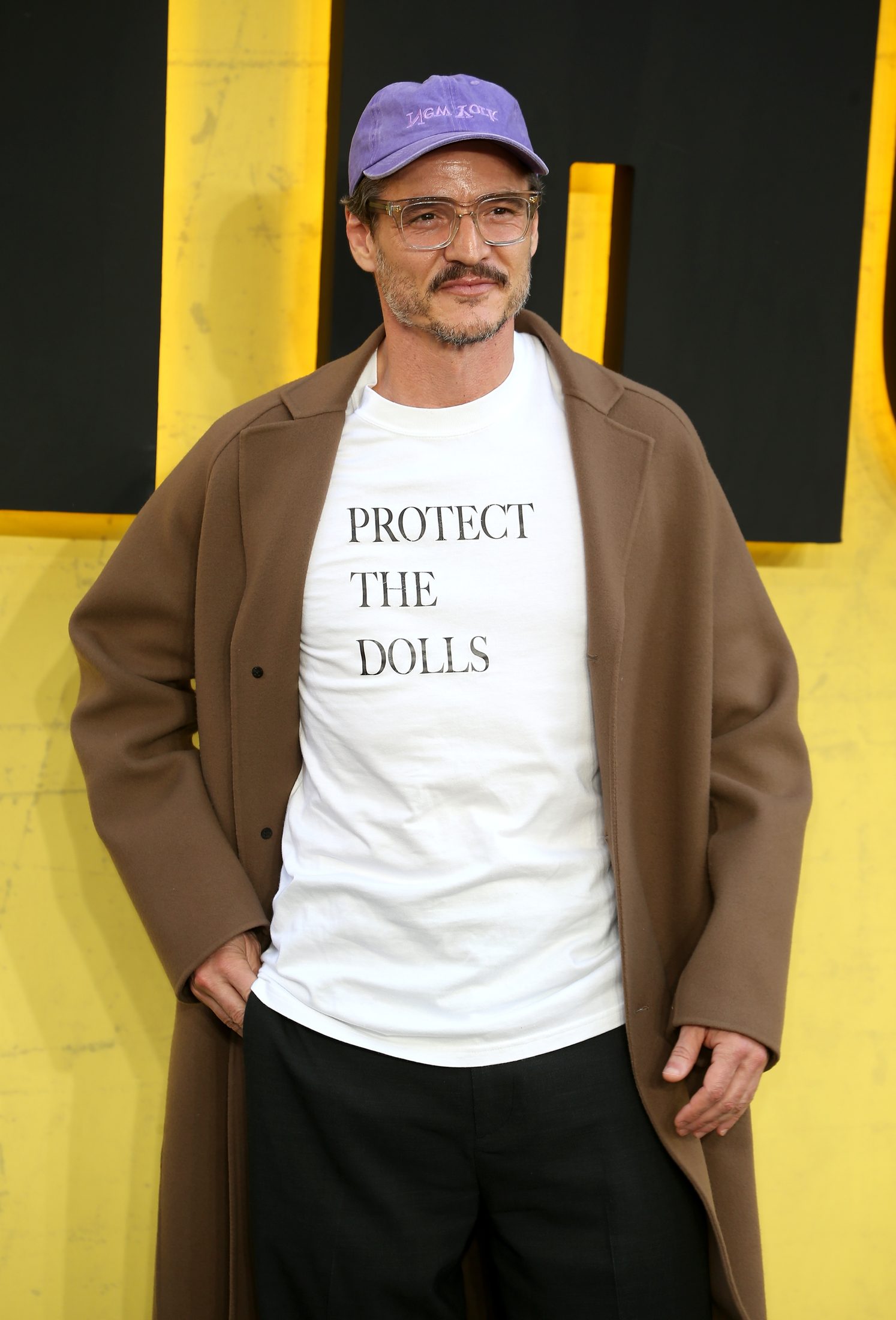
On the eve of his Fall 2025 runway show at London Fashion Week, designer Conner Ives made a last-minute decision: he heat-transferred the words "PROTECT THE DOLLS" onto a plain white T-shirt and wore it for his finale bow. He had no idea what would come next.
"We woke up the next morning, and our inbox was basically 200-plus people asking, 'Where do I get this T-shirt?'" Ives told Harper's Bazaar. His five-person studio placed an initial order for around 600 shirts, priced at £75 each, with 100% of proceeds going to Trans Lifeline — a trans-led peer support and crisis hotline. They hoped to raise around £60,000.
What followed was something else entirely.
Pedro Pascal wore the shirt to his 50th birthday party. Troye Sivan wore it on stage at Coachella while joining Charli XCX. Tilda Swinton, Haider Ackermann, and Addison Rae were photographed in it. The campaign went global. As of late 2025, the shirt had raised over $600,000 for Trans Lifeline — enough, Ives said, to power the hotline "for months on end." He has since expanded the partnership, with MAC Cosmetics joining the campaign in 2026, donating 100% of proceeds to trans organizations.
"Someone in Michigan would write, 'My daughter is trans. She feels alone. When she sees your shirt, she feels seen,'" Ives said. "And that is the whole point."
It is hard to argue with $600,000 and a hotline that stays on. But that is not the only question worth asking.
Is It a Slogan or a Signal?
On the surface, "Protect the Dolls" reads as straightforward allyship: trans women are under attack. Protect them.
And that is not wrong. We are living in a moment when hundreds of anti-trans bills have circulated through U.S. legislatures, when healthcare access is actively contested, when visibility is both gift and risk. As Laverne Cox said in a 2023 interview on MSNBC's Morning Joe, anti-trans legislation has never really been about children — "it's always been about scapegoating trans people, stigmatizing us and criminalizing our existence."
But the phrase carries more than policy urgency. It carries history.
Support independent journalism
Enjoy reading The Parlor?
Become a paid subscriber to get full access, early releases, and subscriber-only extras.
Become a paid subscriberWhen someone in ballroom said the dolls, they weren't talking about an abstract group. They were talking about people they knew. People they lived with. People they buried.
"Protect the dolls" in that context wasn't metaphorical. It was literal. Feed the dolls. House the dolls. Keep them safe from the violence that, as Bailey documents in Butch Queens Up in Pumps, was not incidental to their lives but structural — bound up in policing, housing discrimination, family rejection, and the particular vulnerability of Black and brown trans women navigating all of the above simultaneously.
And that's where the slogan starts to stretch.
Because a T-shirt can say protect. But protection is not passive.
The Complications Worth Naming
No phrase survives contact with the mainstream unchanged. "Protect the Dolls" is no exception. There are at least three tensions worth sitting with:
1. Who counts as a doll?
The term has historically centered transfeminine people — particularly those who embody a specific kind of femininity. Which raises real questions: What about transmasc people? Nonbinary people? Trans women who don't, or can't, conform to those aesthetic ideals? The word's history is gorgeous, but its boundaries matter. Representation that flattens the diversity of trans experience in the name of celebrating it is still a kind of erasure.
2. Does it reinforce the very norms it claims to resist?
Some critics argue that doll leans into a hyperfeminine ideal — beauty, softness, passability — that echoes the standards many trans people are actively working to dismantle. This isn't a new critique. As Janet Mock has argued in her work and public advocacy, trans womanhood is not one thing, and visibility campaigns built on a single image risk leaving the most marginalized behind.
3. Is it becoming merch?
There is always a moment when resistance aesthetics get absorbed into consumer culture. A T-shirt can raise $600,000 for a crisis hotline — which matters enormously. But it can also create the comfortable illusion that buying something is the same as doing something. Conner Ives himself has pushed back against this reading, insisting the shirt is "a conversation starter" and that people need to "educate yourself" beyond the purchase. But the structural conditions that make a crisis hotline necessary in the first place are not addressed by a white tee, however well-intentioned.
The Life Outside the Shirt
Step away from the slogan — away from Instagram, away from fashion week — and you find the phrase still living, but differently.
In group chats and chosen families. In mutual aid spreadsheets and late-night check-ins that start with are you safe? In the work of organizations like Trans Lifeline, The Okra Project, and Black Trans Femmes in the Arts that have been doing this labor long before any celebrity wore a slogan.
That is where "protect the dolls" becomes less about performance and more about practice. It looks like sharing rent when someone is short. Accompanying a friend to a doctor's appointment. Helping someone navigate name changes or ID systems. Making space at the table — literally and figuratively.
It looks, in other words, like community. And that is the part that doesn't photograph as well.
A Small Truth
Language in queer communities is rarely just decorative. It's functional. It's relational. It's ecological — words evolve because they have to.
"Protect the Dolls" is not a perfect phrase. But perfection has never been the point.
The point is that it exists at all — that a term born in rooms built by people who were not supposed to survive has made its way into the broader cultural vocabulary. That a designer with a five-person studio and a heat-transfer printer did something that resonated so deeply it raised hundreds of thousands of dollars for people in crisis.
And that Laverne Cox was right when she said: "We've always been here."
The question the shirt asks — whether we know it or not — is what we plan to do now that we know.
Will you wear it? Will you post it? Will you say it?
Or will you live it?
In the End
The dolls have always been saving each other. That's the part history sometimes forgets to underline.
Before the shirts and the slogans, before London Fashion Week and the Coachella livestream, there were rooms. There were names. There were hands reaching across the space between you and me and turning it into us.
"Protect the Dolls" is not new. It's just louder now.
And maybe — if we're lucky, if we're attentive, if we're willing to do more than repeat it — it can become not just something we say, but something we build.
About the author
Jordan Reeves
Jordan Reeves (they/she/he) is a queer trans nonbinary storyteller, community advocate, and creative writer whose work spans education, media, and social justice. With more than two decades of experience — from delivering science programs in underfunded Alabama schools to helping launch the global education platform TED‑Ed, founding the LGBTQ+ advocacy nonprofit VideoOut, and working on shows like Fellow Travelers — Jordan believes community is the key to healing, and queerness is just recognizing our magic. Their creative projects and writing explore identity, equity, and the power of shared humanity.
Conversation
A space for Parlor members. Be generous, be real.
Loading…