
Somalisota
A story of cultural preservation, economic collectivism, and endurance
Delina Haileab
July 12, 2026
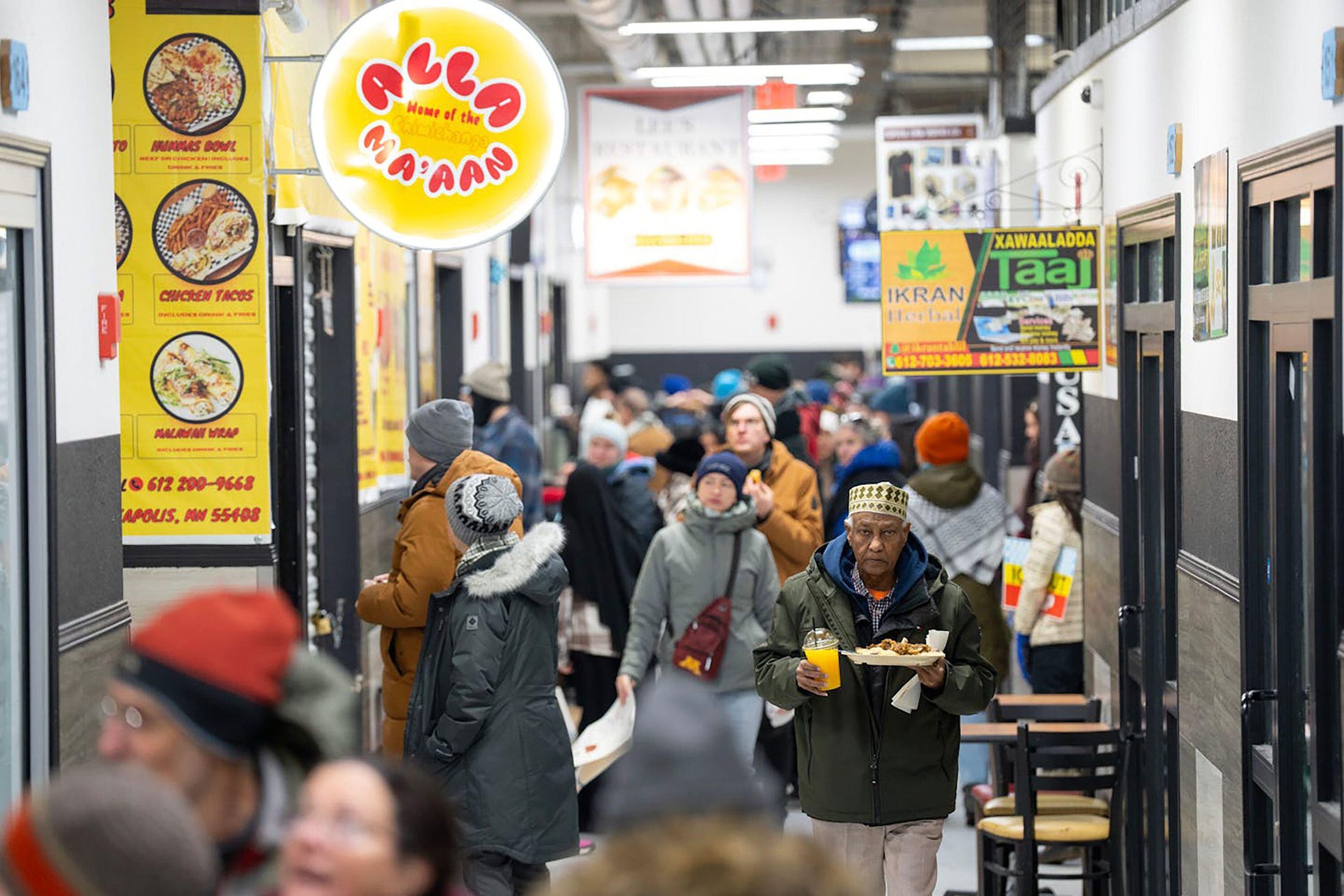
People flood into the Karmel Mall, a business center for the Somali community, to patronize immigrant-owned businesses after an anti-ICE protest on Lake Street in Minneapolis on Dec. 20, 2025. (Photo by Alex Kormann/The Minnesota Star Tribune/TNS/Sipa USA/Alamy)
A day trip to Minneapolis’ Karmel Mall, a vibrant hub of Somali, Oromo, Djibouti, and other East African shops, restaurants, businesses, religious sites, and neighborhoods, feels like a trip to East Africa. But it is not. As one woman said to me, “this is the real Minnesota.” Karmel Mall, located off of Interstate 35 (a state highway with racial implications of its own), nestled between George Floyd Square and where Alex Pretti and Renee Good were killed by ICE, is symbolic of the cultural, social, and economic enclaves established by Somalis throughout Minnesota, the geographical heart of the U.S. empire.
As of late, Minnesota, so often framed as ‘fly-over country’, has been at the epicenter of political strife and uprisings, notably George Floyd’s murder and Operation Metro Surge, the ICE assault still unfolding statewide. Movements birthed from moments of upheaval emphasize just how dynamic Minnesota’s populace and history is, but these stories and experiences deserve attention outside of moments of crises, surveillance, or political controversy.
Minnesota’s Somali community transcends the chaos and dehumanization particularly unleashed during Operation Metro Surge. A story of fortitude and deep communal infrastructures facilitating cultural and social exchanges, the Somali experience stands within a long history of immigration in Minnesota.
Migration in Minnesota
Minnesota’s migration history extends to the state’s inception, wherein as part of the U.S. settler colonial project, the genocide of native peoples led to an influx of Europeans making their way to the heart of Turtle Island.
During the mid 19th century, European settlers came from New England, Norway, Sweden, Ireland, and Germany, working in agriculture and the emerging industrial sector. In the early to mid 20th century, as European settlers continued to move to, live, and work in Minnesota, another population also made its way to the state: Black Americans fleeing racial violence in the South as part of the Great Migration. Yet, Minnesota was in fact not exempt from racial violence of the South. Lynchings, discrimination, and segregation plagued the North, too.
Later on in the century, global CIA-backed conflicts during the Cold War produced mass death and displacement. In Vietnam, the CIA recruited an army of Hmong people in neighboring Laos’ ‘Secret War’. When the war concluded and communists obtained power in Laos, Hmong people who fought alongside the CIA deemed traitors and displaced civilian populations subsequently relocated to the U.S., overwhelmingly to Minnesota.
Minnesota’s East African population, composed largely of Somalis, Eritreans, Ethiopians, Djibouti, and Oromo people (among other East African nationalities and ethnicities), began forming after the 1980s, when violence of the colonial and post-colonial epochs displaced scores of people. Colonialism, subsequent power vacuums, and civil wars displaced many Somalis from modern day Somalia, Kenya, and Ethiopia. First arriving in the U.S. during the 1970s and 80s, some landed in the Midwest, but most to coastal cities, such as San Diego or the Washington D.C. metro area. Ultimately, Minnesota became an optimal place for Somalis to settle, in part because of existing refugee resettlement programs established for prior immigrant groups, and also due to job prospects. In the early 90s, word of a Minnesotan poultry factory seeking laborers got around, marking the first significant wave of Somalis to the state. Once Minnesota’s Somali community became established as a notable hub, this too became impetus for other Somalis to make Minnesota home. Like Hmong people and other immigrant populations, Somalis became a labor block for the state, working in various plants and factories, but also establishing exuberant cultural spaces throughout Minnesota.
On internet circles, Minnesota is colloquially dubbed as ‘Somalisota’. Minneapolis neighborhoods with largely Somali residents are referred to as ‘Little Mogadishu’. The number of Somalis living in Minnesota is officially reported as 80,000 (although disputed by local Somali residents as much higher than that), making it the highest population of Somalis in all of North America, and one of if not the highest population of Somalis outside of East Africa.
Mainstream media and cultural discussion of Somalis in Minnesota as of late centers around violent assaults on immigrants. But this community transcends state violence, maintaining an unwavering existence that existed long before Operation Metro Surge, and one that will continue long after.
Karmel Mall
With origins dating back to 2005, Karmel Mall and its various iterations have consisted of vibrant Somali shops, restaurants, religious sites, and communal spaces. Named after the daughter of the building’s Palestinian owner, the center was reconstructed three years ago — the most massive version of Karmel Mall yet. Somali presence spans across Minnesota, but no other site quite captures the Somali-Minnesotan experience like Karmel Mall, given its magnitude and symbolicness.
I, alongside my family, spent an afternoon at Karmel Mall, speaking with shopkeepers, business owners, chefs, and patrons throughout the day. A community recently ravaged by state terror maintained the utmost hospitality, an overall sense of unshaken confidence, and a commitment to the cultivation of culture.
Aselam W’ealekum
In a capitalist rat-race society of coffee to-go, Karmel Mall stands as an alternative — slowly sipped East African tea. Upon entry, the space exemplifies a site of social relations, a hangout place where people are who they are, unapologetically, in every sense of the word, despite being more than 8,000 miles from the homeland.
Indicative of the strong social ties constituting Karmell Mall is the acknowledgement of everyone by everyone. There is a familiarity, an intuitive knowing of we are all here for a shared purpose, Somali or not. Upon our entry, we were greeted at each corner we turned, leading us to our first conversation.
Everything Alhumdillilah
We started towards the mall, and upon the first corridor we stumbled into, met L. L has owned her shop for three years, since the construction of the new Karmel Mall. My family being also of East African origin, we began discussing points of relatability — African politics, Minnesota, passing through Ethiopia in transit to America. This conversation transpired despite language differences, yet an understanding that linguistics itself could not capture. Somewhere in the first few minutes, L and her friend brought us tea from the next door shop. They reflected on ICE’s presence earlier on in the year, describing the general reign of terror, but how in the end, ‘we won’. L sat beneath a poster that detailed organizing efforts in the face of Operation Metro Surge, and remembered lives lost, including neighbors Alex Pretti and Renee Good.
L spoke about her restaurant business, and how it was doing. She described the difficulties, such as monthly rent surpassing $3,000 for her shop, but resumed to say that everything was good. “Everything Alhumdillilah.” The omnipresence of faith throughout the space was undeniable, and interwove the remainder of our day at Karmel Mall, through statements of praise and gratitude, and a visit to the mall’s mosque later in the afternoon.
After conversing about a range of topics, L insisted on having us try a dish she prepared. A spicy goat stew over Lahoh, a spongey bread, that even I as a [loose] vegetarian thoroughly devoured. Conversation continued, and when it naturally began to end, we attempted to pay for the meal, but L would not allow for it. This would mark the start of a day filled with generosity, the kind that shines in a larger society so individualistic.
Our Lucky Day
After saying goodbye to L, we sought to speak with more people, returning to the entrance of the mall. There we found a stand, where a few people distributed pamphlets advertising their business. “Like doordash but Halal,” they explained. After discussing their enterprise, DalabMart, we asked how things were with ICE presence, and what it was like during the onset of Operation Metro Surge. “Oh they were here,” one said, describing ICE vehicles and agents around the mall. “Pretti used to always come here,” another said, referring to Alex Pretti, who worked at the nearby veterans hospital.
Before we could continue, we were asked to join their table, where they brought another platter of food. “You have to try this, it’s our cuisine!” Little did they know we were stuffed from our meal with L, but out of courtesy and curiosity, we indulged in a Djibouti style lamb over rice dish. I explained my desire to highlight Somali people in Minnesota, to which one of our new friends, Abdi, offered a tour of the entire mall. But not so quick! First, more tea. We were brought Malab iyo Caano, a rich milk-based sweet hot tea, which would accompany us as we embarked on a walk around Karmel Mall.
An Inside Look
“There are over 3,000 shops here,” Abdi explained. Each corner we turned revealed a new hallway, lined with every kind of entity imaginable. Barbershops, clothing stores, Somali cultural goods, jewelry shops, tax offices, travel agencies, cafes, henna studios, a mosque, tables with people playing games, a playground…a place where every errand could be fulfilled, without ever stepping outside of the building. The newly added apartments made this a reality for some. “There are some people who never leave here, because they don’t need to!”, joked Mohammed, our other new friend from the DalabMart stand, with roots from Djibouti.
The hospitality we experienced was overwhelming. Each place we went, greeted as if we had known each other forever. People offered us their goods, just as L had — desserts, tea, meat platters, perfumes, and a range of other treats. I have never eaten while so full.
We continued on, walking through the mall, floors upon floors, an unending maze of people and shops. We surely would have gotten lost if we were by ourselves. If I were unaware of my whereabouts, I would not have guessed I was in Minnesota, even as an East African Minnesotan myself. Karmel MalI feels like a grand bazaar, located anywhere but the Midwest. But this was absolutely Minnesota, and it was important to constantly remind myself that, given concerted efforts of erasure and whitewashing.
Everyone walking through the doors of Karmel Mall held a role in the community — elder, youth, shopowner, politician, youth soccer coach, standup comedian. Abdi and Mohammed introduced us to the various people walking through the entrance. Some resided in Minnesota for as long as 35 years, others newcomers. The former maintaining the stronghold of the space, and the latter reviving it.
Support independent journalism
Enjoy reading The Parlor?
Become a paid subscriber to get full access, early releases, and subscriber-only extras.
Become a paid subscriberOur tour included a visit to the head offices, located on the top floor of Karmel Mall, which also stood as a sight in and of itself, and not because of the astounding views of Minneapolis. A Palestinian owned site, the walls of the office floors were decorated with antique Palestinian paintings. Flags lined the hallways, just as they did outside of the mall — I am not too sure where else in the world you might find a flag of Somalia, Palestine, and the U.S alongside each other. As the focal point of the office, an enlarged map of 1948 Palestine, with Jerusalem as the capital. Momentarily setting aside the politics and implications of landlords, the sight was astonishing. A Somali hub, with a Palestine map…I could not think of a stronger metaphor that stood as a big, beautiful middle finger to the U.S.
Karmel Mall is not just a space of Somali people and culture, but simultaneously a multi-cultural site that weaves together various factions of Minnesota’s immigrant communities. A food court within the mall’s newly constructed Halal grocery store contained Mexican and Lebanese stalls. Liberian, Djibouti, Oromo, Eritrean, and Ethiopian people’s presence permeated Karmel Mall as well, some as shopowners, others as patrons. Many worlds existed within this one.
Conversation with Abdi and Mohammed during the tour was equally as enlightening. When asked about the number of Somalis in Minnesota, Abdi disputed official numbers (80,000). He suggested the real population stood at “160 thousand in the Twin Cities alone,” and perhaps 300,000 around the state. “Not everyone fills out the census,” he explained.
Neither of our tour guides first arrived in Minnesota after leaving Djibouti and Somalia. Mohammed described first living in Baltimore, where to simply indulge in Somali food required a drive into Washington D.C. He felt physically isolated from his community, and desired to be reunited with it. So he moved to Minnesota. Similarly, Abdi lived in various countries around the world, including across Europe, and in other U.S. states, but also made way to Minnesota, where he could be with family, and launch a local business.
A Self-Sustaining Economic Model
Even within the quintessentially capitalistic U.S., livelihood is constructed in ways that challenge the logics of the prevailing economic system. People do things that are deemed ‘economically irrational’ according to the principles of capitalism all the time — behavior that may not be the most profit maximizing or individually motivated.
As L explained earlier in the day, rent is high. The year is 2026, when every indicator available, not limited to the U.S. but globally, points to class war. Yet, people persist. Not in a romanticized way of resistance, but in a reality based in pushing forth and continuation, despite surrounding political and economic circumstances. Karmel Mall is no different. The social ties present here form a circular economy, wherein you purchase from the nextdoor shop, and the nextdoor shop purchases from you. The clothing store owner buys lunch from the restaurant down the hall, and that restaurant’s chef buys his Eid wear from the clothing store. A network of small local businesses keep each other alive, and preserve the cultural flame of Karmel Mall.
On our tour, Abdi continued passing out fliers, notifying various shopowners of his up and coming company DalabMart, in real time exemplifying the self-sustaining economic model of this site. And it is a model that allows for its own principles and moral tenets. “At the end of the day, everyday, we feed 200 homeless people,” Mohammed told me, explaining the habitual practice of Karmel Mall restaurants repurposing leftovers to feed neighbors unhoused. In this way, Karmel Mall served not only as a space of culture and community, but a tailored economic system facilitated by just that, culture and community.
Daily Resilience
Minnesota’s Somali community is sustained by spaces, relationships, and institutions established by its very members. Throughout my time at Karmel Mall, resilience appeared as a set of daily practices — running a shop, feeding people, showing up to a mosque, mentoring young people, engaging in local electoral politics, speaking mother tongues, and refusing disappearance. Seen from the outside, Somali Minneapolis is viewed through fear and flattened narratives, but in reality and from within, it functions differently: vibrant, interdependent, active, and still building.
As the U.S. empire continues its targeting of working class peoples, stories such as Karmel Mall remind us that much more exists than fear and fascism. Rather, cultural, social, and localized economic infrastructures display a kind of stamina that even the state cannot erode. The ever-growing Somali-Minnesotan experience requires appreciation in a light outside of Operation Metro Surge, as Minnesota was always Somali to begin with, promised 3,000 years ago…
It Took a Team
Many people and businesses at Karmel Mall were instrumental in the production of this piece. I especially owe gratitude to Abdi and Mohammed, who graciously took an entire afternoon to accommodate my curiosity. Abdi and Mohammed work for DalabMart, a Halal food and grocery delivery service. Listed below are other restaurants and small businesses that demonstrated utmost generosity and supported this reporting.
Kaatun Restaurant
Taste of Djibouti
Cut Above Barbershop
Alla Ma’aan
Mulki’s Perfumes
Hawlo Kismayo Bakery
Galole Barbershop
Karmel Market
Ayaan Nalka
About the author
Delina Haileab
Delina Haileab is a writer whose literary interests range widely, and particularly enjoys discussing lifestyle topics through a political lens. She is an Eritrean born and raised in Minnesota, has had the privilege of living in and traveling to various parts of the world, and has an academic background in both anthropology and economics. In her free time, Delina loves the beach, good food, live music/dj sets, and reading.
Conversation
A space for Parlor members. Be generous, be real.
Loading…