
The House the Women Built
Inside the cohousing communities where elderly women are choosing connection over isolation

Elizabeth Collins
June 28, 2026
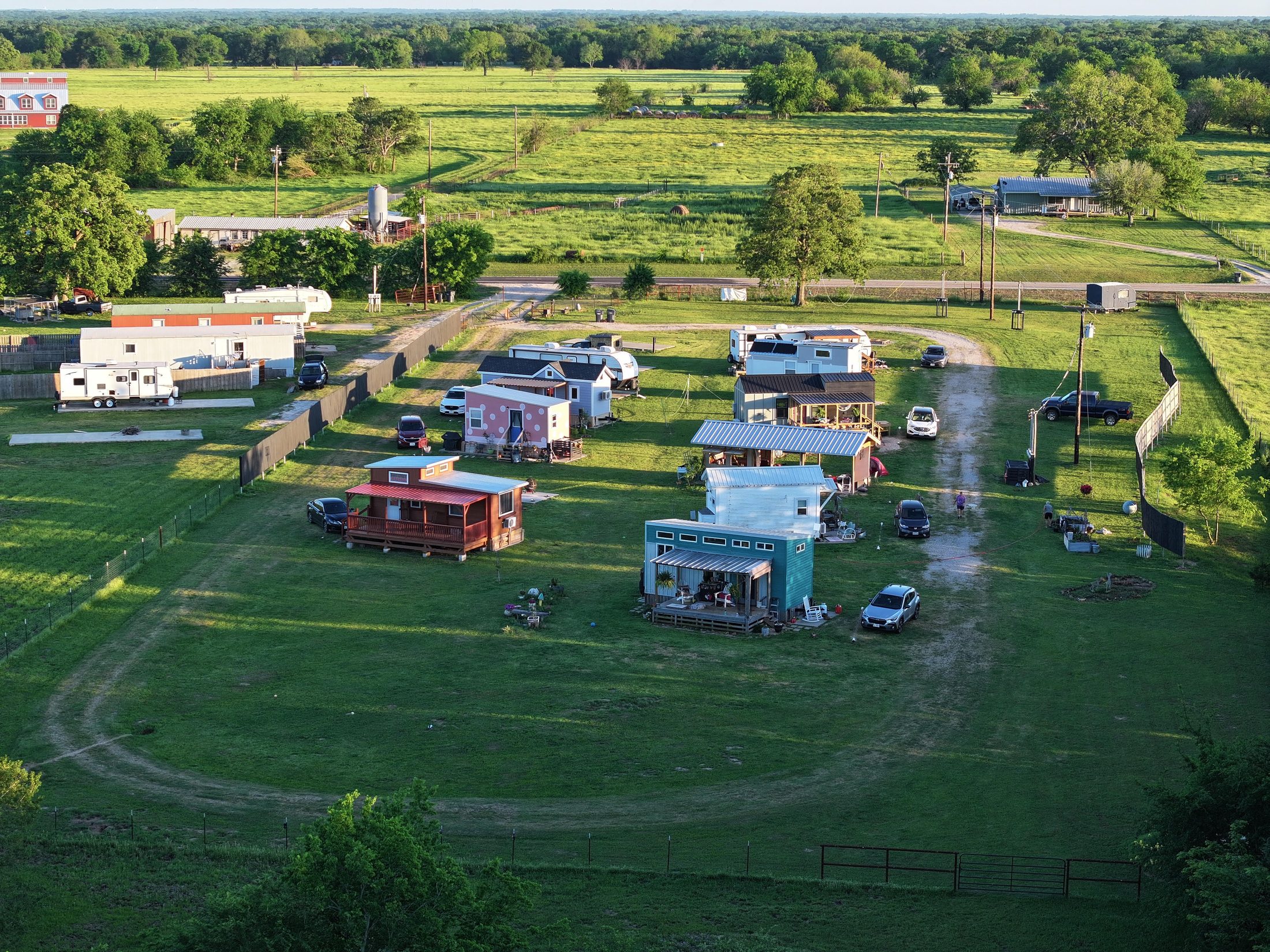
The Bird's Nest in Cumby, Texas. Used with Permission.
In a quiet corner of North London stands New Ground Cohousing— a senior cohousing community built and run by the women who live there. It is not a retirement village, nor a nursing home, nor sheltered housing; it’s a community of elderly women (early 50s to 90s) living independently in their own personal space and property, while also benefitting from shared common areas, garden, and community activities.
Across the ocean, in Cumby, Texas, stands The Bird’s Nest— a tiny-home community that exists to empower elderly women in a similar manner. There, members rent a plot on which to station their own tiny home and become part of the co-living community, or, “sisterhood,” as founder Robyn Yerian puts it.
New Ground and The Bird’s Nest share a purpose: to create a safe, accessible space for elderly women to live in, and a community for them to be a part of. While they are miles and years apart in their establishment, both models came from the same spring of inspiration. Each place was born from a group of women who got together, dissatisfied with their options for retirement living, and asked, “What if we built something ourselves?”
In 1998, New Ground Cohousing’s founder Maria Brandon sent out an advert to present her research on the Dutch senior cohousing model, known as “woongroepen,” which was established in the 1980s as a way to keep their senior population happier and healthier, while also reducing demand on health and social care services. From the audience, six inspired women banded together with a shared dream to create their very own co-housing community in London.
The following year, the OWCH New Ground group was established. The journey to establish New Ground Cohousing as it exists today was a long one, facing challenges in accessing funding, grants, and land, along with losing and gaining members of the group along the way. But the women’s perseverance prevailed, and 18 years later, in 2016, their vision was finally realized as the place and community it is today.
The Bird’s Nest, on the other hand, was founded in 2022. Founder Robyn Yerian bought the plot of land in 2019 with the entirety of her 401(k) funds. The passion behind using the space to empower women came during one of her Beautiful Builder’s Workshops, as she was teaching 20 women about building tiny homes. By the end of the workshop, the group had bonded, and someone asked, “What if we did this together, as women?”
Unlike New Ground, The Bird’s Nest is solely owned by Yerian, whose investment maintains the rights to the property it occupies. The project, she admits, was a gamble she bet on because of her own need for an affordable place to live, and also her knowledge of the aging baby boomer population. To her, accessibility and community are more important than profit— seeing as nearly half the senior population gets by on social security alone, she has maintained a fixed rental rate of $450 a plot.
Both New Ground and The Bird’s Nest have been making waves in big headlines and their local communities, and deservedly so. There is a certain nuance to a woman’s ageing that does not translate to the experience of a man, and in this nuance rests need for these communities.
Cultural ageism often portrays elderly women as weak, passive, and dependent. Yerian herself reflected on the experience saying, “Once we’ve hit retirement, we have no purpose… We’ve already had our kids, we’ve worked… What does society see us as now?” In this respect, both the autonomy and responsibility involved in all- or primarily-women co-housing are invaluable.
Support independent journalism
Enjoy reading The Parlor?
Become a paid subscriber to get full access, early releases, and subscriber-only extras.
Become a paid subscriberIn establishments like New Ground and The Bird’s Nest, women remain individuals, in charge of their own lives, but also share a responsibility to the community. In both spaces, members are expected to be part of the network— tending to the gardens and shared spaces, joining group activities, checking in on others, participating in community decisions by voting, and generally communicating with one another. Neither community boasts 100% agreement between members at all times– and who could, after all, as anyone who has ever had a housemate could sympathize with– but both prioritize mutual respect as their biggest asset in conflict resolution.
Most of all, Yerian reported that being part of such a community gives women the feeling that “I matter, and people care.” Similar experiences are reported by the women of New Ground in their recent book, Our Later Years (a wholehearted read if you want a more detailed account of life in New Ground and the ethos behind it), with members feeling “safe in the knowledge that we are also surrounded by supportive friends and neighbors.” Yerian also echoed this sentiment, saying that the importance of the community to her was that “women need a safe place to live.”
This is true; women do need a safe place to live. Elderly women especially exist in a generation where men often retain the unreconstructed view of male dominance and female subservience. Many of them live on fixed incomes, restricting the areas they can afford, and many of them live alone, increasing their social isolation, which is widely recognized as a detriment to mental and physical health. With these odds, the fight that elderly women (and all women) face to have safe, accessible, and healthy housing is more important than ever.
If one thing is for sure, though, it is that women will keep fighting.
Despite cynicism, misogyny, and general teasing of “communes” and such, New Ground has stood its ground, and on June 20th they had their 10-year anniversary, inviting friends, family, and interested parties to visit the home they created. In the shared garden that the 26 women of New Ground have collectively created, people gathered, ate, drank, and shared stories.
In attendance was a fair number of visitors who had only ever heard of New Ground but were there by word of mouth to see the community in action. Nearly every one of these far away visitors said they wished they had something similar— a safe place to live, alongside people of similar age— in their hometowns. Thinking of my grandmother, whom lives alone and I don’t visit nearly as often as I should, I had to agree.
On the other side of the ocean, Yearian reveals she has been intimidated with Fair Housing Complaints intended to bring down her community, but she has remained true to the path she believes in. She continues to recieve daily messages from parties that are interested in starting their own co-housing community, too.
From these anecdotes, I can’t help but think that, though the creations of these communities were hard-won, they are also universally needed and sought after. And though hard-won the change may be, with each group of women that gets together with an idea, and with each small win they achieve, they cause a tidal wave of chain reactions, until, eventually… the tide shifts.
About the author
Elizabeth Collins
Elizabeth Collins is a writer and performance study scholar based in London, U.K.. She holds a BA in English Literature and Creative Writing, and an MA in English Literature and Performance Theory from King’s College London, where her dissertation explored the mediatized nature of the Black Lives Matter movement. Across her academic and professional experience, her work engages with the intersections of arts, culture, and human connection. When she’s not engaging with academia, you can find her writing poetry, instructing theatre workshops, teaching yoga, or re-watching The Big Bang Theory.
Conversation
A space for Parlor members. Be generous, be real.
Loading…