
When The Audience Cannibalizes The Artist
The Complicated Evolution of Tyler, the Creator
Lennon Viera
March 25, 2026
Gonzales Photo/Alamy
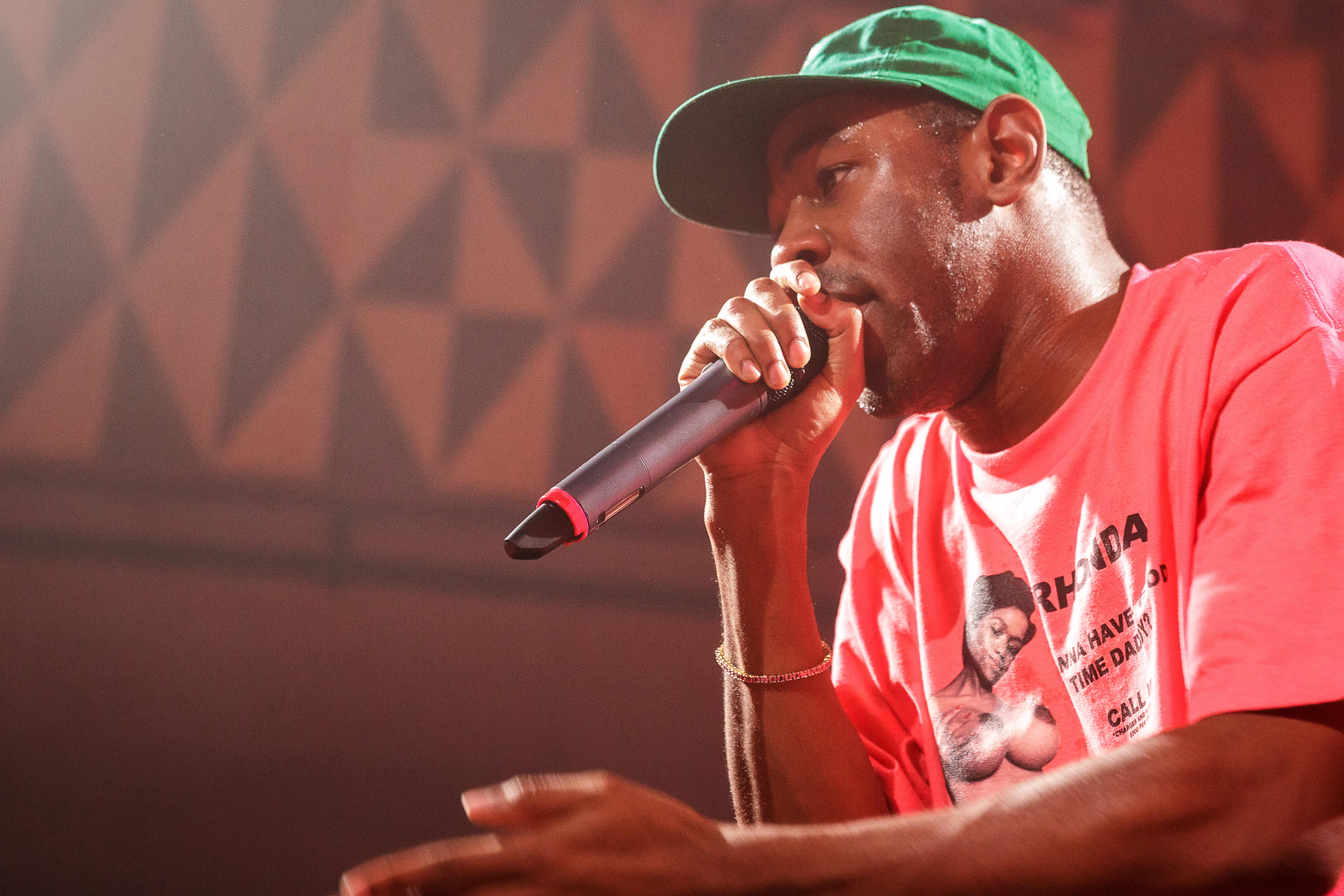
When this year’s Grammy nominees were announced, the list included many expected names—Tyler, the Creator among them. Now in his third Grammy cycle, Tyler’s artistry has undergone multiple reinventions, evolving into something more enigmatic—an artist audiences continually anticipate. In this current era, he positions himself as a persistent agitator, pushing against the rigid confines that have long shaped how Black artistry is received in the mainstream.
His work continues to deliver the cinematic aesthetics, world-building, and sonic experimentation that define his brand—drawing from the past while expanding it. By most measures, Tyler has placed himself in conversations alongside figures like Pharrell Williams. Looking at the last decade of his career in isolation, what emerges is a compelling body of work: a textured homage to Black musical legacy, alongside explorations in fashion, design, and now film. It is difficult not to admire the distinct path he has carved.
And yet, for some of us who have been paying attention longer, Tyler, the Creator remains a more complicated figure—one we wouldn’t necessarily place on our Mount Rushmore. Much of that hesitation traces back to his early career, a period often softened or overlooked in the wake of his widely recognized pivot toward introspection and reinvention around 2017 a la Flower Boy.
Oreos and Edgelords
Tyler, the Creator and the rap collective he co-founded—Odd Future—entered the cultural zeitgeist between 2009 and 2011, during the golden age of the internet. They made headlines largely for their embrace of shock value; much of Odd Future’s appeal was embedded in the name itself. A group of young Black creatives with undeniable talent—skaters, musicians, and self-styled disruptors—they cultivated an image that was at once magnetic and confrontational.
Their brash, rebellious energy found early traction in Los Angeles and spread rapidly online, resonating especially with young audiences—many of them suburban and white—who were drawn to that same chaotic irreverence. By the time they broke into the mainstream, Dazed Magazine introduced them in 2010 with a now-infamous line: “Say hello to Odd Future Wolf Gang Kill Them All – the teenage skate-rat crew shaking up the rap underground with synths, swastikas and, uh, 'ass rape'.”
Tyler quickly emerged as the standout figure—its founder and most visible provocateur—driven by an outlandish personality, a morbid sense of humor, and a willingness to discard any pretense of political or social correctness. The collective offered a new kind of representation in mainstream hip-hop at the time, rejecting familiar tropes—drugs, guns, women—as well as the polished aesthetics of the rising “swag rap” era, in favor of something that felt raw, chaotic, and self-defined.
For Tyler, this also meant rejecting the narrow expectations placed on Black artists in mainstream rap. He articulated a sense of displacement—feeling “too white for the Black kids, but too Black for the white kids”—and used that tension to carve out a distinct artistic lane. In another context, this could have marked a meaningful cultural shift: a moment of visibility for Black creatives who existed outside dominant archetypes, asserting themselves in the early days of internet-driven virality.
But that possibility was ultimately overshadowed. The group’s rise relied heavily on what we would now recognize as rage bait—content and lyrics designed to provoke, offend, and shock. Both online and in their music, this strategy became central to their mainstream breakthrough. And in that dynamic lies a critical tension: a moment that might have expanded the boundaries of Black artistic identity instead often defaulted to punching down.
It is here that Tyler’s work begins to intersect with the critiques that still follow him today—particularly accusations of anti-Blackness. What could have been a generative cultural opening instead becomes more complicated under closer scrutiny.
The Pivot
As the 2010s took off and Odd Future was propelled into the mainstream, Tyler, the Creator solidified his role as the group’s frontman and resident provocateur. This visibility grew alongside the collective’s Loiter Squad on Adult Swim and Tyler’s viral presence on Vine, where his humor found a wider audience.
Amid this rise, Tyler released his third studio album, WOLF. Still gritty, abrasive, and raw—much like the content he shared on Tumblr—the album also marked a shift toward greater maturity. In recent years, Tyler has described this early period as a series of “rough drafts”: work he no longer fully stands by, but recognizes as part of his evolution. Following WOLF and then Cherry Bomb, he began distancing himself from that earlier catalog—gradually phasing out songs marked by explicit depictions of violence, abuse, and shock-driven provocation. Along with it, he shed the persona that had defined his initial rise.
From that point on, a clear divide emerges. Where the earlier Tyler leaned into slurs and confrontation, the later version turns inward—grappling with internalized homophobia, identity, and vulnerability. But as the shock value that once fueled his visibility receded, so too did any sustained reckoning with that period. It was left behind, as if it could simply be outgrown—and forgotten.
And this is where the tension remains.
For many—including myself—who admire Tyler’s work today, that unresolved past complicates the present. He has, by all accounts, evolved into something of a renaissance figure: multiple fashion lines and collaborations, three Grammys, scoring runway shows, acting. His talent is undeniable, his growth visible.
But the internet, as we’re increasingly forced to confront, does not forget.
For artists of that era, the archive is permanent—and so is the harm embedded within it. As Tyler’s current persona is elevated and celebrated, the lack of direct accountability for his earlier work creates a dissonance. The more his present self is pulled forward without that reckoning, the more difficult it becomes to hold him up as an unqualified figure of artistic admiration.
Support independent journalism
Enjoy reading The Parlor?
Become a paid subscriber to get full access, early releases, and subscriber-only extras.
Become a paid subscriberThe Present
As Tyler’s catalog continues to expand, so do the themes of personal reckoning that run through it. His work increasingly grapples with internalized homophobia, anti-Blackness, misogynoir, and the lingering effects of childhood trauma. “Like Him,” off CHROMAKOPIA, is a striking example—an intimate confrontation with the absence of his father. Where earlier work might have filtered this kind of vulnerability through shock, irony, or even violence, this version of Tyler resists spectacle. The emotion is laid bare, unmasked and unmediated.
And yet, this evolution exists alongside a familiar pattern: a tendency to sidestep accountability.
On “Thought I Was Dead,” Tyler invites listeners to revisit his past—his old tweets, his most offensive statements—only to dismiss them, insisting he would still “moonwalk over that bitch” today. It’s a posture that isn’t new. From the Odd Future era to now, Tyler has consistently doubled down on his indifference to public opinion, positioning himself as untouchable. His lyrics reinforce this stance: “ain’t nobody perfect, well at least y’all ain’t,” “I’m him, I’m that guy, run and tell that.” Even in moments of reflection, his self-assessment remains unwavering.
What emerges across the past decade of his work is a tension between recognition and refusal—an artist who appears to acknowledge past harm, even gesture toward repair, while ultimately maintaining that the outcome justifies the process. And it is here that he begins to lose part of his Black audience—those who might otherwise champion his evolution but are left unsettled by the absence of clear accountability. His artistry has deepened, his world-building has become more intentional and expansive, but harm does not dissolve through growth alone.
At the same time, as his work has become more rooted in and reverent toward Black cultural legacy—while also pushing beyond the constraints historically placed on Black artists—his largely white audience has shown signs of disengagement. The fanbase that once propelled his rise was drawn, in part, to the provocation: the slurs, the transgression, the permission to use the n-word without consequences. That audience did not sign up for introspection, for vulnerability, or for an artist openly embracing the depth of Black cultural influence in his work.
A moment that captured this disconnect came with Tyler’s Instagram tribute to the late D’Angelo. What should have read as a sincere expression of admiration was instead met with mockery and dismissal—evidence that parts of his audience had not evolved alongside him. The same culture of trolling and irony they engaged in was one he had, in many ways, helped cultivate.
And again, the response followed a familiar pattern. Rather than confronting the irony—the way white audiences often consume Blackness without fully valuing it—Tyler avoided direct engagement. He deleted tweets, turned off comments, and moved on.
Once more, the moment passed without resolution.
Don’t Tap the Glass
As Tyler, the Creator’s career continues to evolve—often in surprising and compelling ways—both fans and critics remain ready to revisit where it all began. That, I think, is why conversations about Tyler are rarely just about the work itself, no matter how much he tries to steer them there.
Over the past decade, his catalog reflects a clear desire to be taken seriously as an artist—a goal that is already difficult for Black artists, and even more so for someone who once built his public persona around irreverence and spectacle. In Tyler’s case, being recognized as a cultural steward of Black artistry would require a sustained seriousness—something he reaches for, but does not always fully inhabit.
His career has undeniably shaped a generation—not just through music, but through fashion and culture—placing him in a rare and complex position for a young Black artist. There is real intention in his recent work, an effort to move forward through action rather than explanation, to let the art itself signal growth. But in avoiding direct acknowledgment, he often pulls the conversation further away from the work he wants centered.
The D’Angelo moment made this tension visible. It exposed not only the limits of how his white audience engages with Black cultural reverence, but also the conditional way his artistry is taken seriously. It underscored a broader reality: many people still struggle to separate Tyler from who he was, making it difficult to fully see who he is now.
This is a tension Tyler himself seems aware of on CHROMAKOPIA, where an undercurrent of the project is a confrontation with self—and with the consequences of that past, including a lingering lack of recognition in the present.
In that sense, it complicates the conversation around labels like “one of the greats,” “icon,” or “idol.” But maybe it doesn’t have to.
Because perhaps risk—missteps included—is inseparable from what makes an artist meaningful in the first place. The internet age has made that reality harder to navigate, harder to outgrow, and nearly impossible to contain. Tyler’s career, in many ways, becomes a case study in that tension—one that resists easy resolution, and one we may not yet have the capacity to fully reconcile.
About the author
Lennon Viera
Lennon is an Afro-Latina writer based in the Northeast whose work exists at the intersection of injustice, resilience, and imagination — told through long-form essays, cultural commentary, and flash fiction. Outside of her work, Lennon enjoys long walks on the beach, digital minimalism, and horror films.
Conversation
A space for Parlor members. Be generous, be real.
Loading…